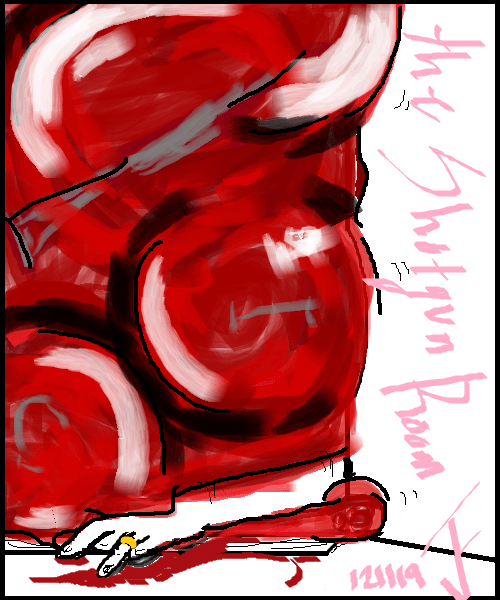
The first entry in the “Shotgun Room” trilogy. For mature readers.
“An overburdened mother starts her first day of work for a new legal euthanasia program.”
No one wanted to admit to the idea, even when it was passed unanimously through Congress. The right to die. Lethal injection was tried and passed-on: there was never any real guarantee those people were conscious enough to legally decide whether to press the shiny red button – nestled atop a comfort handle in a debilitating grip; not to mention specialized staff that required specialized training that only a country in a recession could fantasize of. “Heaven forbid,” said the Men In Suits who decided everything for everyone else. They had to be sure these selfish casualties knew what they were doing, and that there would be no court action. No future action, period. A shotgun. One slug to the face would take anyone out; and anyone ballsy enough to shoot themselves in the face were prepared to die as far as the government was concerned. Every hospital was given a modest sum – taxpayer-supported, of course – to retrofit an unused area of some set measurement in the most private area of their grounds. Each was to be insulated with an industrial-sized FDA-approved compostable vacuum bag made of one-hundred percent consumer-grade recycled plastic, connected to a high pressure suction system powered by a sponsored vacuum system by Inc in an adjacent room. After willing participants were “sure this was what they wanted” and all the proper paperwork was signed they were escorted to this room. The bag would be zipped open for the volunteer and inside was a chair and the single-shelled shotgun. All they had to do was sit down and make the necessary adjustments: the federally-mandated sign that hung off the back of the door facing the chair helpfully suggested in a clear, legible font that your eyes should stare directly into the barrel.
Sure, people were allowed to leave if they changed their mind: it wasn’t so far into the future that civilized Western medicine had devolved into pure genocidal experimentation! All they had to do was press an Alarm button: an especially-red button this time. But “statistics showed that more then ninety-nine percent of those who entered the room never came out again”, the Men In Suits would boast to the television cameras, “and statistics are numbers! And as we all know, numbers don’t lie!” This time, the numbers didn’t. There was something about that shotgun. Seeing it. Touching it. Some of the volunteers who passed through had never even seen a gun in real life before. It was finally real to them. But the Men In Suits couldn’t let the reporters leave yet: “Imagine shooting yourself in the face, and not leaving a mess? Think of the man-hours we are saving on the federal level! Who do you thank first?” It only took the one shot to aurally-notify the nurse outside, and with the twist of a key and the push of a button – the shiniest you’ve ever seen – the plastic bag would have all the air sucked out of it like a FoodSaver and could be removed from the sponsored line with a quick rotation and then sanitarily-cremated, bag-and-all. “With the introduction of this next-generation vacuum technology from our friends at Inc, we have eliminated the need for an estimated million-dollars-worth of overseas labor to clean the rooms if we didn’t have the bags!” The crowd cheered without really understanding what was happening. One journalist asked what would happen if someone was only maimed from the shot? What if they were physically-unable to press the Alarm button? “When our nurses hear the shot then they will activate the suction system. And I pray it never happens, but if someone is unfortunate enough to be unable to shoot themselves properly – or have a change of heart, excuse me – the system is quick and strong enough to provide a fast and humane end to their suffering.” They had an answer for everything, and behind closed doors they laughed when they realized they didn’t have an answer for Madam Chow and decided to take all three of her girls for the night instead of having to pick. There wasn’t an official name for this room and no one seemed to remember them mentioning one: just a sign marked “Private”, which hung from the outside of that and any other door hospital staff didn’t want opened. The nurses lucky enough to have the key called it the Shotgun Room. It started as one unit’s joke at the annual Christmas party that spread quickly and stuck.
It was easy enough to dispose of the remains but someone still had to be assigned to it. A hundred-pound plastic bag full of potentially-hundreds of pounds of heavily-compressed human remains. The nurses union fought against having to do it even though they were already there, so one of each hospital’s maintenance staff was made to do it instead. It was Rebecca’s first week on the job at one particular hospital when she accidentally spilled the remains of someone’s hot leftover coffee on the light blue collared shirt the Head Of Brain Surgery wore underneath his white uniform. She was terribly apologetic and he said that there wasn’t a problem but she left that Friday, and Monday morning she was told she would be working clean up for the Shotgun Room. Rebecca – or Becca, as everyone called her – knew that the Bill had passed, but she was just a nine-to-fiver with a mortgage; two kids; and a crippled ex-MMA fighter for a husband. She wasn’t experienced in the act of death. “Not a bother,” her supervisor told her; she wouldn’t be taking part in the act itself: simply removing the waste afterwards. It would already be in the bag and she would be provided with a waste container to ergonomically-transport it to the furnace for incineration. The pay wouldn’t be any different but with the level of business the Room was seeing she could make a half-a-dozen round trips from there to the basement in a day and her shift would be over. “We don’t expect you to do anything else if you work down there.” It sounded like a promotion to her.
She didn’t know how to get to the room, and no one else seemed to know either. It was only after some convincing to an Administrative Secretary that she wasn’t pulling her leg, that the skinny graduate looked in a filing cabinet for some mention of it. At that moment, Linda walked by and eavesdropped on what was going on. Linda was in regular rotation to the Room and had just started her shift. “Come with me, hunny. I’ll show you where to go.” With Becca tagging behind, Linda walked out of the main building and across the parking lot through the rain to the brown structure that everyone thought was a mental health ward. It was, but the freight elevator went down two extra floors: one was an empty, unused floor used for storage; the other – the basement – aside from the furnace, housed the morgue. Becca lumbered behind Linda in her baggy tire shop onesie; the legs especially baggy today after loading her pockets with anything – everything – she might need to make a good first impression. Linda chatted away mindlessly, talking about her grandchildren and how the two boys would always roughhouse in her guest room “because that’s where we keep the king bed. I always want my children to be happy to come over with the little ones.” But the two rabble-rousers were starting to jump-kick each other and use the pillows and comforters to suffocate themselves. “I tell you, it has got to be the violence in the video games. Or the fighting sports. Let me tell you, boys these days go crazy for that.” Becca nodded in agreement but inside knew all too well what it was like to live with a fighter: the night shifts to make up for all the times he wasn’t fighting; missing their daughter’s recitals and their son’s soccer games because she couldn’t stop herself from collapsing from exhaustion; and the lingering guilt that he wasn’t going to be reliable enough to pick up her slack. But when he did win, he won big. It hadn’t been in a while, but somewhere deep down she knew that those days weren’t over: just postponed. “Here we are.” Her voice echoed the words down the long, linear hallway of vacant rooms; through open ones and off the closed, and carried long after she had spoken them. It woke Becca out of her fantasies, and she found that her and Linda were standing outside a discrete and closed door with a simple sign marked “Private” hanging from the outside. “Well go on, open it!” Her excitement was deflating. It didn’t look like much from the outside: maybe a maintenance locker? It wasn’t big: there were two doors on either side of it leading to what she assumed were larger examination rooms. She opened the door and was hit in the face by the force of the bag, which was under pressure from being crammed into such a small room. Linda laughed at her. “Everyone does that their first time! Just remember to step back.” Becca stood and noticed the sign on the back of the door prompting you where to shoot. Down the center of the bag, facing the hallway, was a huge steel zipper; it looked double-reinforced and really heavy-duty. “Well go ahead! Open it up!” Becca took the flap and pulled the zipper down in one fluid stroke. There was an audible hiss as she did. There in front of her – surrounded by a ductile sheen – was a comfortable-looking folding chair that must have come from the finest waiting room in the land; a giant hole on the lower-right wall with a plastic flap over it and an X cut through it; and there, resting on the floor – the piece-de-resistance – was the gun. It was glossy like everything else but stood apart in its deportment. How do they keep this place so clean? “Well, that’s part of the job. You polish and clean the gun and the chair, and the shaft there if any goop gets in to the suction system.” Apparently the full breadth of her job was not explained to her properly: you see, she had to pull the gun and the chair out of the bag before it went into the furnace. “We don’t have the budget to just keep a rotating selection of chairs and shotguns around! What do you think this is, the Taj Mahal?” If she was trying to be ironic, it wasn’t working: standing as they were literally surrounded by unused chairs, and other equipment that began to show a thin layer of dust. Becca said nothing. Linda offered a demonstration as the first appointment wasn’t for an hour and she needed the overtime pay for Christmas: “it’s expensive raising a family these days, don’t cha know?” Linda zipped the bag back up and shut the door – requiring a bit of force to squish the now-saggy sack back in – and took out the key from her pocket and opened a small panel that disappeared completely into the wall next to it. Inside was a button. “Do you want to do the honors?” Becca took a minute and pressed it. There was an impressively-loud whirring that stirred both girls, then a big guzzling sound, and then silence. “You have to wait a minute.” A little bit of smoke came out of the strip of space that remained beneath the door to the right of the Room. “The motor does that sometimes. Don’t let it bother you: it’s green emission.” She opened the “Private” door again and the collapsible chair and shotgun were PVC’d nicely into the bag. It didn’t seem like much. Linda hung around complaining about her wage while she let Becca disconnect the suction hose, pointing at things and pretending she knew what they did. It only took a few minutes for Becca to realize this: Linda had obviously never cleaned the Room before. But the hose was easy enough to disconnect and it reminded Becca of being a janitor at the elementary school before her own kids were born. There really were only a couple different ways of cleaning up other people’s shit, she thought. Around the corner from the room was the rickety trash cart with a removable rim for easy-loading. She packed the bag into the glorified wheelbarrow while Linda talked and talked; shut the barrow door; rolled it back to the freight elevator; took it downstairs to the furnace; unzipped the bag and removed the chair and shotgun and put them back into the barrow barrel-down while she heaved the bag down a ramp and into the open-and-awaiting furnace doors. Linda showed her the “Service Desk” – which was a dirty corner with a shower in the same room as the furnace – where the chair and the gun got rinsed off; the cabinet that housed the extra bags in tightly-folded rows; and then took her back upstairs. It was almost nine o’clock. “By the time they sign their papers and we figure out how they’re getting down here I say you have an hour between appointments? Takes up to an hour once they’re here, lots of humming and hawing and making up their mind. Then another hour to dispose of it and set the room up for the next person.” Despite consolidating herself to the truth of the situation, Becca agreed when Linda continued to paint an easy picture of the job: sounded like a good deal of free time. Maybe if things go well she could bring her account stuff in tomorrow? Steal a nook in one of these empty rooms and lay out all the statements and the past-due bills. Linda wished her well, and before she left made sure to ask that Becca “vamoose” by ten o’clock and come back by eleven. “Don’t want the magic ruined for them if the clean-up crew is still hanging around!” Linda knew her joke was grim and left without another word. Becca attached the new bag to the hose and locked it in, and she was surprised to find that the bag began to slowly inflate automatically – crinkling open from the heavy compression. Everything seemed to be in order. She shut the door and a low-purr emanated from the motor room til a pressurized-plastic sound came back from the Room. The purring stopped. It must mean I can put the chair and the gun back. She opened the door and there was the zipper, staring her in the face again. She unzipped the bag – setting up the chair and gun how she had seen before – and then back up before trying three times to heave the door closed before she was successful. It was nine-o-five. She wheeled the barrow around the corner where it was before and started emptying her pockets onto one of the free counter tops. Two box cutters; different-colored sharpies; even a nine-inch-long saw blade that attached to the tool she used to cut through drywall when she worked on the renovation the month before: she didn’t need any of this stuff; why did she bring it? She pulled her vape out and decided to sit up on the counter and wait. As she smoked, she thought: how could I have scored any better? “I mean, this job is ridiculous but it really is as easy as she said.” She pulled out her phone and began commenting on posts: something she hadn’t had the time or the energy to do for a long while. The smoke filled her lungs with whiskey flavor and the photos of her daughter she took at her last birthday warmed her heart, as her eyes closed and she leaned back; hoisting her legs up onto the counter. There was more space there then the bed at home when she tried to crawl in beside her blacked-out husband. She slept.
She woke to the sound of footsteps echoing closer and closer. She rubbed her eyes and stretched before hopping off the counter and quickly collecting her things; stuffing them back down her hefty pockets. She checked her phone: it was ten-twenty. The steps were close now. She winded around the corner in a daze thinking she could somehow get her bearings and leave unnoticed but Linda and the patient were just feet away. Becca silently retreated and continued to watch detached: her green eyes, receding-hairline, and unmanicured nails the only things seen – if anyone bothered to look. Linda and the outpatient were in their own little world. The man – in his late thirties, judging by his bleached baby face – was morbidly-obese. When he opened the door and Linda unzipped the bag for him he was more then happy to enter but took twice as long to squeeze through the door and in to the tiny Room. Linda whispered a few indistinct words – presumably of encouragement – and then zipped the bag back up and shut the door. There didn’t seem to be any of the emotional pressure Becca would have expected. She didn’t see any tears: only a stoic understanding of one man’s choice that wasn’t her own. She hoped that she would never have to make a decision like that for herself or, God forbid, her kids. An ear-piercing explosion that sounded like a bomb going off in a mine shook the whole floor, and then dissipated just as quickly like a needle on a skipping vinyl record. Linda casually took out her keys and opened the secret compartment; pressed the button; waited for the motor to do its work and then walked back down the hall toward the exit. Becca had one hour until the next poor schmuck would have their turn; Hell, she’s probably have more then that. Linda struck her as someone who was deliberately late. She stretched and made sure it was a good one before she put her work face back on and wheeled the barrow around the corner to the door. She opened it. Sure enough, in the middle of the floor was a big bag of chunky red goop with a shotgun and a folding chair still floating around somewhere inside. You could hardly make them out, though: the enormity of the bag and its contents hadn’t yet registered; even larger then the man himself had made it seem it was going to be. There wasn’t even any room to squeeze around to unhook it from the vacuum. She placed her hands upon the bag and gave it a gentle shake. It rippled like Jell-O. Disgusting, she thought! What kind of job is this? She grabbed as much of a fold as she could muster on either side of her and began to sway the bag back-and-forth like a pendulum. Maybe if she got it going then it would settle with enough room for her to get in. She put her hips in to it and found herself making a stupid face, feigning unbelieveablity. This entire situation was unbelievable! Why did it have to be put in such a small room, when they had an entire wing full of empty rooms? What about the next room over? The one with the motor in it? There looked like plenty of space in there; just how big was the Inc anyway? Did it need the double-wide room? Did they use the utility closet because they thought empty space around the bag would inspire divine trepidation? What was the average of patients who opted out at the last minute? What would they do if no one was around? But it wasn’t like there was: she was there. The bag still wasn’t budging. She became acutely aware of how much time this was all taking, and the paths and forks her mind was taking along with it. She hadn’t over-analyzed anything this much since Grade 12 Psychology. She remembered that class well: she enjoyed it. Much more then anything else she needed to graduate. She remembered the boy who sat two rows over from her and three seats up. He would always peek over his shoulder back at her, and sometimes she wouldn’t even be listening to what the teacher was saying because she was so distracted by him. She couldn’t recall what color his eyes were: just the vastness of their confidence; his dark pupils failing to hide his teenage desire. She still passed the course, but her and the boy never had a conversation. She wondered where he was now: what kind of life he was living; what kind of woman he picked; if he had a career or was a layabout. Something budged in the room. She jostled herself back to consciousness and noticed that she was, in fact, gaining some headway. Very little, but enough that she could see an air pocket by the outlet. But was it enough for her to squeeze through? The bag was, theoretically, as compressed as it was going to be; maybe not as good as it could have been; maybe they bought the motor from China! That wouldn’t surprise her. The government seemed to be rolling out new initiatives faster then the old and broken ones were being repaired. You can’t blame the government for everything, she told herself, but it was nice knowing that she wasn’t the only one who blamed them for something. A gap appeared. Without thinking, she stepped into the Room only to be jostled at the waist by the reproaching bag and squished like a vice against the wall. She couldn’t breathe. With the back-side of the bag contents rolling towards her, the sticky plastic crawled up her chest to her face. The shotgun swam barrel-first into her stomach, delivering a gut punch. The bag began to peel away in its momentum and she fell to the floor on her knees in shock. She had to get to the door! She couldn’t breathe. Before she could compose herself the bag rolled back and slammed her head against the side of the wall hard enough that the last sound she heard before she was knocked out was the crack of her own skull.
When she woke up later in Intensive Care and couldn’t move, the nurses couldn’t pry what grip her thumb mustered on her very own red button. She collapsed in the perfect position for the bag to push her perpendicularly to the crease of the wall, where she continued to be crushed for 35-minutes until Linda came back with the next client; early. First she saw the cart and cursed the new girl for robbing appearances. Then she saw the door was open, and that the bag was still bobbing in the center of the room like gelatin. She was so angry that she couldn’t even process that the latest subject, upon seeing the bag of gore, was passed-out on the floor of the hall. Was that blood? There was a trail she could make out faintly, but with this giant fucking bag here she had no idea that Becca limply lay, faintly breathing. After much commotion and time the bag was removed and Becca was found, and a few more hours of legal rumblings upstairs and a hushed phone call to a Man In A Suit aside the hospital’s Shotgun Room was back-to-business the same day like nothing had happened. “You’re lucky,” Linda told Becca the next evening, “It could have been a lot worse. The zipper could have broke and blood could have literally gushed out like The Shining! Or maybe the shotgun could have gone off in the bag while you were moving it and taken out half your face! Or maybe he wouldn’t have been dead and you would have taken him all the way down to the incinerator before you realized it! Boo!” She spooked her, touching her for effect and sending a shockwave of nerves to the parts of her body that she could still feel. She didn’t think Linda was funny but couldn’t tell her to go away with her mouth covered-up by the cast. “We’ve had all those things happen! I can tell you now that you’re going to be out-of-commission for a while, I trust you can keep those a secret? Don’t want anyone upstairs finding out I broke confidentiality!” Linda stayed another twenty minutes before disappearing through the haze of sleep that hovered over the open spaces of her paper balaclava. Her stomach hurt. The doctors said the damage the shotgun barrel did to her reproductive system was to the same extent as a saw blade through drywall. She was told she should expect to never have children again. She wondered when her husband was going to show up with the kids or if he was going to at all but the enormity of the day took its toll and she fell asleep. She slept all the way through the night. She was glad they didn’t come.
//jf 12.11.2019
 theory of a daskeman