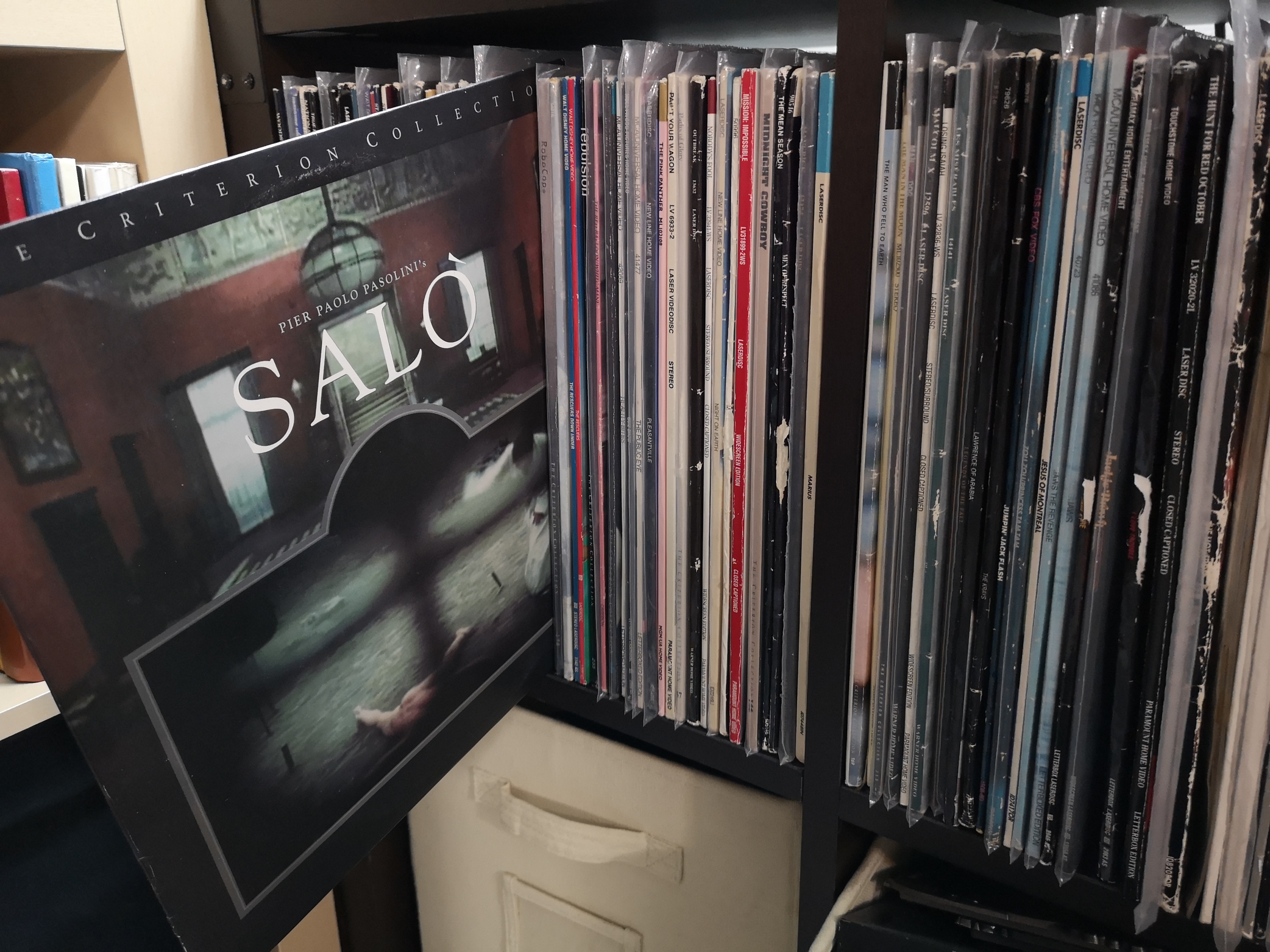
I’m an odd guy. I like odd movies; especially ones that elicit a reaction. For a long time, the late Italian independent filmmaker Pier Paolo Pasolini’s final film Salo – an adaptation of the Marquis de Sade’s final novel – was the defacto choice when it came to disturbing, shocking cinema. Sure, there have been more horrifying movies released since, depending on one’s own preferences: August Underground; I Spit on Your Grave (any of them); Irreversible; Hereditary, to name a few. Any one of these could be a “jumping-off point” for future-filmmakers with a skewed world-view, but my own entry-point was Salo. I couldn’t tell you how I first came to know about it – probably from some Internet forum – but I can tell you how I came to watch it. Salo is a part of the Criterion Collection: a maverick distributor that secures the rights to oft-forgotten classics and international cinema (and movies that no one else seems to want to deal with, like Lena Dunham’s Tiny Furniture and Bowling for Columbine) and releasing expansive special-edition sets that cost an arm-and-a-leg for. It seems they are contented now with putting out anything that isn’t tied down, but back in the day you could count on a Criterion release – whether that was Laserdisc or DVD – to be the definitive edition of an otherwise-lost film.
Criterion had their start with Laserdiscs but when the DVD format came out they began rolling out re-releases of their earlier titles, including Salo: spine #17, with the “White Ring” around the center of the disc to let you know it was legit. Soon after releasing their barebones original Salo DVD, they lost the rights and for years the only way you were able to watch it was to buy the exorbitantly-expensive “First Print” disc with the “White Ring”; a bootleg; or on a region-free import (of course it’s far easier to watch it now, whether that’s through mischievous means or Criterion’s own 2011 Blu-ray re-release). I opted for a bootleg copy off Ebay, which my Dad had to buy for me with his credit card – how old was I at this point? 16? – and a far-cheaper alternative then the sanctioned $700-and-up option. I didn’t care that the quality was subpar – not a fault of the bootleg but of Criterion’s original master, which was ripped straight from the Laserdisc (which at best looks like a VHS that had been recorded-over a few times) – just that I finally had it. Why was this purchase sanctioned by Mein Papa, you wonder? Surely there had to have been more of a parental-probing into my pubescent interests? Well, my Dad is a big film fan too. A cineaste, if you will. He’s the sort of guy that forced my sister and I to sit through Dr. Strangelove when we were too young because he thought it was the funniest film ever and he wanted to share it, only to berate us later when we tried to walk away because we couldn’t understand the humour. So he was just as excited to see Salo as I was, if only because I sold it to him as “the most disturbing movie ever made!” “My 16-year-old son HAS to see this movie, then!” And if it was going to be him standing in my way of watching it, then not only did I have a peer-to-peer version downloading on Kazaa (with no subtitles, and so slowly that I eventually only ever got five-minutes into the movie before realizing it wasn’t going to happen) but I also had a backup argument: “Well Dad, I have seen R-rated movies before.”
And I had. I used to spend hours after school at the video store and around the time that the Canadian ratings guide came out, all new releases would have to have the new rating stickered to the back of the rental box overtop of the American rating. This was before home video releases would incorporate the Canadian rating into the box art. So on Tuesdays – when I could get seven old rentals for seven days for seven dollars – I would go in, peel the 14A sticker (Canada’s PG-13) off of new movies and paste it to the back of old R-rated movies that didn’t have it, and the staff was none-the-wiser. So by the time I was 16 I had seen all three Godfathers; Heat; Scarface; Once Upon a Time in America; Apocalypse Now: classics! (the one time I did forget to change the rating, on Tom Hanks’ Philadelphia, it was Mom who said I had to return it because the original rating was PG-13 and I was only 12) No wonder I was looking to new horizons! Come to think of it, it’s pretty incredible that I ever had a chance to watch these movies when I did: when I was 6-or-7-years-old, I watched Terminator 2 with my parents. When Arnold cut off his arm skin to show Miles Dyson his robotic endoskeleton I said, “When I’m older, I want to do that!” What, cut off my own arm and wave my floppy bones around? It didn’t matter that we had all sat down and watched the movie before: as soon as I said that, the movie was shut off; I was sent to bed; and promised that I would never be watching movies like that ever again, if they had anything to say about it. Then they got a divorce. SO I COULD DO WHAT I WANTED. I bought my copy of the Criterion Salo Laserdisc as part of a 10-disc lot on Ebay for thiry bucks, and if you’re inclined you can probably pick it up on its own for the same price: it was produced at the height of their original license and are plenty available. Plus, you’ll get to see the only time I can surmise that a Chapter Listing was printed on a single sheet of toilet paper inside the case itself.

This was my world. I was ostracized in elementary school for drawing violent pictures but I was a BOY who was raised on video games and R-rated movies. In today’s culture, that would be grounds enough for counselling. Instead, after the divorce I lived primarily with my father and he supported my interests if only because he liked watching fucked-up movies too. I was pretty desensitized when I first watched Salo all-by-myself in the dark in the basement where my parents stored a spare TV and couch (presumably for when my Dad was kicked-out of the bedroom). Honestly, I wasn’t that impacted. How was I going to make the connections that Pasolini wanted me to when I wasn’t even educated about World War 2 at that point, let alone the Italian-side of the conflict? Or the de Sade connection, other than the Geoffrey Rush biopic-slash-revisionist-comedy Quills from 2000? All it was, was a bunch of teenagers getting raped and made to eat their own shit by a group of domineering bureaucrats who would promise them amnesty only to cut off parts of their bodies as tribute (what a strange T2 connection). At its most basic level, this is all Salo is: a controlling group of bald, middle-aged Men In Suits living the most debauched autumn of their lives while their post-war reality crumbles around them. They kidnap a large group of teenagers (children in de Sade’s novel), whose numbers dwindle even before they make it to the compound as some attempt escape only to be shot. And not only are the men beyond-hypocrisy but educated too, so they wax polemic on their off-time while another excruciating “game” with their victims is conjured. At the end of the movie, those sufferers left-alive become the bureaucrats’ suitors and presumably leave the compound to escape the encroaching occupation by Allied forces, while everyone else is killed. The End.
It’s all very bleak and depressing, but shocking was not the word to describe my initial reaction. Reverie? I need to tread carefully because the subject matter of the film does not leave it much wiggle-room to be analyzed in the traditional sense, lest I be misinterpreted as a creep. I don’t condone bad behavior and my respect for darker cinema stems more from a desire to be stolen away from convention and watch content that appeals to my mind and my emotions rather then my adrenal glands. There is disturbing media with NO context that can make a viewer feel deflated and sad (the TV show Criminal Minds comes to mind immediately, as does the new show Evil, which glorifies unsettling content without actually having a reason to other than exploitation), but Salo did not make me feel sad. It made me feel angry: angry that the men seemed to get away scot-free; angry that the children didn’t stand up for themselves (as the film suggests an impending coup that never materializes); angry that Pasolini was killed over a work of art. And no bones about it, Salo is art. This is not an essay about Pasolini himself or how his body of work influenced such a divisive film: this is an essay about the film itself. And Pasolini the filmmaker supports Pasolini the polemist with artistic and directorial choices that further distance the material from anyone not invested in his disquisition. There is something deliberate and insidious at the core of Pasolini’s vision, and it’s more frightening than any of the “acts” depicted.
Consider the denuded production design and cinematography, where everything looks as ugly and as grimy as we can imagine it does beyond-the-frame. Often, the camera is left to its own devices: keeping moments out-of-focus (the aforementioned shit eating) or off-screen (the climax), and things that can be controlled within-the-frame are either dead-centered like an old photograph (the wedding) or unbalanced and unpurported to the Rule Of Thirds (whenever the four men convene alone). Colors are washed-out and muted (not the fault of Criterion’s master: the HD releases look the same), with the Italian countryside depicted in poverty and imprisoning grey abodes underneath a perpetually-darkened sky: overcast from a fog or war. The only “real” colour – besides blood-red – is the green of the grass, and there isn’t any more once the film switches to inside the compound. Legendary composer Ennio Morricone contributes a haunting main theme on piano that straddles the line perfectly between utter hopelessness and a dancehall exuberance (remember, the Men In Suits are happy to be there!). The actors are brave, and moments of overacting are forgiven as supplements to the Italian standard of filmmaking. And mention should go to the special effects team, who pull off some wicked practical tricks (principally in my personal “favourite” shot, of the girl eating the sponge cake with nails in it) that will sufficiently make your tummy turn over. There is a duality to the film’s technique that contributes to its divisiveness: while some choices could be seen as “ugly” or “lazy filmmaking” – considering Salo rides the line between art-house and mainstream, which Pasolini played with already in his Trilogy of Life – this is just an excuse from viewers who cannot accept the film on its own terms or cannot place it within the context of their own lives. I’m not saying that EVERYONE needs to run out and watch Salo RIGHT NOW because many of you would be angry with me if I did. Salo does not make any consolations about what it is, nor does it take any shortcuts to try and win the viewer over. You’re either on-board or you aren’t, and if you are watching it today it is probably because you read something or heard something about it, and are amply-prepared for the experience. It was made in the 70s in a politically-heated climate, in a part of the world many of us cannot connect to socio-geographically. If you remember this while you watch it and that its adaptation was in direct opposition to fascism, then it really does levitate the material to where it was always intended on being. This is NOT a blind-watch (or a first-date film, for that matter, UNLESS SHE, TOO, IS THE PESSIMIST OF YOUR DREAMS).
Another anecdote to send you on your way with: in my first-year of film school, Salo was one of the “Jason Movies” I would show to my friends and colleagues who hadn’t been corrupted yet. One of my best friends at the time latched on to it in the same way I did and we held viewing parties where we tried to make sense of the excuses and poetry the bureaucrats would turn (the English translation had been improved since that DVD bootleg all those years ago) and dissect our feelings about the content. Of all the movies I watched in groups during that time, Salo was the one that inspired the most heated debates. It heartened a couple of my peers to make short films with similar themes (without the pedo stuff). It became, and has become, a cult classic based on the quality of its themes and discourse and less about its heated and controversial content. There is more disturbing content out there now, some of which you can watch right-now on YouTube. People are trying to push buttons the best they can to make as much noise in a busy market. There are also incredibly tame movies out there too, where people are too scared to push those buttons and would prefer to ride the coattails of contemporary society’s wishes than to deconstruct them. Pasolini didn’t seem like he gave a shit and maybe that’s why he was assassinated: he was more perturbed with the lack of historical and directorate responsibility then he was with becoming a mainstream filmmaker. He could have also been killed because he was gay, because that happened too (and still happens). It’s still an open mystery, but what isn’t a mystery is that times have changed. The original Last House on the Left was seen as a disservice to conservative audiences until it was outdone by its contemporaries. There is porn out there that is worse then ANY of the content these “video nasties” from the 70s could conjure up if you put the scenes back-to-back in a Faces of Death-style sizzle-reel of “most controversial scenes in cinematic history”. None of this changes the horror the real world can dish out, nay has dished out. That’s all Salo is trying to communicate. That it does so with a sledgehammer is merely an artistic choice.
And that’s it! “The Month of the Laserdiscs” has reached its Grand Finale. If I’ve learned anything from the experience (other than reinforcing my theory that nothing is original and everything has been done before), it’s that there are a LOT of movies out there. One is never starved for choices, and chances are if there is a new movie that sounds interesting but you just can’t bring yourself to watch it for one reason or another (maybe it looks lamer then whatever attracted you to it; maybe there’s children in it and you cannot stand whiny children in movies; maybe you just don’t like the actors in it, period; etc), rest assured that there is probably a movie out there in the last 50 years that did the same thing, but better-produced and less-manufactured. Everything now is for the money. Not that it wasn’t in, say, the 70s and 80s, but mainstream films now are geared towards the audiences that the studio says they’re intended for (Star Wars 9, anyone?) and not for the sheer joy of making movies (Star Wars 5… or 2? Should I just say Empire?). Nor am I that interested in seeking out Duplass Brothers people-in-a-room joints made for 20-bucks or the latest indie darling from the I.T. girl on Bull that got killed off in Season 3 who said she left to direct her own movie but probably because Michael Weatherly sounds like an asshole.
No, those movies shot on iPhone or that take three years to make it from film festivals to Netflix don’t interest me. They are generally too self-aware and overblown by their own self-imposed importance. But 50-year-old monkey movies? SIGN ME UP!
//jf 3.25.20
 theory of a daskeman