A spoiler-heavy multi-scene film review & analysis.

The late, great, Italian multi-disciplinary artist and filmmaker Pier Paolo Pasolini wasn’t always about doom and gloom and the dark side of the human condition. His trio of films dubbed the “Trilogy of Life”, adapted from three prolific tomes of short stories, is as light and airy as your garden-variety Italian sex romp: something the filmmaker specifically hated hearing. But it’s true, and that’s not to fault it! His “Canterbury Tales” adaptation is wedged between his cinematic depictions of The Decameron and One Thousand and One Nights, respectively, and his detached filmmaking style lends itself nicely to the non-streamlined essence of the picture.
Less one complete story followed by another, the film is broken up into a series of vignettes with no determined point of starting or stopping. There weren’t any roles that were double-cast (except for one particular segment we’ll touch on later) so that’s how I found myself differentiating between pieces, and how you may, too. This could have been intentional. Canterbury Tales the Film has a “shooting-the-shit” quality to its writing, which compliments its bawdy sense of humor. One minute two cherubs are helping a mismatched couple reconcile and the next someone is staring through a hole in a wall at two guys banging, Caligula-style. Pasolini shoots the film with his trademark realist visuals, sometimes handheld, often centered (if he wants you to know something, he’ll show you, bluntly); period-accurate in his Production Design; and frank with portrayals of sex and nudity. Lots of penises and vaginas in this one, folks (if that sort of thing bothers you). I was just talking to my wife the other day about why I watch such weird, obscure movies (after struggling to pick from Netflix’s National Archive of Teen Bullshit) and I told her that I still like to be surprised. Canterbury Tales the Film surprised me. It wasn’t always successful (one-or-two of the segments could have been cut for pacing, and the audio mix was not great) but it was something different. I’ll give it that.
A full disclosure – plus some ground rules for the new S.S. format – before we begin: when I was a young sprite I did try reading The Canterbury Tales the Book, unsuccessfully. It’s old. We don’t read or write like that anymore (except largely academically), and I am willing to admit I do not have the skill to decrypt it. I have also tried getting through The Decameron the Film twice but couldn’t (not my speed), and Arabian Nights the Film (aka 1001 Nights) is currently on my playlist. Such is the mindset going in to this “new generation” of Selected Scenes: predominantly first impressions, based on what I already know. So we’ll be talking about Canterbury Tales the Film on its own merit, referencing the text or other movies if necessary for authentication but we’re going to try and avoid it (saving hours of research I’m too A.D.D. for right now). Let’s dive-in to some screenshots of notable (or dare I say, “selected”) scenes that I found memorable – Ray Hardgrit-style – and see what we find:
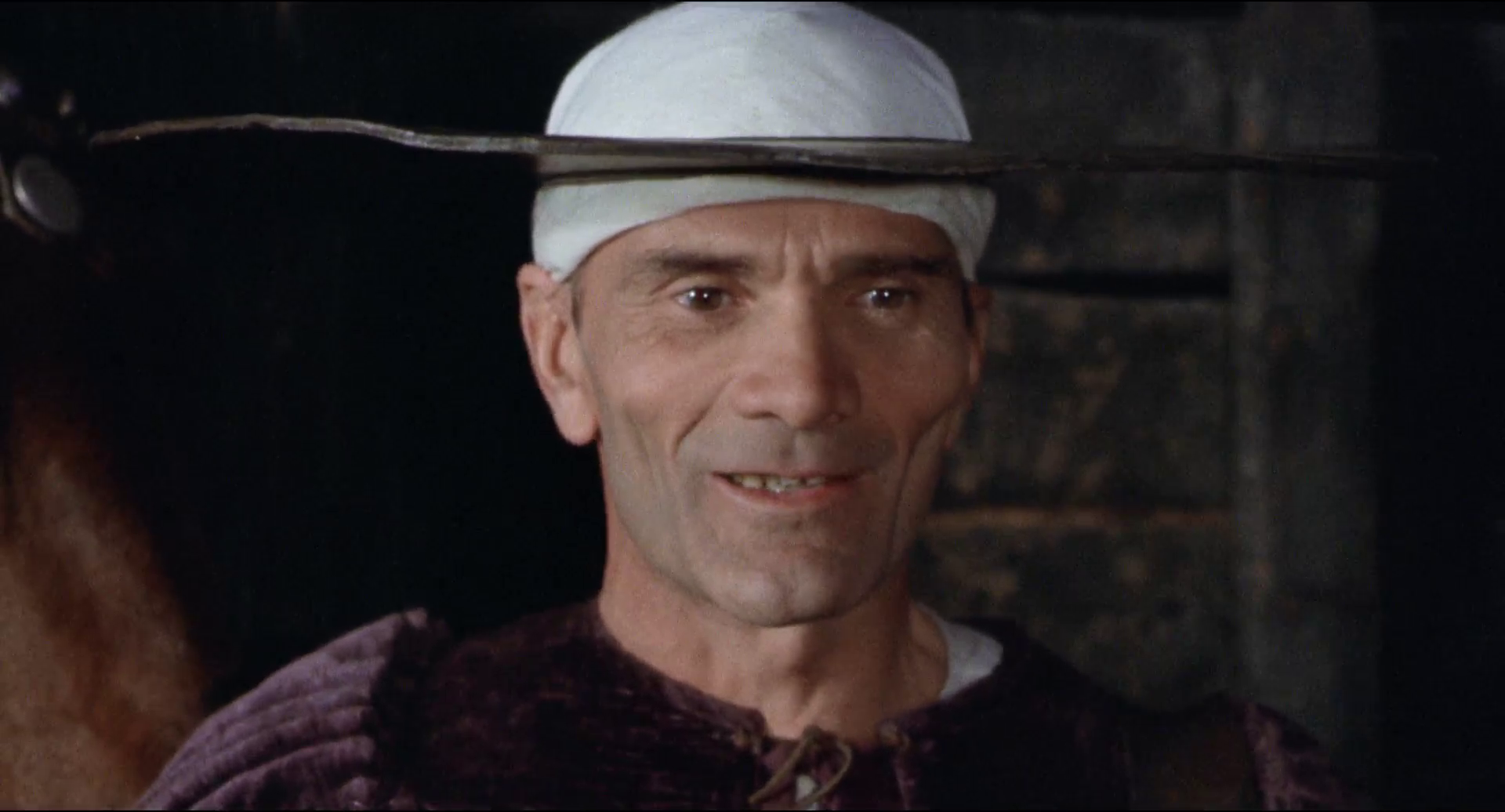
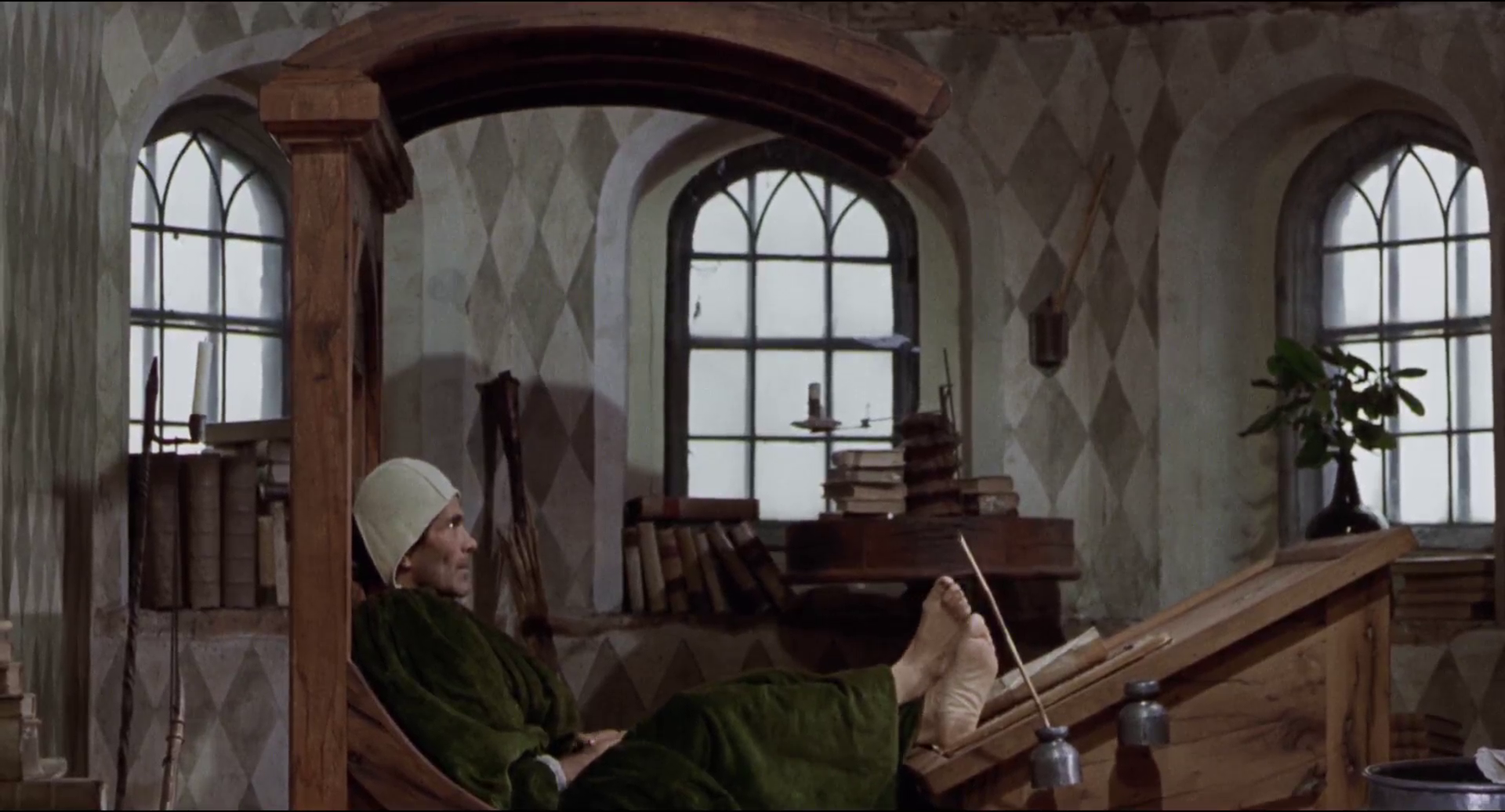
The man, the myth, the legend: Pier. Is that what his friends called him? Did they call him Paolo? What about just Pasolini? There are professionally-produced DVD special features that can answer such questions (and an independent film bio with Willem Dafoe! They do look oddly-similar). We are just here for the facts: what we can see; what we know already; and what we can prove. He looks like he’s having a good time, and that’s a good thing for the viewer to see: when the film’s director is happy and game and throwing in a cameo Stan Lee-style for good measure. Here, he plays Chaucer in a few goofy links depicting his “inspirations” behind the writing of the book.
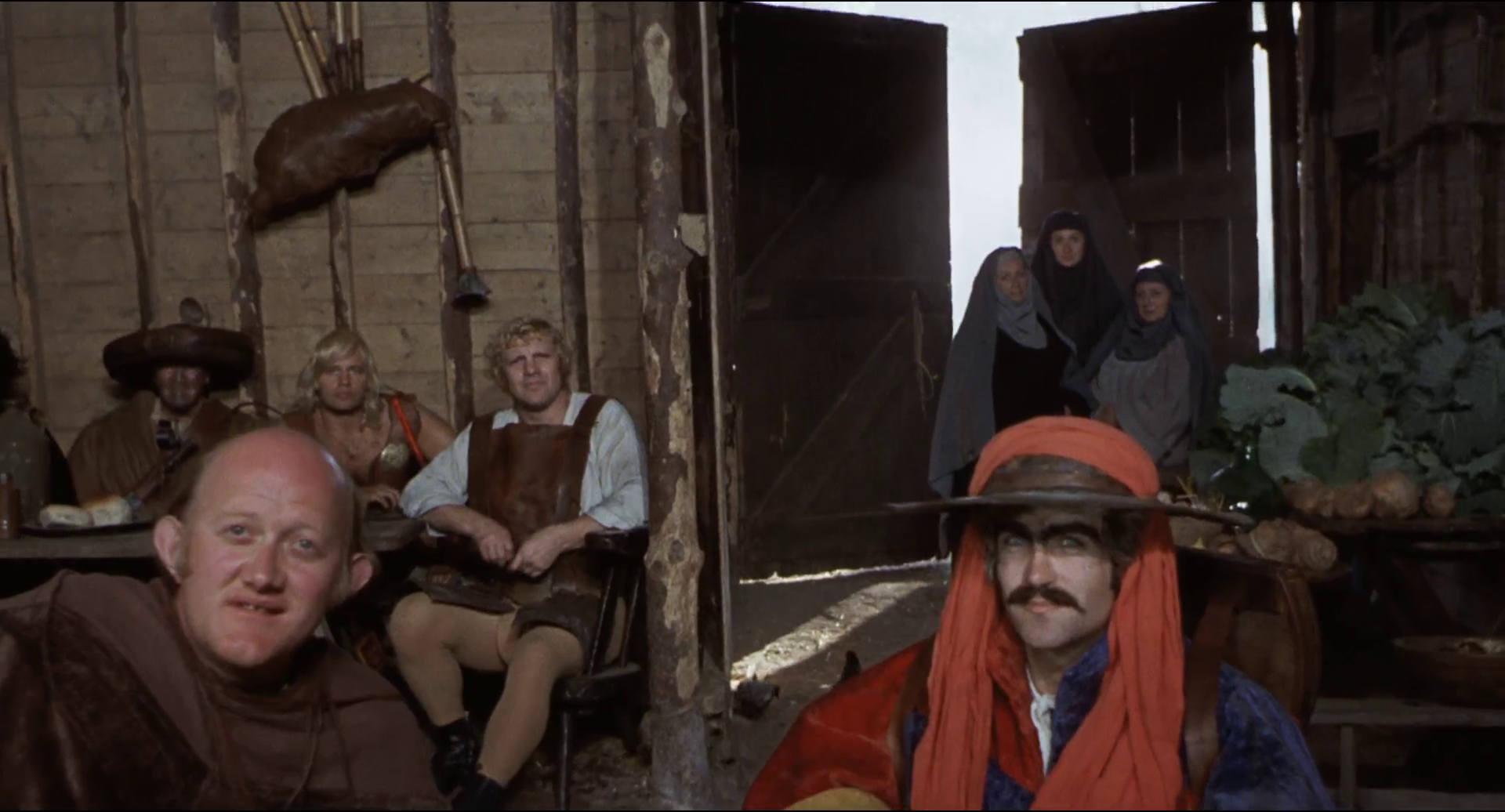
Wait a second, who’s that in the bottom-left? Nicholas Smith? Ol’ Big Ears from Are You Being Served? Random question, but what was it like for him to work with Pasolini for the day? As far as I could tell, he’s only distinguishable in this one shot. Maybe he had more footage in a pre-release cut.
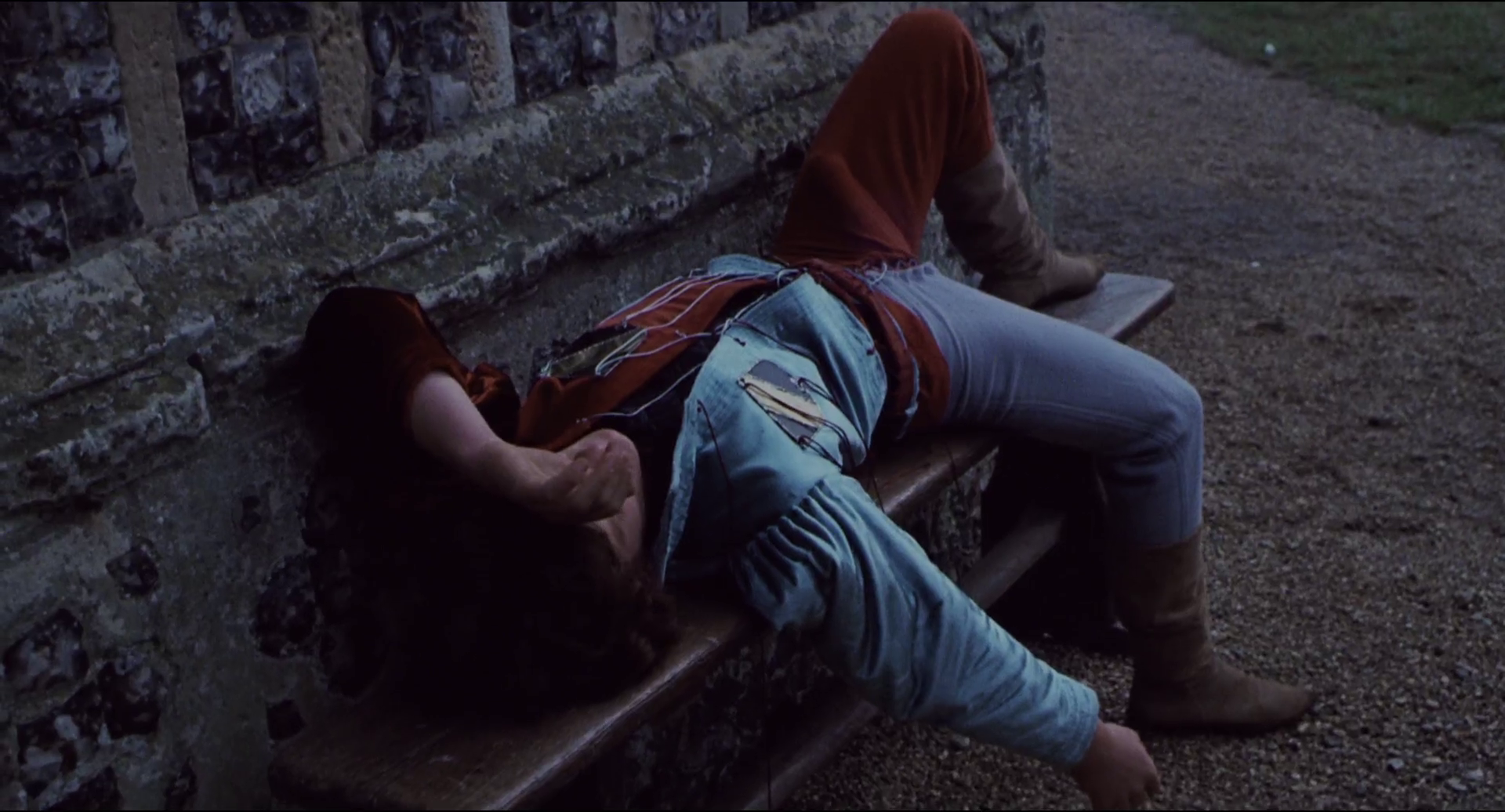
WHAT THE HELL IS THAT THING IN HIS PANTS? I’m sorry, you didn’t think I could keep it all serious, did you? This is supposed to be a comedy film, after all. And I know Pasolini was gay, but is that really necessary showing this guy’s massive silhouetted erection? It’s like, a foot long! Is that a prosthetic? I can’t remember the stand-up comedian, but they had a bit about the “water bottle” in Tom Jones’ pants. It’s so strange watching a dirty movie from Italy with an international cast and your two predominant wiener shots are from White guys and not Italians. I can’t believe I’m typing this right now. I’ve seen a lot of movies, OK? Moving on.
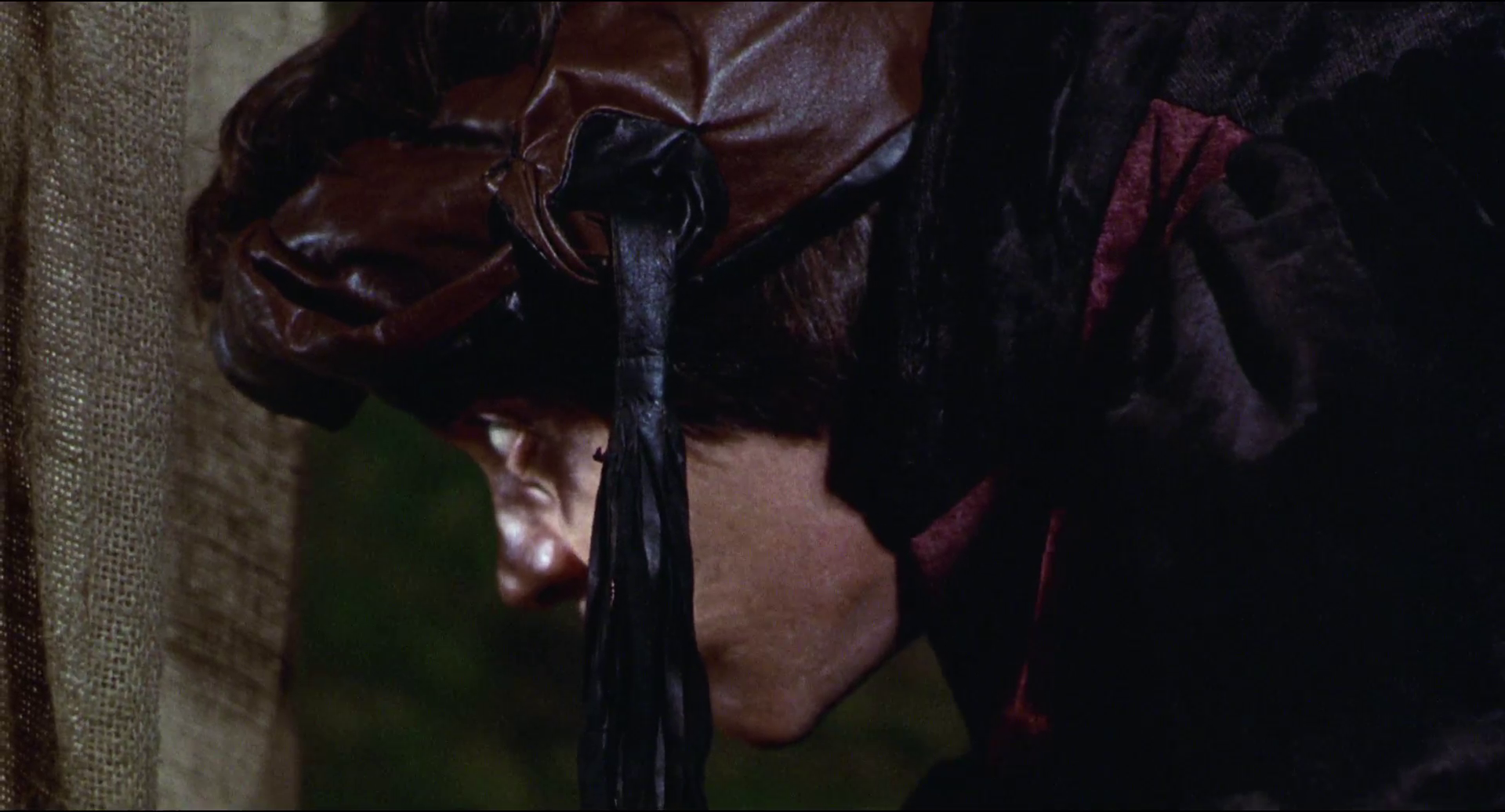
Let’s talk a bit about The Friar’s Tale, with Franco Citti as “The Devil”. You all probably remember him best as one of Michael’s Sicilian bodyguards in the original “Godfather”. Citti worked with Pasolini on all three of the “Trilogy of Life” movies and his stoic, man-of-action features immediately attract your eye. Very similar vibe to the Clint Eastwoods and Franco Neros of the world. However, this story is split in to two different parts – unlike the others in the film – and if it wasn’t for Citti’s involvement in both parts, you’d swear they cut from one story to a completely unrelated one with the same actor, and that is a baffling proposition in a movie that hadn’t done anything like that til then. Simple solution: it’s the same story. Whaa?
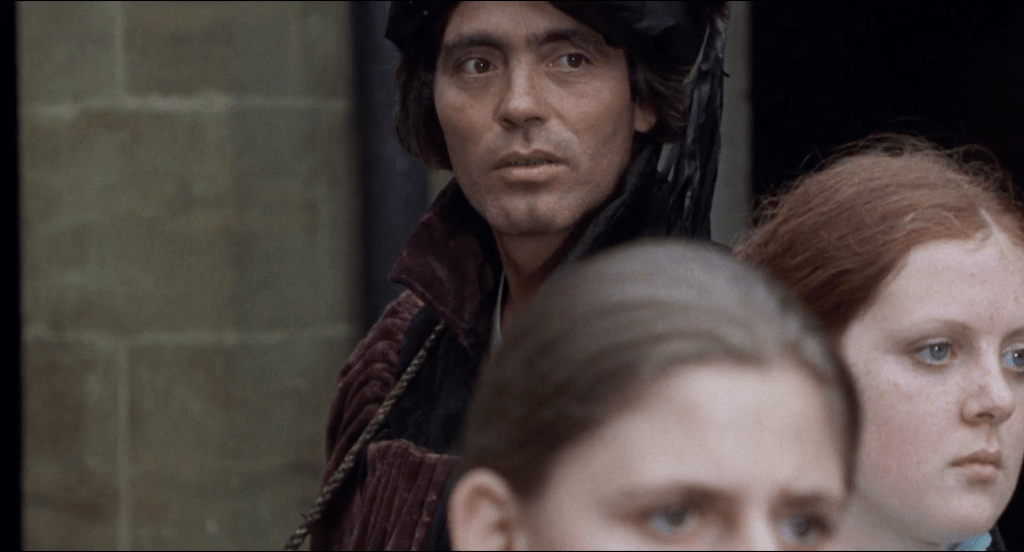
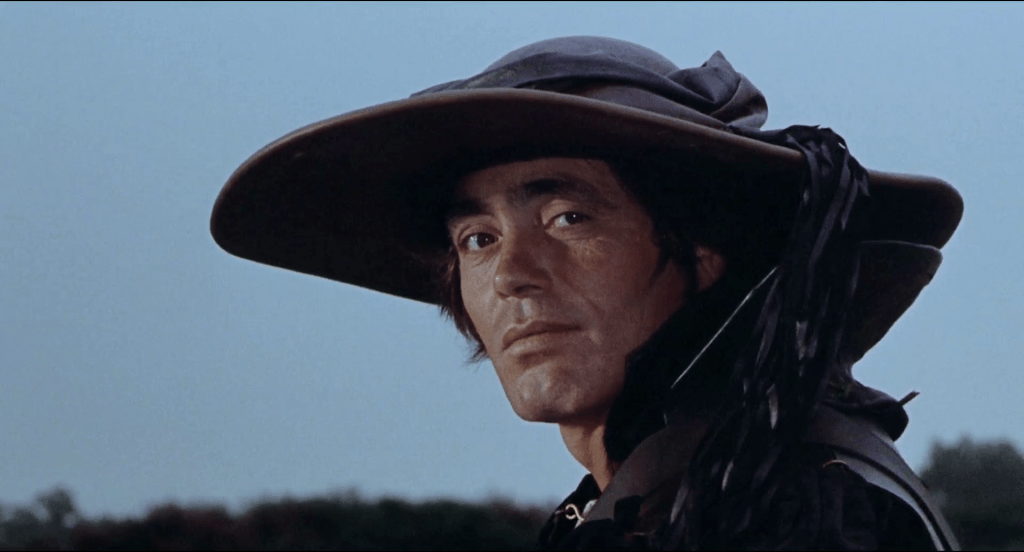
This is probably the best example of my own unintentional-ignorance as an uneducated modern-day casual audience member. In the original book, both parts constitute the Friar’s Tale: a cake vendor for public executions is actually the Devil, and oversees two different illegal couplings being broken up by guards in exchange for bribes. One guy, sexing a young girl, gets off by “paying everything he has” but the other, sexing a young boy, is burned alive. Then we cut to the Devil riding away from town, but he’s caught up to by the same guard – a “summoner” who retrieves money for the state – who levied the money out of the hapless fornicators. The Devil and him form a partnership. They arrive at an old woman’s home. She owes money to the state, so far as I could tell, and when she’s unable to pay the guard, the Devil takes her chamber pot, and the summoner himself, to Hell. Okay…
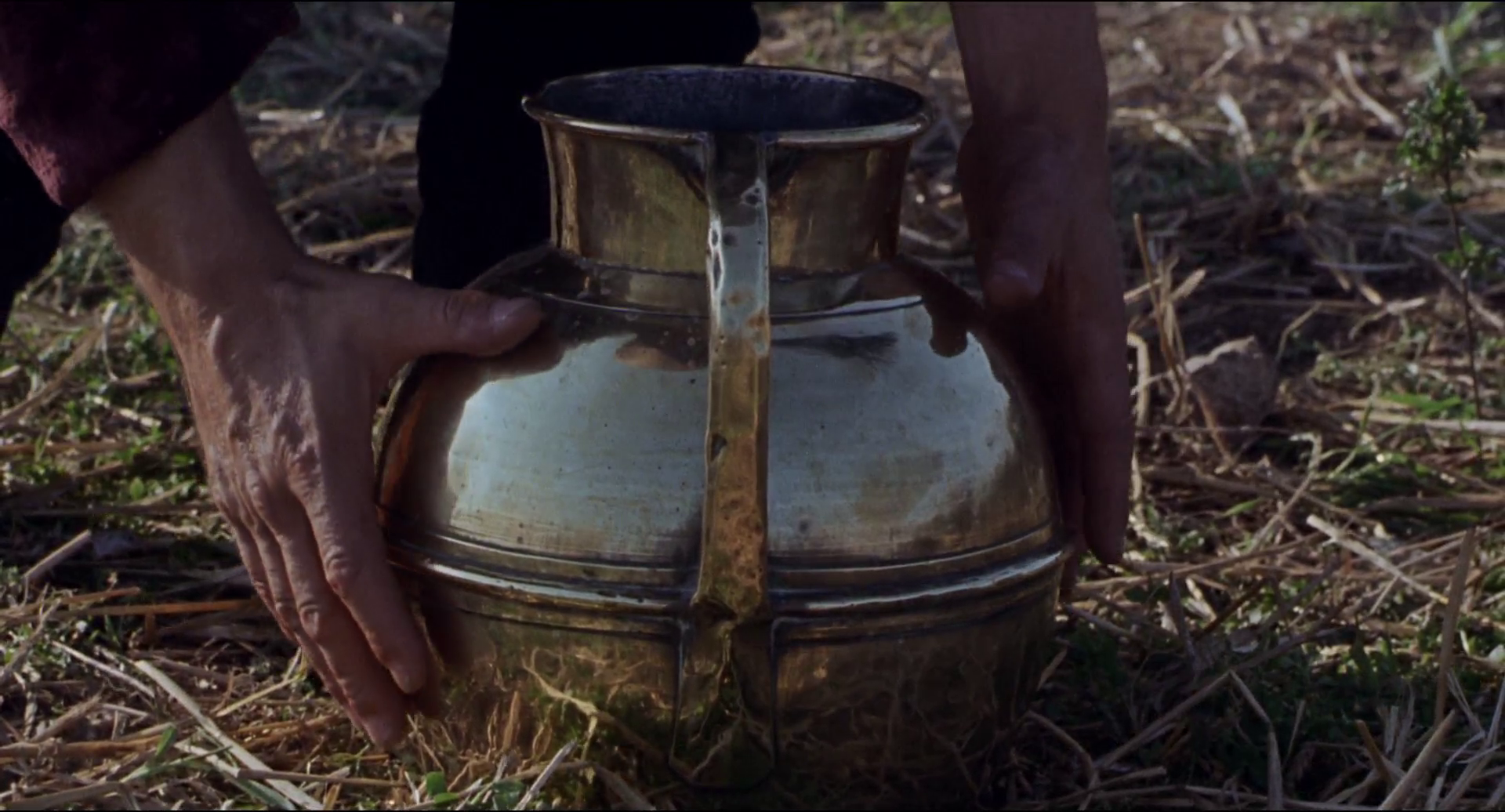
Now, this is not how it was written, nor I’m sure how it was intended to be portrayed. But in the second scene of the Devil riding away after the execution, Citti is wearing different clothing and his reveal (swiveling around while on horseback, John Wayne-style) suggests a different character altogether. Maybe there isn’t supposed to be a connection? Maybe there is, but it’s just slight, and its fracturedness adds to the non-linearity of the film? Maybe that’s not a chamber pot at all? In the book it’s supposed to be a frying pan. Does that make it more ironic that it’s a potty bowl the Devil takes in exchange for money (a shiny one too, which I suppose the summoner could have taken from the buggerer instead of burning him sans-cash bribe)? And if it isn’t a chamber pot then maybe it’s just the simple fact that the Devil is an asshole and took something he wanted with him too – instead of what was owed to him, which was the summoner’s life – which then makes more sense that he would take the frying pan instead of the shiny pot, WHATEVER kind of pot it is. So there are changes to the material from page-to-screen. It isn’t helped by sub-standard sound mixing in the version I watched, which made all of Citti’s dialogue so quiet it was virtually-indecipherable without subtitles, which I did not have. So I missed a chunk of exposition. Again, the volume level is possibly intentional: this is the Devil we’re talking about, so there is some artistic license there where his portrayal is concerned. Maybe Pasolini wanted a quiet-but-commanding, get-under-your-skin quality to the voice. But the wires of filmmaker-and-viewer were definitely crossed, here.
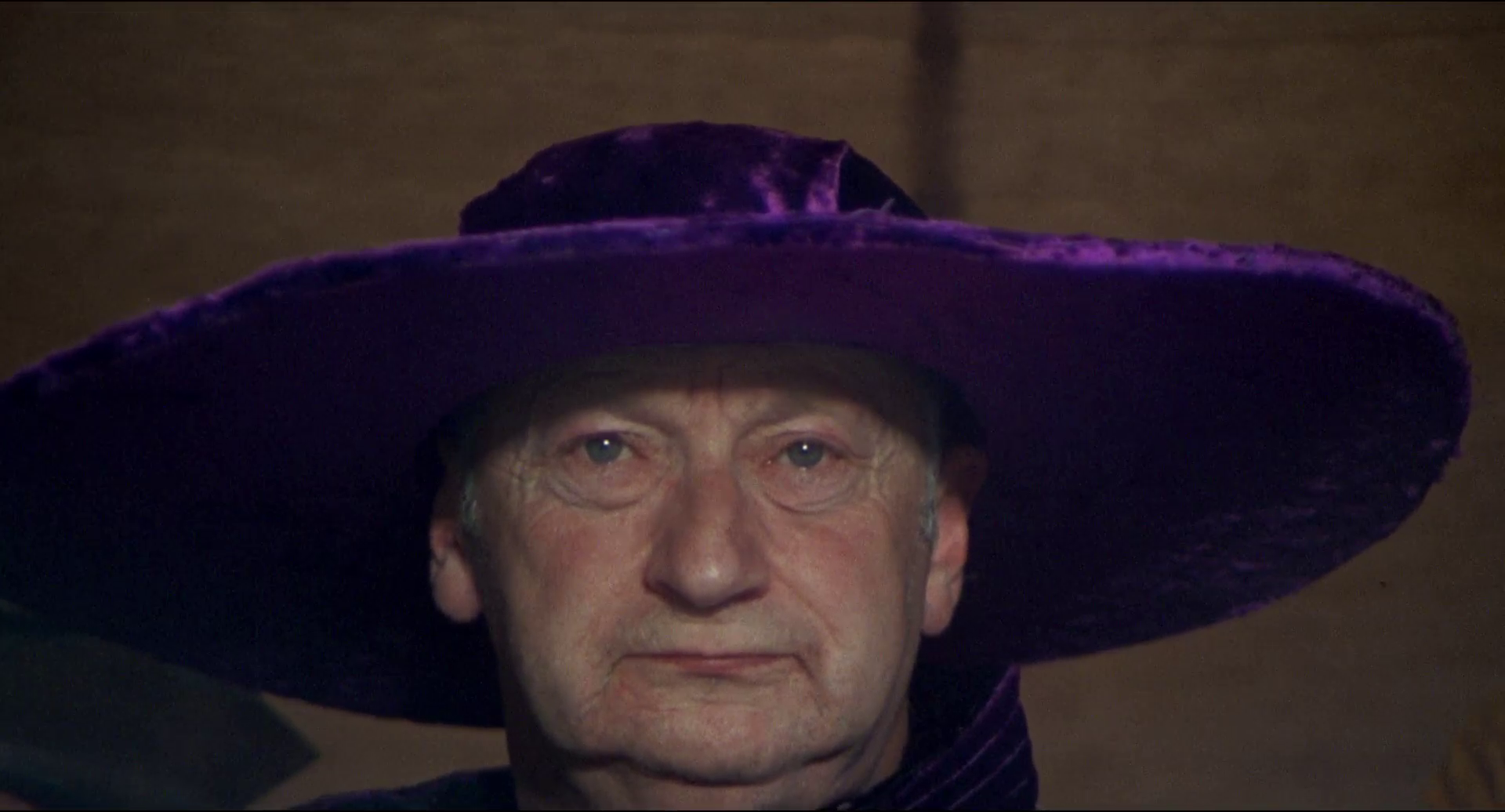
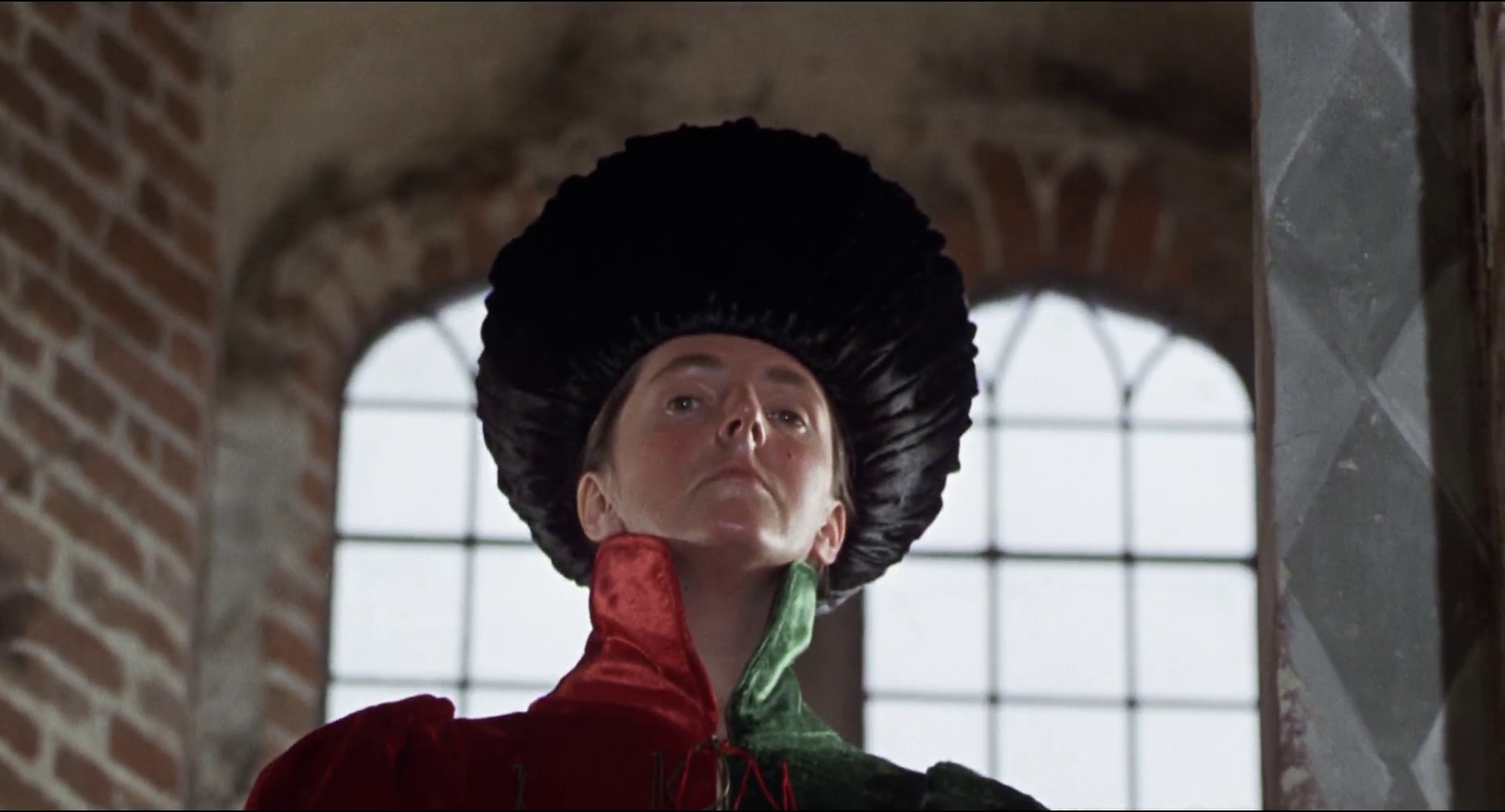
Now THAT is a fancy hat. I like how Pasolini centers the hat and not the actor. Clearly that hat is the star of the shot, anyway. Come to think of it, the brim is reminiscent of the Devil’s brim on the hat he wears later in the story. Not the same hat – and maybe the comparison is unwarranted – but it is something I noticed. And it may be a defendable opinion, if the state (or this fellow: an overseer of the execution) was the orchestrator of the broke man’s death. Maybe the Devil was actually the man at the execution, and his vending cakes was just a facade to blend in with the common man? A projection?
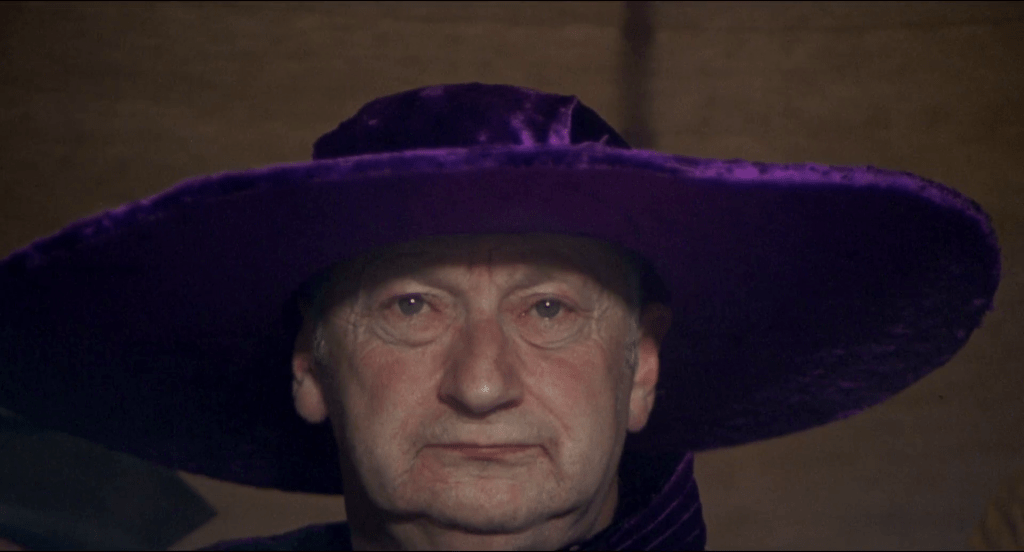
…or maybe I’m just reaching for material. Maybe there isn’t anything going on under the surface. But where’s the fun in that?
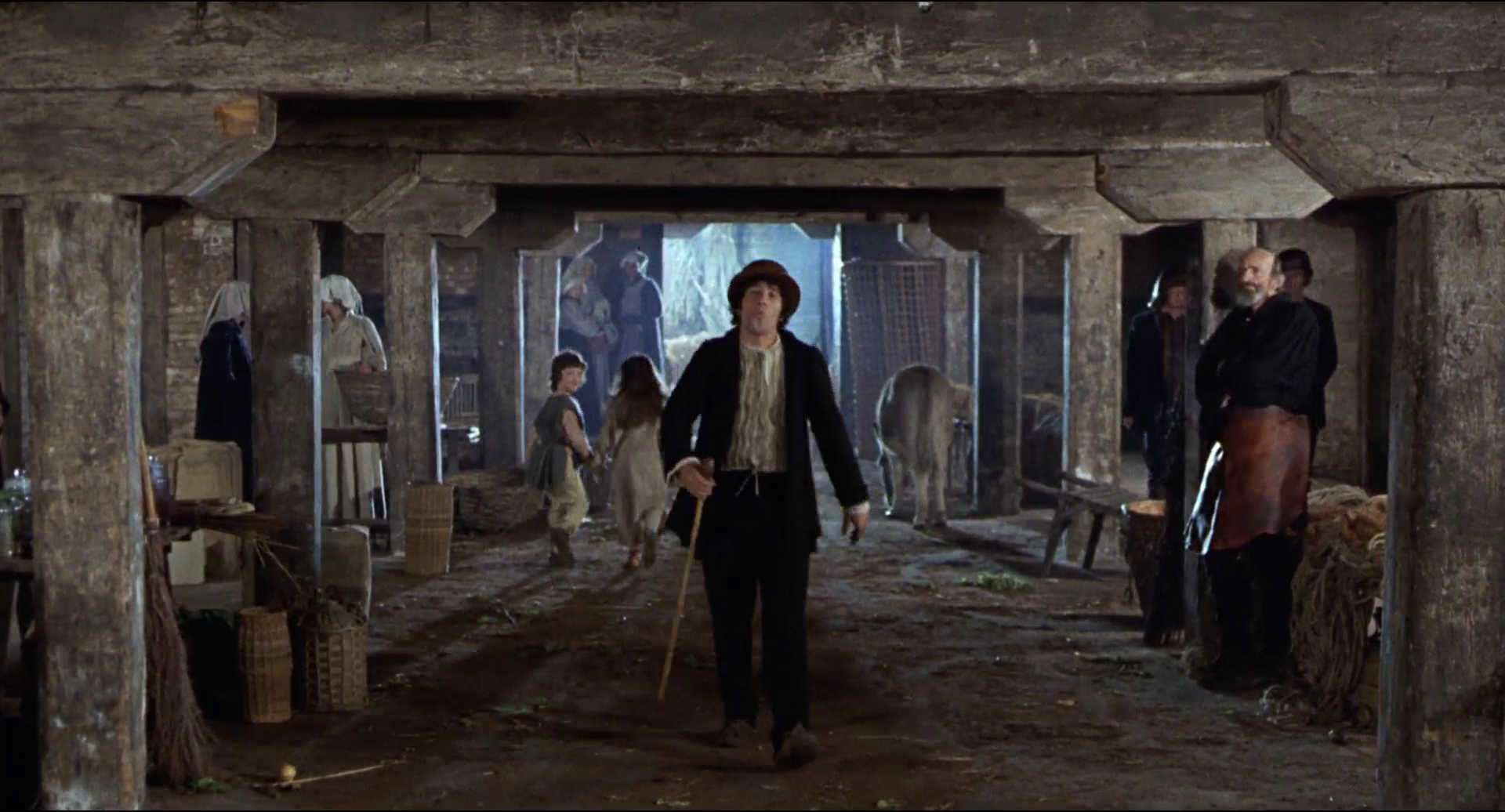
The extended Cook’s Tale with Ninetto Davoli as a young rogue feels like Pasolini’s centerpiece – coming right smack in the middle of the film – serving as the director’s ode to Charlie Chaplin and his “Tramp”. If you had told me yesterday that Pasolini had directed an epode to Chaplin’s Tramp I wouldn’t have believed you, but he did: Davoli struts around with the trademark bowler hat (now made of wood) and a cane, and even adopts the waddle (after he pisses on the side of a building). Are they able to pull off the same physical comedy and timing? Yeah, it’s pretty good, although when it comes to the lines Davoli’s obvious dubbing is admittedly distracting. But it ends with probably the best-earned laugh in the whole movie, in my opinion. What’s the joke? Well I can’t spoil everything for you, can I?
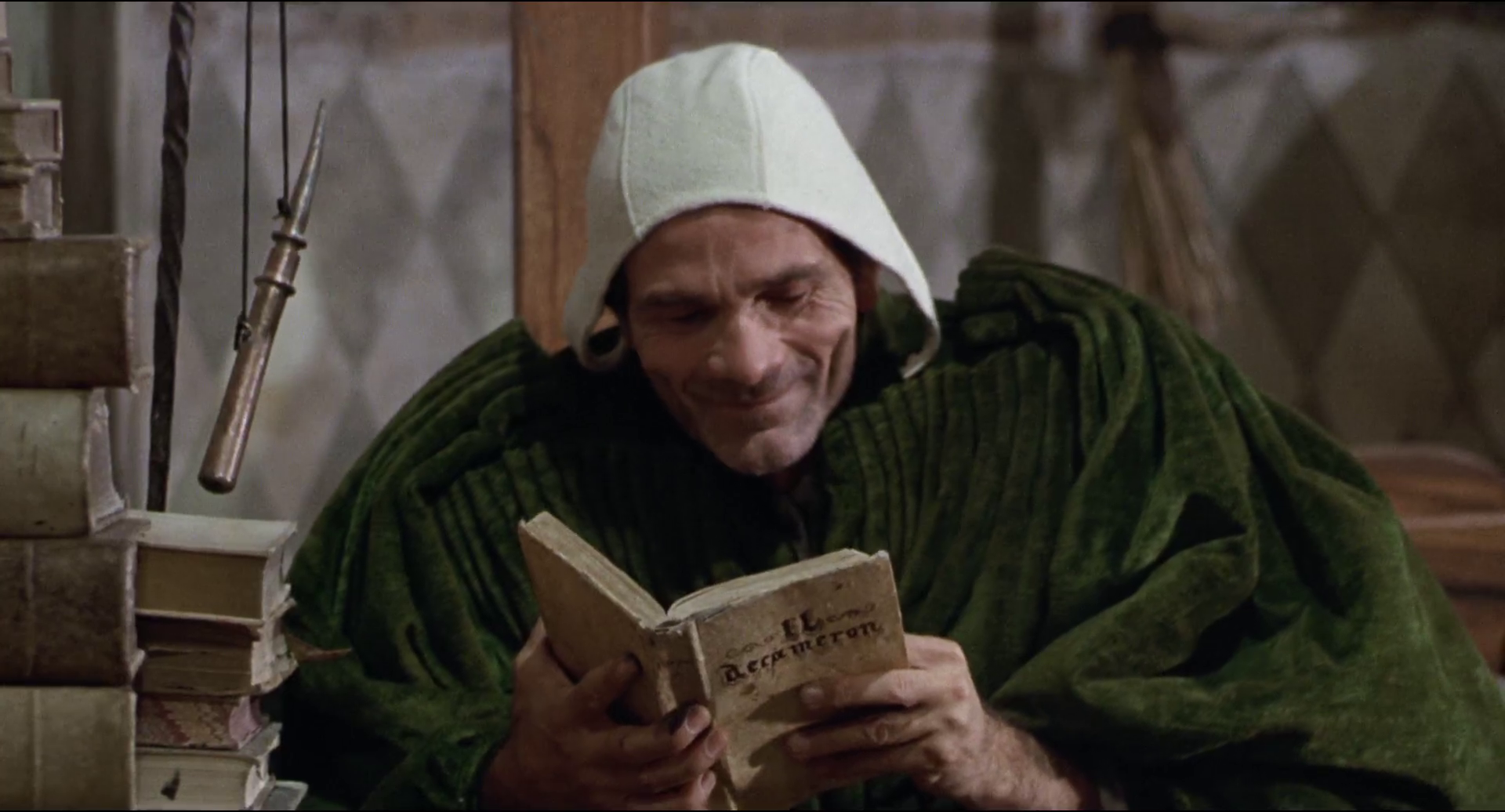
Here Pasolini shows Chaucer being partially-inspired for his Canterbury Tales by “The Decameron”: a welcome wink to the audience (or, in contemporary terms, “easter egg”). Totally random too to have his wife lording over him to get his work done (sort of a, “why are you reading that dirty book” sort-of thing), and her framing and costume suggests Middle Age portraiture. Although I’m not sure why my mind immediately goes to quantifying the icon’s gender, when it could have been intended an an icon of the church, judging Chaucer for his chutzpah. Regardless, great twofer.
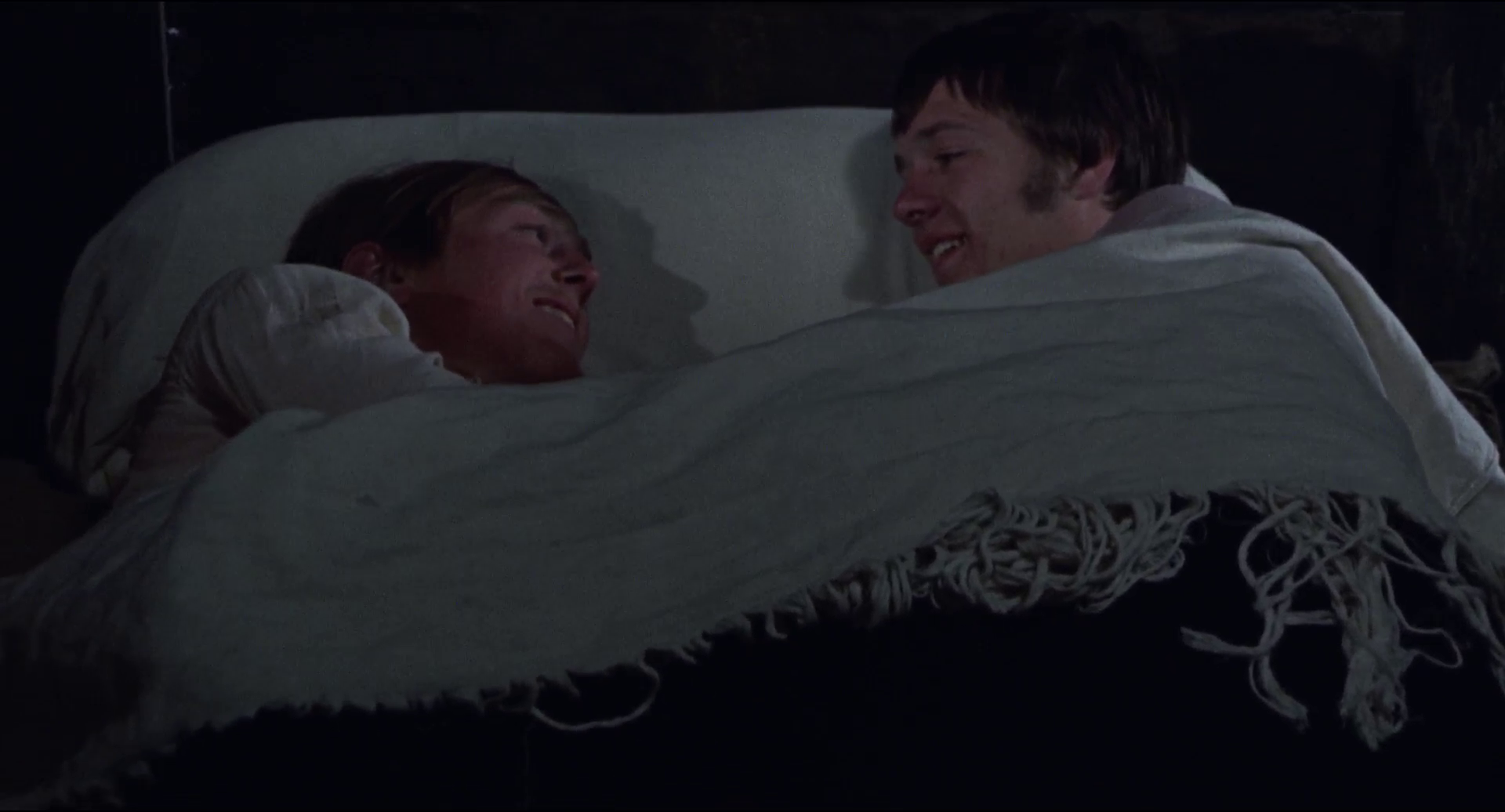
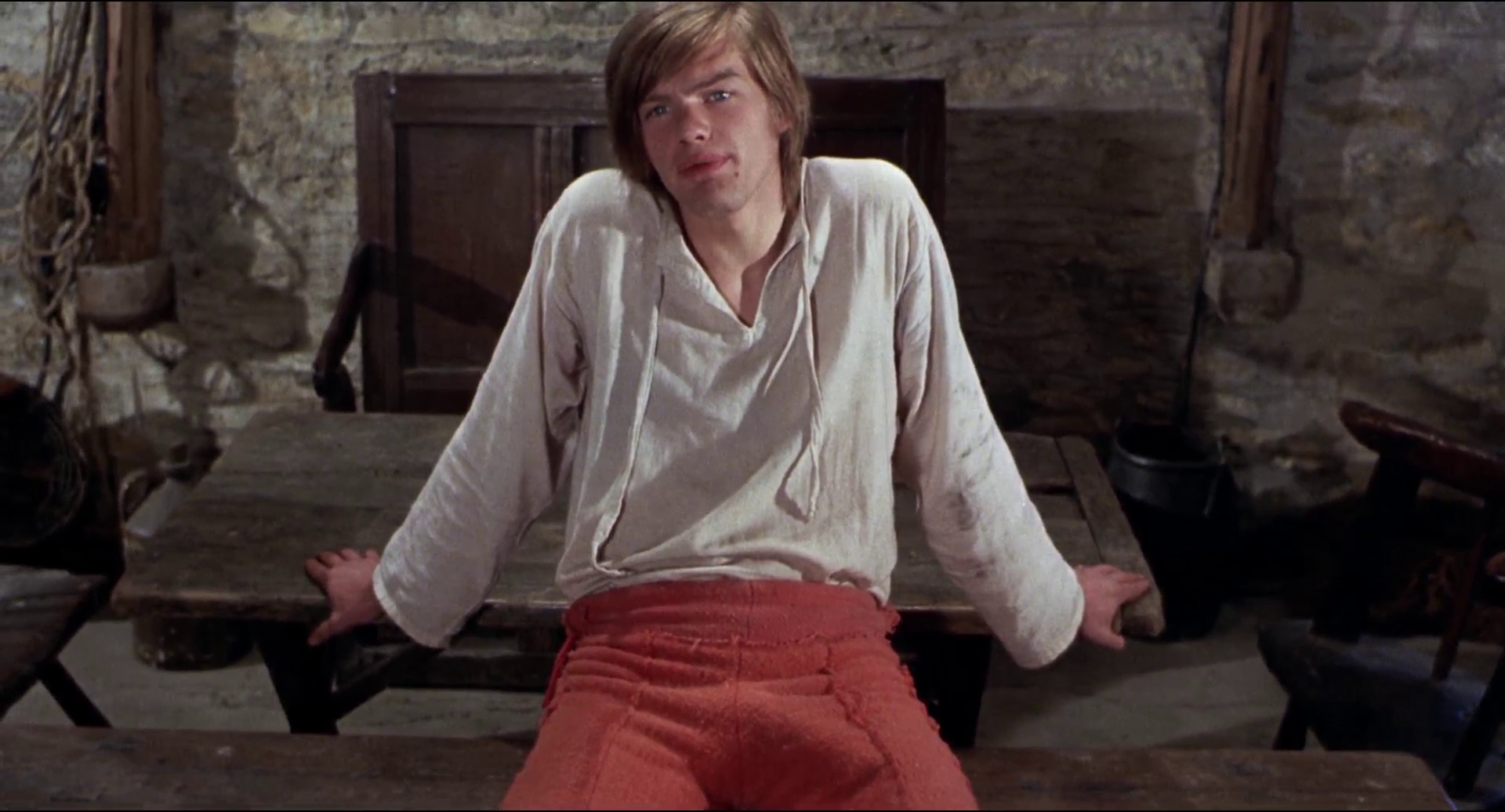
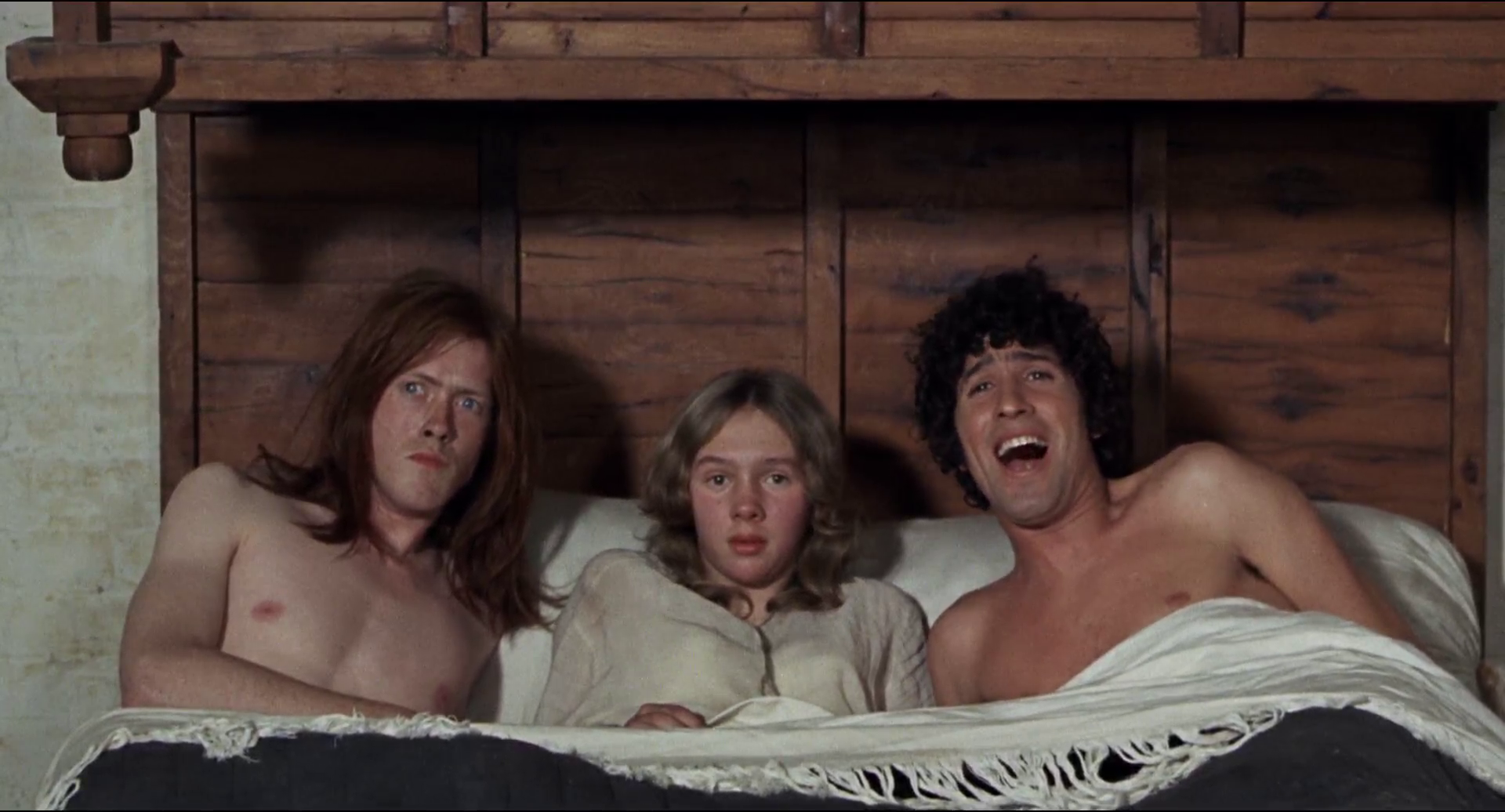
With all the film’s juvenile humor about penises and chamber pots, funny how this quick shot is probably the most purely adolescent thing in the whole movie. Our two heroes in The Reeve’s Tale, determined to get laid with the two ladies sleeping in the same room as them without waking their master, test each others’ boners before they leap in to action! This is a total five-year-old show right here and is a good rendering of the film’s overall tone: it’s hard to get offended with boys being boys.
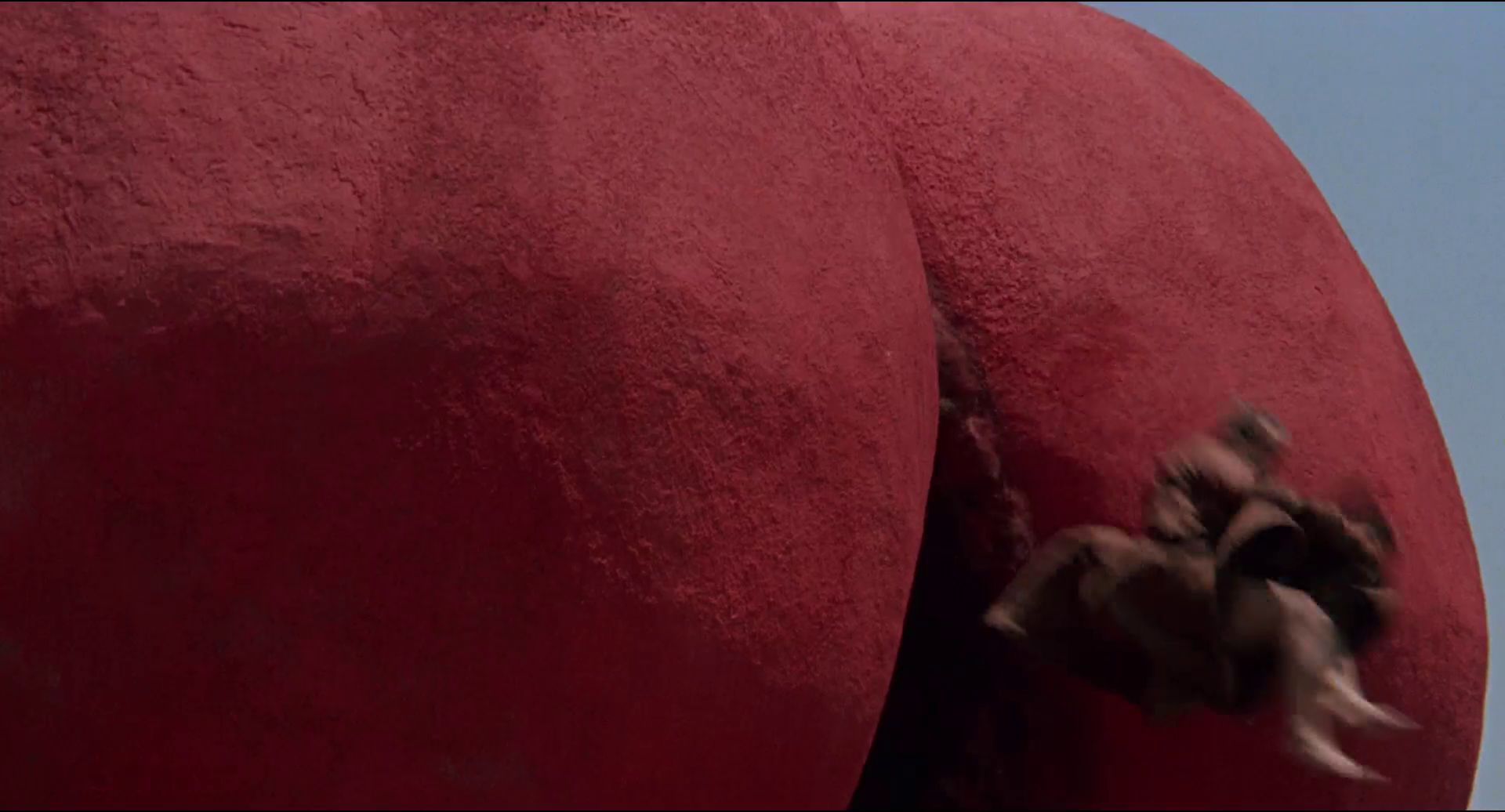
Without going in to too much detail, the final story features a vision of Hell, where the corrupt friars are doomed to suffer eternity in Satan’s asshole. Literally! He defecates them out. In what harkened to the homemade arts-and-crafts project that was the water dragon from Terry Jones’ Erik the Viking, Pasolini somehow found the resources to build a cheap set of Satan’s big red ass for the close-ups of the friars being “ejected” from the cavity. What a description. AND depiction. Kudos to the construction team behind “Satan’s Big Red Ass”. Funny to think that almost thirty years later, we would have the South Park boys joking about their Satan’s “big red ass” in the 1999 movie: the only other comparison I can think of.
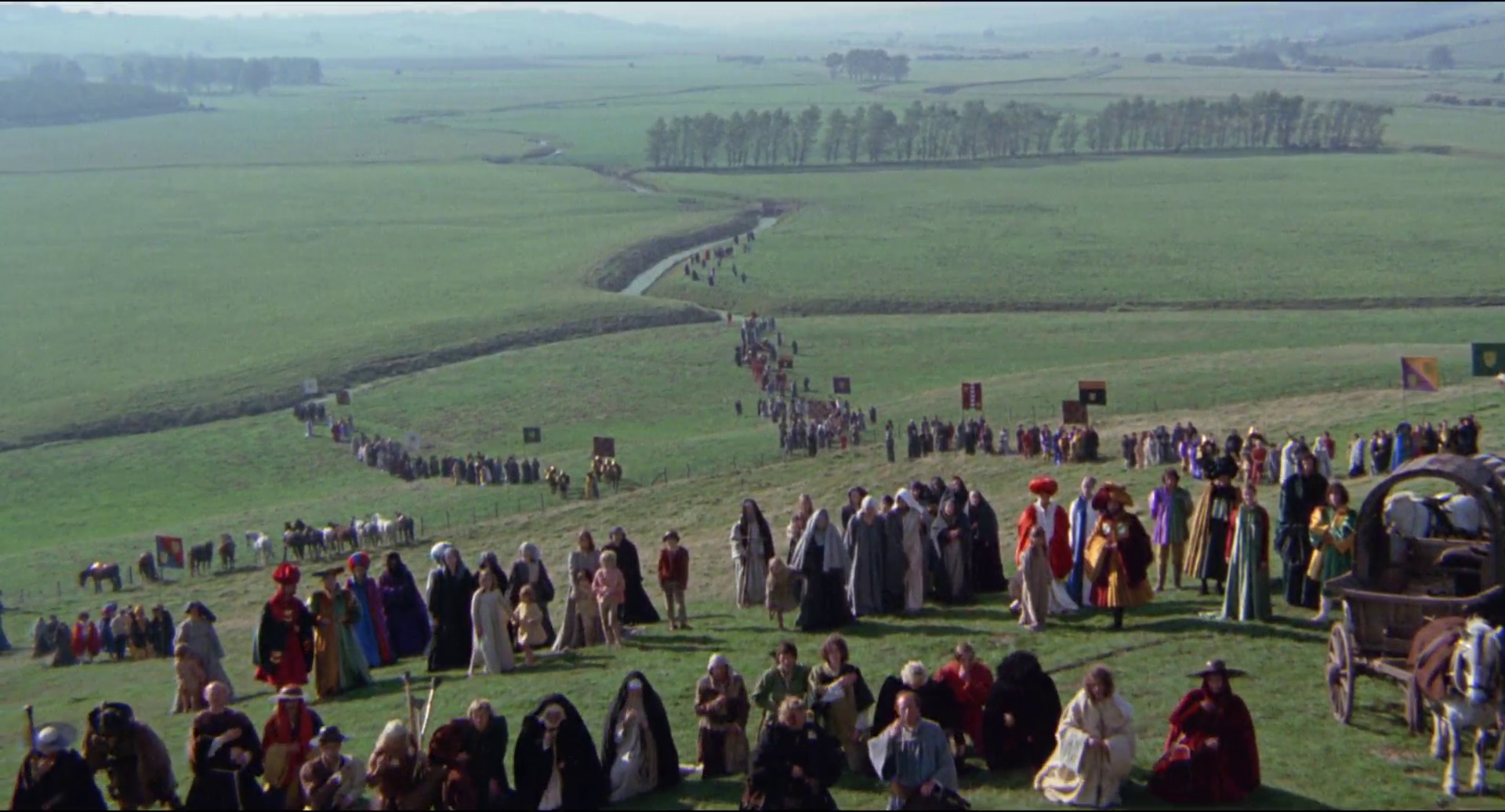
The film ends in Pasolini’s quintessentially-anticlimactic way, where at first glance it appeared to be the characters from Chaucer’s book – saluting him as he finishes his novel – but is evidently just his companions on the fictional pilgrimage that inspired his Tales (even though there is only the one shot of him “writing on the road” between the second and third tales, and in the others he is already at home writing). The shot only lasts a few seconds so I understand the misinterpretation, but that’s a pretty big difference of opinion (the costumes confused me. I suppose I figured that could be the Wife from Bath in the bottom-right).
Pasolini apparently disowned his Trilogy because he felt its financial success spawned more explicit and conventional imitators but again, you can’t fake the director’s own joy in presenting the material – even if it’s ultimately intended as a sort of artistic deliverance: that regardless of the obscene nature of the content, Chaucer’s own joy in conjuring up his rag-tag ensemble of dirtbags and sex deviants is as much a creative genesis as coming up with any other novel. Maybe in this case, the final shot of the crowd paying tribute could be interpreted as the common public, approving of Chaucer’s work as much as the artist himself. And they did: The Canterbury Tales the Book has been a staple of Middle English literature in Universities everywhere, obscenity-be-damned.
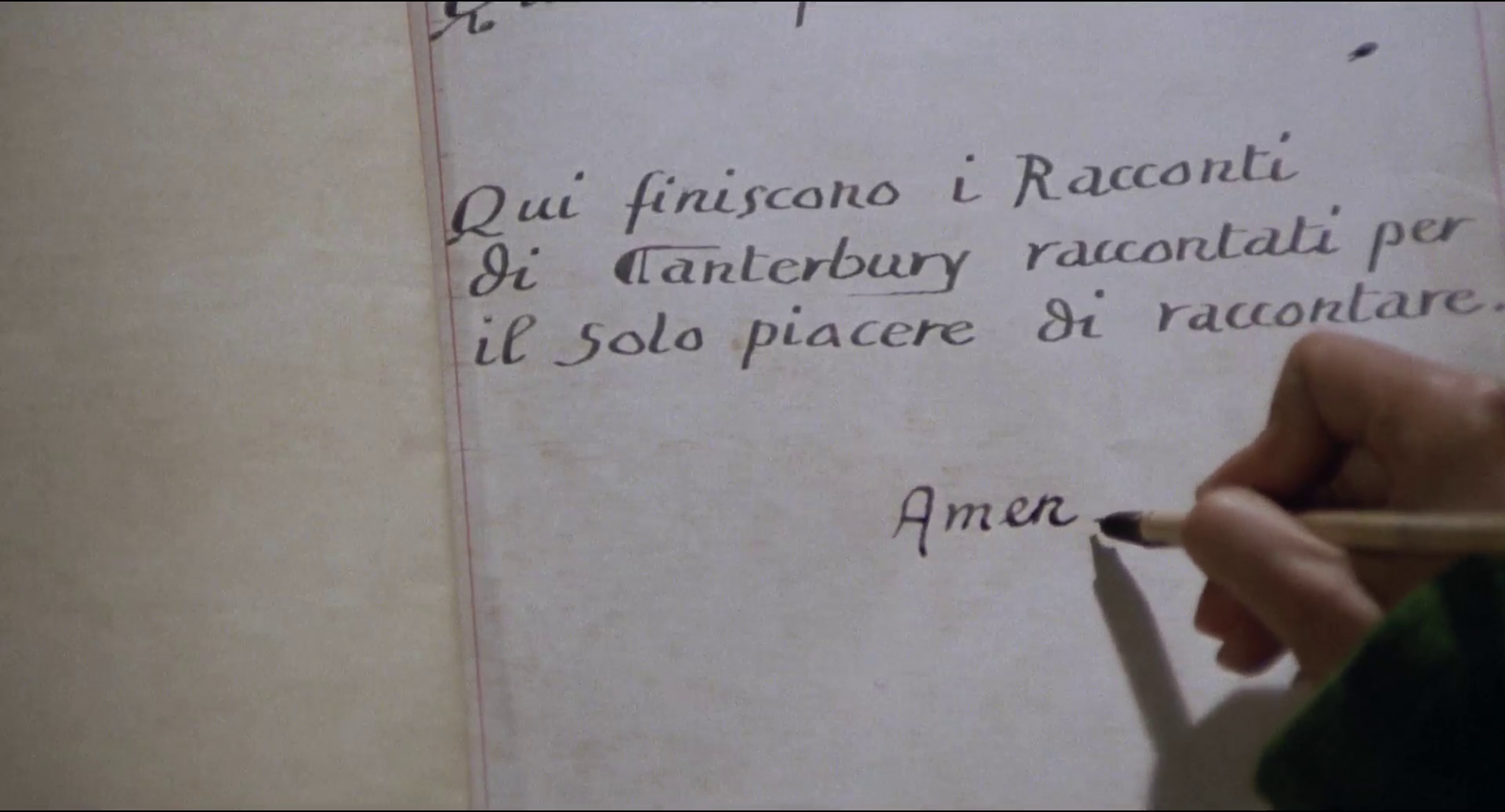
Criticism for the film aside. As said earlier, some of the post-production sound work is not fantastic (not only do we have the Friar’s Tale volume-control issues, but the classic “mouths moving without speaking”, too), however the English dubbing had the appropriate amount of dramatic chutzpah; and the film seems to lose steam in its last half-hour and could have been trimmed without affecting the cadence of the rest of the picture. Even the second-to-last Chaucer cut-away is a disappointing throw-away…
Still, the movie is funny and it is challenging and really, just another slice of life from those free-spirited Europeans. Recommended? Sure.
//jf 4.29.2020
 theory of a daskeman