A spoiler-heavy multi-scene film analysis & review.
Hmm. Another shot of a woman peeing. She pees standing up at a sit-down toilet, pees on the floor, and pees on a dead guy’s face. Sometimes she poops, too: often at the same time as Number 1, lit sultrily by a bonfire where our protagonists are burning the disemboweled corpse of one of their own. Characters stick their fingers in each other’s holes and you are guaranteed a money-shot of their shit-stained fingers after, too. “Oh, well there’s that” I thought to myself as another disturbing image passed my view while I sat on my couch, high and alone at 10 PM on my Friday night.
Director Marian Dora’s “The Angels’ Melancholia” (or The Angels’ Melancholy, or its original German title Melancholie der Engel) has quite the reputation to live up to, and often it does, but far more frequently it does not; but when it doesn’t it reveals itself – at least to this humble critic – as an accomplished art film about the evil nature of man. If that is, in fact, what it is about. I found myself genuinely stumped at-times by the philosophical and naturalistic rudiments that constituted the other 80-percent of the picture, but this is where I found its appeal, to me, personally: in its decryption. Yes, I’m sorry to break it to those of you looking for a new video nastie to watch (or those who have read much on the film already and are looking for a new take), but Angels’ Melancholia did not break me. It did not shake me to my core and make me question my moral judgement for watching it in the first place. Dora’s epic runs almost 3-hours-long and all of the material one could deem “disturbing” only really takes up, maybe 20-minutes of the whole picture? And your boy Jay is incredibly desensitized. I’ve seen “Cannibal Holocaust” and “Men Behind the Sun” so I wasn’t bothered by the on-screen cruelty to animals (some real, some faked). I’m a fan of Gaspar Noé so the sexual violence didn’t faze me, either. In fact, I’d be hard-pressed to say that the film’s “signature scene” (if you can call it that) of a handicapped girl’s torture was the most unsettling thing in the whole movie, but only because Dora had taken two-thirds of the picture to build up to it AND it was the one scene every site online would mention. I went in with high expectations, and ultimately I was left wanting “more”.
I know, I’m sick. But these so-called “extreme” horror films have carved their own niche in giving adventurous viewers such as myself what they are after, and that is non-mainstream approaches to storytelling with unsettling content produced by talented artists trying to one-up each-other. These are still movies, and can still be deemed entertainment to the small subsection of audiences they are made for. Aside from “Salò”, I was introduced formally to the genre with “Inside” from 2007, about a home invasion to claim an unborn baby. The violence and gore was out-of-control, and made all the more grisly because the film looked like it had solid production values. It was shot professionally like a mainstream theatrical film would, and it had the added luxury of famous people being in it (Beatrice Dalle, one of France’s sweethearts), all contributing to the ultimate endgame that was keeping viewers uneasy and on the edge-of-their-seats, waiting-for and anticipating the next reveal. Inside came from the new-wave French extremity movement that saw other, similar movies trying to make their mark, including “Frontiers”; “High Tension”; and my favorite, “Martyrs”. All of those were characterized by their extreme content and expedient technique. Dora’s Angels’ Melancholia from Germany is a different beast, entirely. It’s almost-exclusively shot in an over-bloomed soft-focus – often in close-up – that gives interior scenes a student-film quality and exterior scenes a contextual beauty. The soundtrack is relentless and runs the gamut from synthesizer covers of classical music to disparate “hero-affirming” piano solos to a mind-numbing droning that dominates most of the “ugly” scenes (apparently part of the soundtrack was composed by horror-icon David Hess! That’s random). Characters range from having no dialogue at all (the aforementioned handicapped girl) to an endless tirade of psychobabble that serves the nihilistic essence of our protagonists. Certain scenes seem to go on forever (the initial seduction of our victims at a carnival) and some don’t go on long enough (a very “Irreversible”-style bit in a barn loaded with satanic paraphernalia where the camera swoops and swoops and swoops until this viewer was dizzy). And the plot, if you can call it a “plot” in the traditional sense, takes center stage over sickening us. It is an “art” film at its core: an expertly-shot one at that, and it’s obvious that Dora had honed his filmmaking method from his 2006 debut “Cannibal”. Dead animals in various states of decay surround our characters wherever they go, and Dora makes sure to show that life carries on, even if it’s in the flies and maggots that envelop the carcasses.
The film is audacious, and its actors and actresses very brave for tackling it. But it is not marketed as an art film, or an experimental film. It’s being sold as “the most controversial movie ever made”. For some, this may be true, but it couldn’t be further from the truth or what I think Dora’s “intent” for the picture ultimately was. There is something insidious being communicated here about angels and demons and God’s intervention in the affairs of man; whether man’s atrocities are worse than those perpetrated by God; there is even the possibility that one of the characters is a fallen angel himself, corrupted by sin. But the film is never 100% clear on any of this and the slightly-pigeony English used in the subtitles I watched it with didn’t help. Maybe when the eventual Diabolik blu-ray edition comes out (not sponsored) we will gain more insight from the special features and a more-adept translation. Dora seems to have intentionally kept his real identity and process largely a secret (he works under a pseudonym), so it is up to us, and myself (or myself for us), to dig into this one and make some fly-on-the-wall observations.
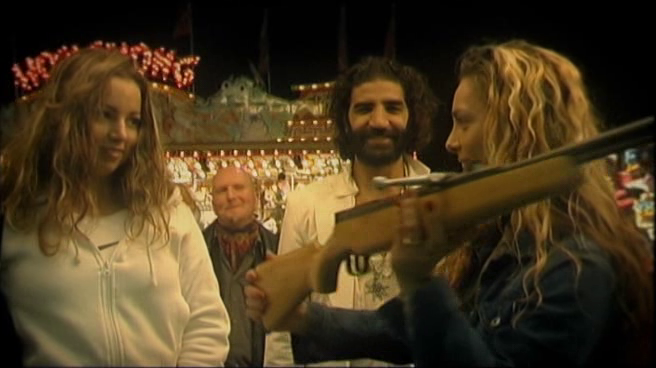
A brief synopsis: two men – one of whom is tormented with violent seizures, or possessions – attract two girls at a local carnival and convince them to join them, and a third woman who acts as the men’s follower, to an abandoned house in the German countryside. The house and its grounds chamber a malevolent force that seems to consume the two men – who are haunted by their time there when they were younger (although the film is never clear on what exactly happened when they were kids, but I’m sure it wasn’t good) – while this force seems to make the one ill man act more irrationally than usual. They are joined by a third man, who brings his own companion with him (the handicapped girl), and they spend the next few days letting the evil of the property and their own hearts take over their consciences.
Let’s start with that initial seduction at the fairground. Melanie and her friend Bianca seem innocent enough, but what is it about these men that wind the girls up? Rico-suavé Brauth gives off Christ-vibes with his white suit, long hair and beard, and Katze is creepy-as-fuck in all-black with a trenchcoat and goatee. They are played by porn actor Zenza Raggi and Dora-regular Carsten Frank respectively, and neither man is particularly attractive nor seem to have to make much effort to get both girls into their car. At this point, minutes into the film, Dora has packaged the men together without differentiating them (if Katze is, in fact, a fallen angel nearing the end of his life as he knows it). Since there isn’t a higher-level of character development at work, I can only assume that these men do, in fact, have supernatural abilities of seduction. Of the two girls, Melanie is louder and more dominant while Bianca is mousy and pliant: although Melanie does seem to look out for Bianca like a sibling, by the end of the film Melanie is subverted to join the men’s cause while Bianca is left to suffer of her own devices.

Kudos to Patrizia Johann, who plays the submissive acolyte Anja. Her role in the film has to be the most courageous, based on what she is expected to do on camera: she pees and poops in full-frontal; rides a horse bareback; gets strung-up S&M-style with rope; makes out with the remains of a decomposing pig; runs her course in a couple of rape scenes (and one where a goat looks like it’s going down on her); AND she plays the violin! Whether that is actually her on the soundtrack playing the violin during these scenes I don’t know, but it certainly made me respect her and her contributions to the film more. However, I should leave my comments about Ms. Johann there, because there must be mental wounds in her past to make her so willing to play the character as straight as she does. Maybe there isn’t anything? Maybe she considers herself an artist or performer and her work here is just a reflection of how much faith she had in the material? In her own integrity? I never met any girls like this when I was in art school but I sure wish I had: fearless and uncompromising. I suppose it was just the different circles we ran in.
Side note: what does it take to film someone shitting, really? At last year’s HUMP festival there was a short where a dude injected pancake batter into his ass, rode a bike to his buddy’s house, and then shat it out into a sizzling frying pan. And then they ate it. Disgusting, yes, and hilarious, but it does raise a good point: you could just “inject” your “poo” (or whatever you use to mix it together) into your actor’s “cavity” and then have them “push” it out… you could also time the shot? Have them eat a certain meal and then plan your shooting schedule around everyone’s bowel movements? Or do you just wait until someone has to go and then you stop everything and film a quick cutaway that you can use later?

A recurring motif are the burned-and-buried doll heads scattered around the property and surrounding hillsides alongside the animal corpses. There is an understanding between Katze and Brauth when Katze digs up this one head, wrapped in a cloth, and there is something to be said for the metaphor of “digging up the past”. Maybe it has something to do with a loss of innocence, or childhood. The charred face highly suggests that fire will play into their hellish ritual, which it does. But when Anja asks them about the head, she is hit and thrown to the ground. Is there a connection being made between the doll heads – which are feminine – and the violence our main characters perpetrate on the women? Violence towards woman, unfortunately, is an oft-used device to show the depravity of a male character, but then at the end of the film it is the sacrifice of a man that ties the circle together and, I suppose liberates the souls of the surviving characters? That Katze’s deliverance was the result of his going against standard protocol? You are supposed to sacrifice the women, right? Isn’t that the archetype of this genre (or the oft-used stereotype of the “virgin”)? The heads could also simply be visually-connected to the animal corpses in the traces that trauma leaves behind, if not biologically then incorporeally? Let the hypothesis’ continue!
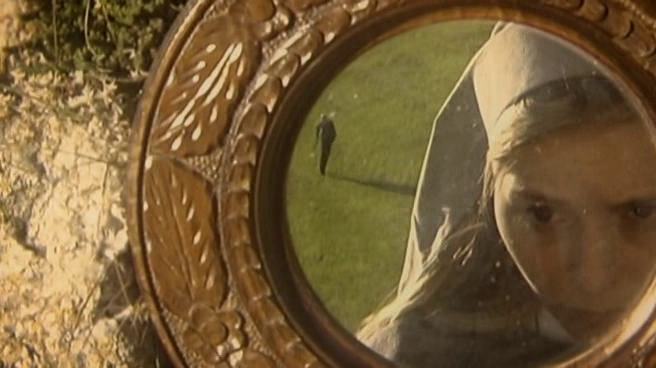
Personally, the most divisive sequence comes about a third of the way through when, the morning after arriving at the house, everyone splits off on their own and the film cuts a three-way montage between them: Katze travels to a nearby church to terrify and, in turn, charm a young (and stacked!) nun; Brauth assaults Anja near a stream with more animal corpses dissolving in it (these things are everywhere!); and Melanie takes part in the slaughter of a pig. What is happening here?
Well, Melanie shows little-to-no resistance to her captors the whole time (not even batting an eye when Brauth takes her cell phone away at the onset), so the slaughter comes across as her own evil and supernatural nature awakening, as she takes part in its disemboweling and even seems a little turned on (she gets all hot-and-bothered with a VHS tape of a snuff film later in the film, too: literally, the tape itself). Brauth’s assault of Anja could have something to do with Anja’s fascination with Katze, primarily. We have to remember, that all of this still takes place on the same property as the house. It isn’t just the house that’s haunted or cursed, but the surrounding countryside as well. The bit at the church is a little harder to follow. The church’s foundation is crumbling, which suggests that it was around at least as long as the murder house was. Does the church have something to do with Katze’s corruption? If Katze is indeed an angel, or some other otherworldly entity in human form, then is his entering the church a sign of his indignation? That his end is near so he can do whatever he wants, placing the flower on the alter less as an offering and more as a fuck you? And as much as the nun tries to resist him, soon she is half-naked and playing with herself right in the nave as the corpus watches on. She is literally running away from him, trying to avoid his gaze: she either knows Katze, or knows what he is capable of. We see the nun again at the end, as Anja walks away from burying Katze. I suppose you could say, that both women were equally-captivated by Katze and are mourning his loss together. To quote Brauth: “He’s really not such a bad guy.”
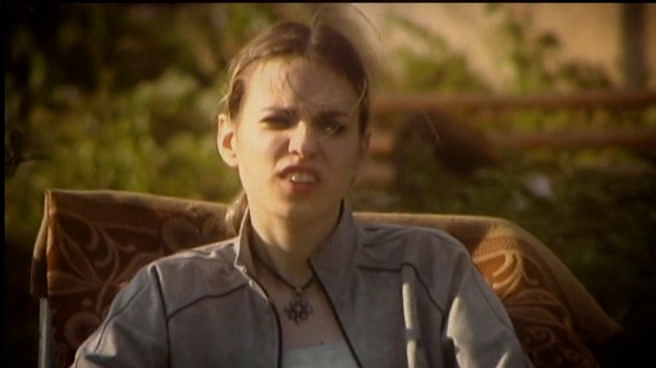
Margarethe von Stern plays the hapless Clarissa, stranded for the duration in a wheelchair and brought to the compound by an elderly man named Heinrich. Heinrich is the one who is ultimately sacrificed in the fire, suggesting his allegiance wasn’t always with our protagonists (and who was possibly one of the instigators of the “event” that drove Brauth and Katze to madness in their youth), but when he arrives at the compound he brings this poor girl with him and it seems like no one, especially Brauth, want her to be there. She is a burden, saddled with a colostomy bag and a pathetic gait as she tries to peddle her wheelchair around unfamiliar terrain (in an early scene, she has to be carried up a flight of stairs after Brauth struggles with her wheelchair and throws it across the room, breaking a religious-looking statue in the process). In the image above, while everyone else wanders off on their sophomoric adventures, she is confined to the house, unable to revel in the joint excess. Even without any discernible dialogue aside from whimpers and screams, there is the suggestion that she wants to go with everyone else. She wants to be a part of the group and yearns for companionship, even if she doesn’t necessarily understand the cost of what she is asking for. Sadly, she is an easy sacrifice for the lot, which is probably why she was chosen in the first place.
All this of course, leads to the scene everyone talks about: Brauth, in a fit of rage (proclaiming that handicapped people have more rights than the common citizen), locks her in a basement, pulls out her colostomy bag with his bare hands, and fingers the abscess left behind. In the minutes leading up to this scene (because anyone watching the movie knows that it’s coming), I felt a dread overcome me. I was already 90-minutes into the 160-minute film. I was scared. Maybe it was the pot but I didn’t know what to expect. How realistic would the scene be? Would there be more to it then what I had read? How prepared was I for it, really? Could it be that the film would bother me so much that I had to turn it off? What? A movie that Jason had to stop watching because he got sick? NO WAY! This is supposed to be one of contemporary cinema’s great “evil” movies, isn’t it? Unfortunately, it didn’t turn out like that. As much as von Stern tries to sell Clarissa’s fear, I was all-too aware during the sequence that this is, after all, a movie and that these people are actors, and that von Stern probably doesn’t have a colostomy bag in real life. The effects are well-done regardless – and if I wanted to nit-pick you could say some of Dora’s attitudes towards the disabled are quite contemptuous, but I won’t – but taken as a part of the whole the scene felt like a natural extension to the movie and not like they had to shoehorn in something shocking because they were contractually-obligated to. Plus, it isn’t like he stuck his dick in the hole or anything (which is what I thought was going to happen). That’s just how I felt. Then I wasn’t afraid anymore. Special mention needs to go to her death, which is a beautifully-shot scene where Heinrich leaves her wilted frame on the edge of a cliff, and as the camera pans down and Heinrich smokes his cigar, Clarissa throws herself off as her wheelchair rolls after her.


Why is Katze grieving at the grave of German national treasure and late-filmmaker Rainer Werner Fassbinder? Does this have something to do with Dora’s mentor – and Fassbinder contemporary – Ulli Lommel? Lommel rejected producing Dora’s Cannibal and acts in the film as the voice-over, or (as the credits list him) The Angel of Katze. I’m sure Lommel’s involvement led to the Fassbinder easter egg as being a bit of a cheeky inside joke (that sort-of “look at me now” kind of posturing), but listing the voice-over actor as the “angel” of one of the main characters? So Katze’s voice-over is actually him narrating after death? Like William Holden in Sunset Blvd? So he is an angel? And if not an angel in life, then an angel in death? Why would Katze be allowed entry into Heaven? Or Brauth, or Anja, or even Melanie? Does Heaven exist for these characters? Maybe it’s the Heaven on Earth: the freedom to live their most debauched existence knowing that it’s really all for naught? That if eternal oblivion is all we have to look forward to then why not live your “best life”? Isn’t that what self-help gurus preach? Is this why there is an extended flashback where a grown Katze appears to live naked in the wilderness eating raw meat and playing with dead things like a child, with Earth being a kind of Garden of Eden situation? Or is it not Heaven at all, and these are angels of the Underworld? Don’t get me fooled, though: I wouldn’t want to run into any of these people in the big back-alley of the sky.

Poor Bianca: of all the characters, she has the worst go of it. It’s a laundry list of shit that she is subjected to and for once I won’t bother with a spoiler (compared to the rest of this article). However, it does lend itself to another personal diversion. As much as I love “extreme” cinema, one thing I cannot stand is an over-reliance on sexual violence. It’s been done to death for decades: “Last House on the Left” (both of them); “I Spit on your Grave” (all of them); “Death Wish” (most of them), to name a few. When sexual violence is used sparingly and without irony, it can be quite effective (for whatever reason, 2010’s “The Whistleblower” comes immediately to mind). It’s when an entire film’s content seems to be back-to-back rape that it can be grating, for me. Again, we are talking about The Angels’ Melancholia, not “Bananas in Pyjamas”. Extreme cinema has all sorts of subsections of its own and if you want to watch one that is wall-to-wall sexual abuse and torture, I’m sure you could (just look at any of the staged role-playing you see on porn sites everywhere). You can certainly watch some that are wall-to-wall vomiting. The Angels’ Melancholia is not wall-to-wall rape. For that I am grateful.
Maybe all of this interpretation is for naught. Maybe it really was made solely with the intention to shock and confuse audiences, and to showcase some wicked practical effects work. Maybe all of this intellectual mumbo-jumbo was added because Dora and co-writer Frank consider themselves intellectuals and wanted to show off. Show off what? Their knowledge of philosophy and literature? Their capacity to quote? To bring a false gravitas to otherwise-smut? Some of what I’ve read online has suggested that there is an academic and/or historical approach to interpreting the material but how much of that is for naught if you have no prior knowledge of German sociology? And I am German!
Maybe there is something deeper going on with Bianca’s character and her naivety, making her the “angel” of the title? There could very well be something that supports this that I missed the first time watching.
Or maybe, another way to look at it, is that the film is Dora’s deconstruction of the “German myth”, in the same way Salò was for Fascist Italy or “A Serbian Film” was for Bosnia: that the acts depicted were intended as symbolic of how the government, or even – in Germany’s case (if you want to go that far) – how the Nazi’s treated the common people despite their proclamation of being the superior ethnic group? That Anja represents the blind follower, Melanie the converted, and Bianca the “real” victim as the sufferable populace? Does this mean that Katze himself is a symbol of Germany in some way, and that his seizures are a kind of awakening of his dark side after years of gritting-and-bearing his trauma? It’s quite clear from the film that Bianca gets the short end of the stick in the end. Does this explain a scene where Katze visits what looks like Auschwitz? So Dora can help us make that correlation?

But that’s enough. Phew, that was a long one! I’m sure there is much more to dissect but without participation from the director, all we know is what we have. And what we have is a fascinating saga about some morally-reprehensible people making some very bad choices that appear beyond their control, and produced by a film crew enamored with the duplicity of its themes. Don’t let my positivity fool you, though: if you are even the slightest-bit squeamish, or would prefer not seeing the insides of a handful of different cute forest animals, then this movie is not for you (I’m talking a fox, a rabbit, the pig, two cats, some deer, rats, squirrels…). If you aren’t thrilled by the prospect of sitting through a three-hour subtitled horror movie then I cannot convince you, either. But if you have the time and the stomach, I thought it was a worthwhile watch. It demanded my attention the whole way through. It was expertly-paced. I wanted to know what happened next. Now that I do, it’s not that I wish I hadn’t seen it, or want to forget that I had: I just wish I had understood its message better; understood its references better; correlated the shots together better in my head. It’s an enigma. Some of that is on the filmmakers, and not the viewer. I suppose it depends how prepared you want to be for the experience.
//jf 6.24.2020
 theory of a daskeman