A spoiler-heavy movie review.
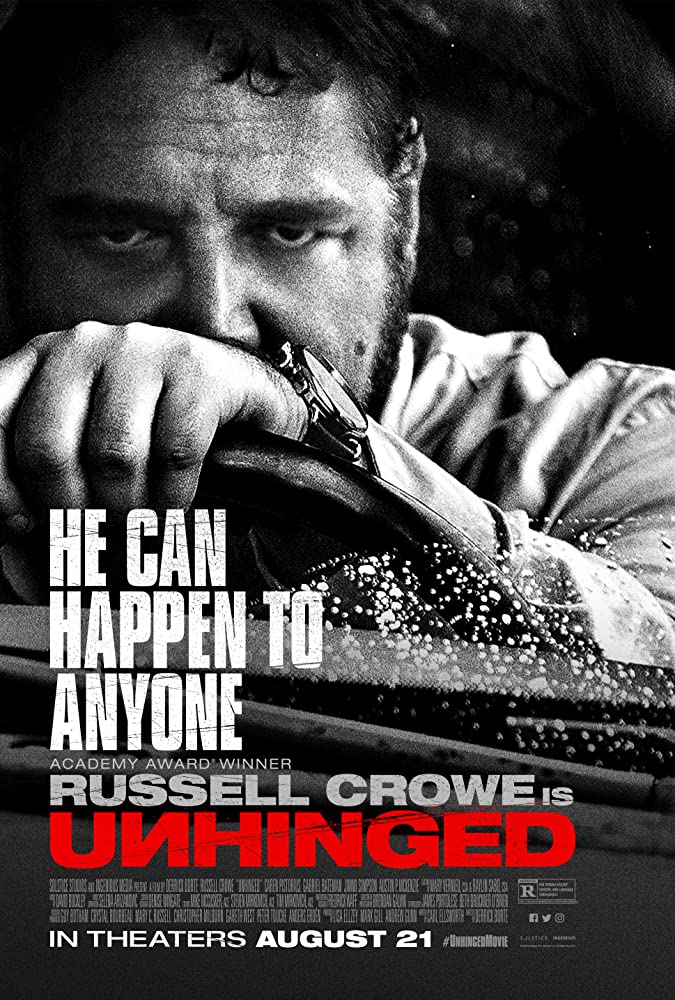
The biggest piece of criticism I can level at “Unhinged” – the Russell Crowe-vehicle that has the dissimilitude of being one of the first major releases after the Coronavirus lockdown – was that there simply was not enough screaming from its cast. Or yelling. Or raised voices at all, really. When I was still in my early-1s (10 or 11), I would lay prone at the top of the stairs that separated the second-and-third floors of our family’s home and listen to the movies that my parents would be watching downstairs while I was supposed to be in-bed sleeping. If you went by my word then, I would have thought all they ever watched were horror movies, because all I heard from my perch was 90% screaming. I don’t even know why I bothered: the volume was never loud enough to actually discern any dialogue, so I would literally only ever be hearing swelling music cues, gunshots, and screaming. I’m blown away just thinking about how many nights I would be there, through how many movies, fascinated by the idea of what they could be watching. And screaming always sounds more painful when it’s out-of-context.
Years later, I rewatched some of what I remember them renting and realized that “Clockers” and “Timecop“, while both – in my opinion – excellent movies, weren’t really, you know, the barbarity I thought they were (or, in the case of Clockers, they were, but not from violence alone). And I imagine little Jason laying there in his bed afterward, wishing that, someday, he too could be an adult and watch adult movies with the other adults. As opposed to the adult watching adult movies by-himself late-at-night with his pants off that he is now. When characters in director Derrick Borte’s Unhinged are faced with “life-changing decisions” that test the limits of their own nature, they turn inward when I was hoping they would be howling outward: pissed-off, scared, and angry. It is still an excellent genre-film with one guaranteed-great lead performance, genuine thrills, and well-executed action, but its human side (our batshit-crazy antagonist notwithstanding) is sorely lacking and minimized the impact the film could have had, had they taken things just a step-further.
Not that Unhinged really needs to be any more intense than it is already (at least not for the average movie-goer). Whoo-boy, I knew Russell Crowe was going to be playing a nut-job but it is seriously-impressive work he puts in here. We haven’t really seen him in anything mainstream lately and it’s obvious he’s gained a few pounds (I would have too, if it was my contract with Universal that fell-through), but for whatever reason his bulkiness adds to the menace of his character, while enunciating his more native-Kiwi physical-traits. Honestly, it was just nice seeing him not having to put in the method required for his more-demanding roles like in “Gladiator” and “Cinderella Man” and just, generally, seem more relaxed and more open to embracing his inimical side, when for years he was lambasted in his private life for the same. I wonder if he acknowledges this irony himself. Anyway, his performance as the titularly-unhinged, unnamed, pill-popping & mentally-unstable sadist – no lie – is Oscar-worthy. And during a particularly-trying morning for actress Caren Pistorious’ Rachel (your garden-variety disorganized, unemployed, chronically-late single-mother going through a tough divorce), she does herself a grave-misfortune by honking at him in traffic and triggering him, spending the rest of the movie in do-or-die mode. Much like my earlier review of Netflix’s “Fatal Affair”, having an actor known primarily for their hero roles playing against-type is more of a rite-of-passage these days than a vertical-career move, so for some that may not be enough to see it. This is fine. Unhinged apes the same plot of a dozen other films (including two Halle Berry movies from the last 10-years: “The Call” and “Kidnap”, both also heavily-featuring car chases and protagonists who can’t get their personal lives in-order but have no problem becoming a super-bitch when their family or value-structure is threatened) and it follows the same trajectory, to the point where tuned-in viewers can probably predict every story beat.
Unhinged, then, compensates for this lack-of narrative creativity with some thrilling action set-pieces, including a great confrontation in a diner (between Crowe and “Westworld”‘s Jimmi Simpson), and not one, but – count ’em – TWO spectacular vehicle-related fake-outs (one of which sets off a huge freeway pile-up that is entirely-gratuitous, but pleasing to know they kept it in anyway). It was short (only an hour-and-a-half). Even the build-up was successful in its timing, particularly in a prolonged gas station visit (the single-best scene in the film, which probably deserves its own “Selected Scenes” when it gets released on video) that felt perfunctory until I noticed Crowe’s singular pick-up truck sitting behind Rachel’s car on the surveillance tape playing in the background. There is a great eye for detail at work in these moments, and when it comes down to pure suspense-driven filmmaking, director Borte has what it takes.
However, it isn’t all lollipops and rainbows. First off, the film tries for social-commentary that, for myself, rang false. On one hand, there’s a theme of public disintegration via Crowe’s road-rage, but it isn’t referenced enough in the 90-minute runtime to resonate. Crowe’s character didn’t need to be fighting for-or-against any “injustices” other than the ones inside his own head: the screenwriters would have had to keep hammering this home to keep me engaged in that angle the whole way through, if that’s what they wanted, like in “Falling Down” (where the whole film was thesis). On the other, there is the good-ol’ vigilante-justice perspective. This is more developed, especially in an impressively-produced and topical title sequence featuring newsreel footage of civil unrest. Yes, an argument could be made that real people like Crowe’s character are few-and-far-between, and that the human race is still worth saving if we stick together – as every extraneous character shows, particularly in the aforementioned gas station sequence, that they are willing to go out of their way to help Rachel: a stranger. However, even the police are helpful in this film. There is literally nothing standing between Rachel and Crowe’s bull-in-a-china-shop other than fate and filmmaking contrivance. Maybe if they had included a few more people fighting-back in the diner scene – you know, someone tries to be a martyr and pin him down, but Crowe just wastes them? Then I could buy what the film was selling. Is this a scripting fault? Maybe they wrote it in and someone told them to take it out. It’s their fault this angle doesn’t work, then.
More criminally-exigent, however (back to the screaming), was how the lead female character of Rachel was developed: I wanted to see, and HEAR, her shock-driven anxiety, when what we got was merely shock-driven forbearance. She’s too quiet and too mousy in moments when I believe anyone else would be fighting for their life, yelling at Crowe, “If you f*ing hurt my son” and this and that: I really wanted to see her flip out (and, from a story point-of-view, so does Crowe) and she never did. Maybe this decision had something to do with the way contemporary media feels it has to over-represent the “capable, independent female”, and Borte didn’t want Rachel falling in to the old stereotypes (a comparison can be made, again, with Nia Long’s muted turn in Fatal Affair). Problem is, the film already sets Rachel up to be incapable and co-dependent. This isn’t helped by Pistorious’ calculated performance, with a delivery that comes across quite flippantly for someone the audience is supposed to sympathize with. I personally think there is nothing wrong with anyone not knowing what to do in these situations: it doesn’t make you any less human (or, for that matter, less of a modern woman) to lean on reaction, and – in the case of a movie plot – it makes your protagonist’s arc more believable if you’re setting things up for a “final confrontation”. A better example, then, is Halle Berry in Kidnap: for as much as it could be seen as overacting, I believed she was in-distress in that movie, and yet was still super-bitch on-top of that. And for those of you thinking that I’m singling-out the female actresses specifically, consider how Rachel’s brother is portrayed as a zoned-out, loser drug user who only seems to get upset once he’s set on fire? Or how long it takes Simpson’s Andy to clue-in to what’s going on? Yes, I understand that these characters are traumatized, but there has to be a limit to the madness. Nevertheless, Unhinged is too short and too invested in keeping you on the edge-of-your-seat that you may only notice these things because I mentioned them. All-and-all, a potentially-life-threatening visit to the movie theatre well spent.
//jf 8.22.2020
Movie poster image sourced from the IMDB.
 theory of a daskeman