A spoiler-free single-scene film review & analysis.

Do you ever have a bad day on the road? Sometimes, I get a kick out of pretending that asshole who just cut me off has a life far worse than mine (even though they drive a shiny Escalade with a bumper-sticker that says “My Other Whale Is My Boat”).
Par-example: today at 3 PM, near a school, my wife and I are trying to get out of our Chinese-reflexology foot massage clinic’s underground parking (or CRFMCUP). My wife was driving, and – men, let’s commiserate here – she’s not the best driver. Truth-be-told we’ve never been in an accident, but I sometimes fear for my life just the same. Now picture a four-way traffic stop, and we’re trying to turn left. Everyone driving straight is coming from the Middle School, and left is bumper-to-bumper because of construction two blocks down. My wife pulls into the middle of the intersection – not letting anyone turn right – only to be denied access to the last spot before the light at the end of the gridlock from some person & their kid in a pick-up. We pull in behind him & stick-out ass-end just as the light changes and we start moving again. It doesn’t sound so bad describing it – considering it took all-of five-whole-seconds out of my day – but I assure you that I was on Death’s door.
Once the dust had settled, we were still sitting behind the pick-up, and killed time before our turn-off to curse their life-force for cutting us off: “his kids should be lucky they’re being allowed to ride in the truck; I would have just thrown them in the cab”; “Dad probably has to take a bump off the dash just to keep his sanity”… less so than Pacino’s “Scarface”, this got me thinking about 1992’s “Bad Lieutenant”. Although I’m sure the parent in the pick-up in-question has far less on his plate than Harvey Keitel’s unscrupulous police investigator does, no matter how hard they complain about the all the whip on their soy latte they didn’t ask for.

I’m not even 30% familiar with director Abel Ferrara’s filmography (which is so massive it rivals Woody Allen’s pre-exile annual output), but – from what I have seen – Bad Lieutenant seems to fit snugly into Ferrara’s repertoire about “bad” people seeking redemption: either through religion, or a difficult transitionary period of either making amends or procrastinating. Keitel’s eponymous Lieutenant ambles through both over the film’s week-long timeframe, starting out as a corrupted official who would put “Chicago PD”‘s Hank Voight to shame – robbing robbery suspects; taking advantage of some naïve teenage girls; skipping-out to do smack with the late Zoë Lund – to being confronted with his own apostasy while inquiring into the rape of a nun. The LT believes in God, although somewhere along the way he wasn’t afraid of His wrath anymore, and the nun’s case changes this: how can the victim forgive these rapists if the LT can’t even forgive himself? We as the audience never get to know definitively how the LT got to this point, other than he’s here now (although we can make some assumptions, at least from his day-to-day); the movie thusly proceeds to knock him down a few pegs before delivering his ultimate reclamation.
It’s very good, overall: Keitel is great, but you would expect that; there are some over-the-top bits that are unexpectedly funny (and wouldn’t seem out-of-place in Werner Herzog and Nicolas Cage’s 2009 remake, including Keitel’s twining, and a scene where the LT shoots the radio out of his dashboard); and it has a pretty satisfactory ending, despite some back-half pacing issues.
There’s enough material in the film to write a far-longer piece, but better scholars than I have probably done it already (and I stuck to my guns that I would keep this one short, like the early “Selected Scenes”). In a film obviously top-loaded with great individual scenes, my favourite comes right at the beginning. Our LT wakes up to a routine morning’s commotion at his house, presumably with only a couple-hours sleep after passing-out on the couch. He lives with a full-brood (a wife, her sister, their mother, and at least three kids – including a toddler), as the relative silence of the street outside his house in the Bronx is broken simply by the opening of his front door, as his two boys clamour to get to school on time. It speaks volumes a third into the film when we see the LT simply leave the house rather than to put up with another family breakfast. But he still drives his kids to school, offering them a good bit of advice about leaving late in the future:

…listen to me: I’m the boss, not Aunt Wendy. When it’s your time to use the bathroom, you tell Aunt Wendy to get the fuck out of the bathroom! What are you, men or mice? She’s hoggin’ the bathroom – call me! Call me, and I’ll throw her the fuck out!
The kids look a little perturbed in the screenshot, but otherwise are unfazed by their father’s outburst: probably because that isn’t the first time he’s spoken like that. But consider then, that they aren’t afraid of him either (and as we see in the film, maybe they should be): if he’s leaving his family to go to work at the first opportunity he gets, how much time does he spend with them, really? Again, what was the inciting incident to make the LT essentially give up – to such a degree – that he was able to spend enough time from then-and-now to train his family to not give a shit about him? “Leave him, it’s just another bad day at the office.” And then his wife and him are Catholic with three kids, so they aren’t getting a divorce any time soon, either. He fell in the hole of starting & supporting a family, and they’re riding it out. The only one who really pays attention to his warning signs is Grandma, but I wouldn’t read too much in to their relationship other than she thinks he’s a knob, which he is.
Since we’re here, let’s chat a bit anyway. Maybe it wasn’t one solid event. Maybe it was a slow degrade over time? What is it exactly that he excommunicates Christ over late in the film? Is it what he’s seen as Police? What he’s done? What he’s become as a result? The direction his life has headed? Or is it as simple as he’s old and burned out? Only Ferrara, Keitel, and co-writer Lund know for sure. As for the viewer, the film is better for its ambiguity over repeat viewings. First go-around, Ferrara tries his best to disturb you. and will be successful at it (particularly in the traffic stop scene with the two girls). But on subsequent viewings, you can acknowledge the realm of the “moment” as the world the LT lives as thematically-appropriate, opposed to shock-value for shock’s sake. Rather than have that spell broken by the derivativeness of having a scene say, between the LT and Grandma, or even a cut line where she would tell him that he isn’t the same “since the baby died” or, “ever since you shot that kid accidentally, you’ve been a wreck.” There’s nothing like that in the movie, and that’s a GOOD THING.
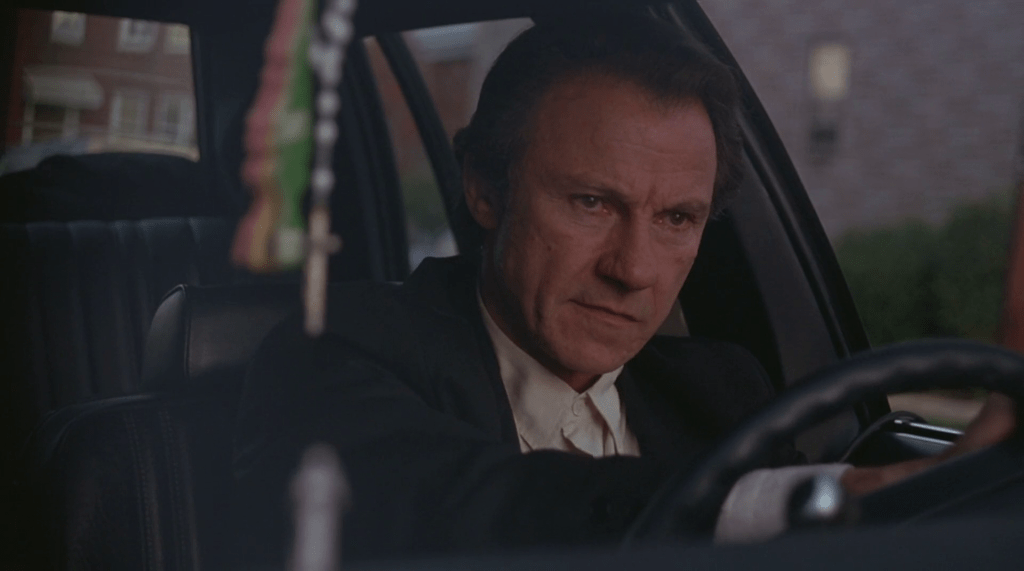
After dropping his kids off, he has a bump (of course he does), only to be noticed by the Sister who accompanies his boys into the Catholic school. The contrast between the Sister’s looks, Keitel’s guilt, and the rosary hanging off of the LT’s rear-view mirror is the perfect thesis statement for where the film will eventually take us.
Keitel is still working, but his output seems mostly in indie films and direct-to-video releases now; though giving the guy credit, he’s always been part of the indie scene. I would say his renaissance hit its peak in the 90s with “Pulp Fiction”, “The Piano”, and Bad Lieutenant: by this point, he had been around long enough that “dangerous” directors like Tarantino, Campion & Ferrara knew exactly what to do with him. I may be scared of my wife’s driving, but I certainly don’t want to be honking my horn at a guy who’s life is permeated with dread.
//jf 6.9.2021
Screenshots author-obtained.
 theory of a daskeman