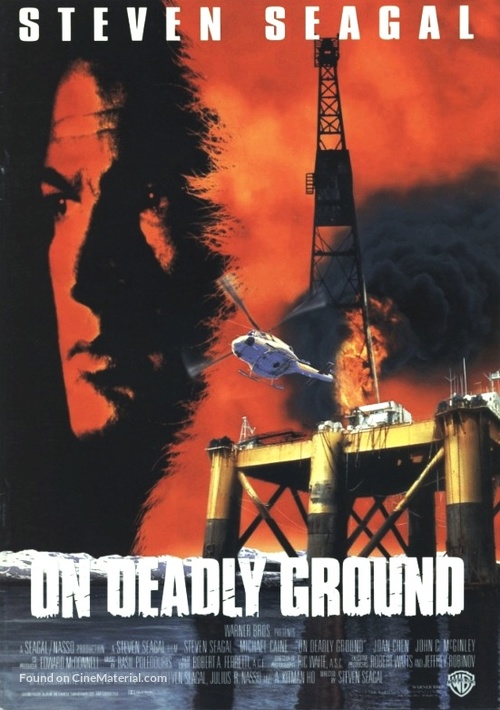
A revisionist movie review.
“You wanna know who he is? Try this: delve down into the deepest bowels of your soul. Try to imagine the ultimate fucking nightmare. And that won’t come close to this son of a bitch when he gets pissed.”
– Michael Caine re: Steven Seagal
Let’s talk. Aside from the man himself, do any of us REALLY KNOW Steven Seagal? Sure, NOW he’s the schlub who can disarm a pistol-toting goon faster than my Mazda can reach top-speed uphill in eco-mode – who has private “line readings” with his co-actresses (albeit allegedly) in expensive hotel rooms in cities whose elite still see the man as the mainstream movie star he was 40-years-ago – but just WHO is he? No one understands the “mythos” of Seagal better than Seagal himself. And for this review, it’ll be important that we make this distinction now, at the beginning, because -SHOCK- “On Deadly Ground” is up for re-evaluation, and (surprise!) it’s really, really good.
It’s easier for most to dismiss Seagal’s filmography in the post-#metoo & #timesup world because it isn’t really like he has a “Valkyrie” or a “Usual Suspects” in there. “Under Siege” was probably as close as I ever thought to any of his movies achieving “high-art” status, and THAT one had him as a cook on a Navy boat fending off Gary Busey and Tommy Lee Jones! No, his films are not classics. But then again, they are, for those (like myself) who love the genre. And if we’re separating Seagal between the borderline-incriminating personal tragedy he is now, versus the icon I will now refer to as (patent-pending) “Screen Seagal”, then On Deadly Ground – produced, co-written, AND directed by the same – is as much a Magnum Opus as we’ll ever get from the guy: a film that embodies to its core what Screen Seagal believes he stands for emotionally, physically, spiritually, and sexually. Really. Everyone looks like they’re having a great time, including his outlandishly-casted co-stars, all playing against type (at the time) and all of them giving it 110%. And shit goes BOOM real good. That Seagal never went on to direct another movie again speaks less to his actual technical ability and more to the reputation of Steven, who – unlike Screen Seagal – can’t seem to get out of his own way.

But, don’t assume this review then will morph into a defense of the man, or a Jason-esque essay-length deep-dive into my personal thoughts on the myth of Screen Seagal. Unfortunately, another high-profile actor has a movie out right now that deconstructs his OWN myth on film, and all the reviews for it are ALSO giving THEIR own opinions on Cage’s iconology as an actor. They even used all the buzz-phrases that I was going to, like “Nicolas Cage as Nic Cage deconstructs the myth of Cage the actor as Cage the man”, and so on & so forth. Neither do I feel like wasting a paragraph rehashing the plot for you (though I seem to have no problem wasting a paragraph telling you why I won’t waste one).
So, “forget it then!” I said, storming out of the room, throwing a hissy-fit the likes of which my wife has only seen a million times from me before. But, fateful reader, I pressed on, knowing that somewhere, somehow, in this movie, there was something worth talking about that NO ONE else has, or seems to be (other than the fact that I think it’s a good movie: that’s an original idea right there). Something to make my review stand out amongst the endless ocean of bloggers and other university-dropout movie reviewers: to make that ONE reader stop and say, “I’m sick of reading all the NORMAL reviews of this one particular Steven Seagal movie! I’m looking for something different!” And I think I found it…
Yes, Seagal’s casting is outlandish, but that word doesn’t begin to describe how WILD it really is, or how successful it makes the film. Michael Caine as the villain was apparently working for-pay (like Sean Connery in the ’80’s), but when I think of Michael Caine, I think of exactly the kind of cockney performance he puts in here (the standout of which, has to be the “de-aging cream” scene, for sure). If he’s phoning-it-in, he’s hiding it well. And then there’s John C. McGinley, who in a MILLION YEARS I never would have pictured in a 100% serious “main-henchman” role. It’s surreal, and one must only point to his own standout scene (the torture of Seagal’s hapless mentor-slash-kindly-old-man-who-doesn’t-really-deserve-it) to blow the mind of anyone who otherwise sees him as “that guy from Scrubs”, or as the chicken-shit Sgt. O’Neill from “Platoon”. And a pre-“Sling Blade” Billy Bob Thornton and post-“Full Metal Jacket” R. Lee Ermey pop in for the Hell of it, too (both, coincidentally, getting blown up real good as well).
As for famous animal actors, Bart the Bear makes an appearance in a “vision” sequence as Seagal’s spirit animal-slash-a manifestation of his inner demons (not actually super-clear), but we’re getting to that.

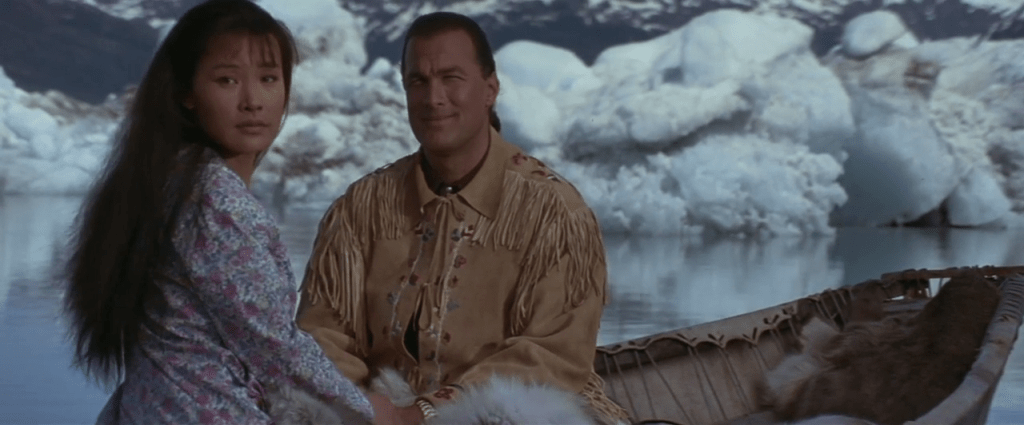
Who I really want to talk about is Joan Chen – AKA Josie Packard from the original run of “Twin Peaks” – as Seagal’s Inuit (!) love interest-not-love interest. First, having a Chinese actress playing an Indigenous person when the rest of the First Nations cast are largely unknowns is not super cool. I suppose Seagal needed a “name” for his female lead. Honestly, I would have expected Chen to play Caine’s secretary: a role that went to Shari Shattuck instead. While Shattuck is fine as Caine’s complicit assistant, I could see Chen adding a smolder to the line readings that’s missing from the character in the finished film: one that would have made you question her loyalty more, and would have made a third-tier character exceptional.
Sadly, I think Chen is smarter than that, and saw not only more of an acting challenge in the role of the Chieftain’s daughter (where she speaks Inuktitut and gets to ride a horse, neither of which Shattuck gets to do), but an opportunity to play an atypical character: one who offers her help to Seagal without playing into the archetypes often associated with the female role in these sorts of pictures. Unfortunately, we’re practically WAITING for Chen to take Seagal like the naked lady in the vision sequence, because her character really serves no other purpose narratively. Sure, she’s avenging her father’s murder, but none of her skills are actually necessary for Seagal to complete his mission (OK, OK, other than helping him plant bombs. So he needed an extra set of hands: so what?). The role just ends up coming across as perfunctory.
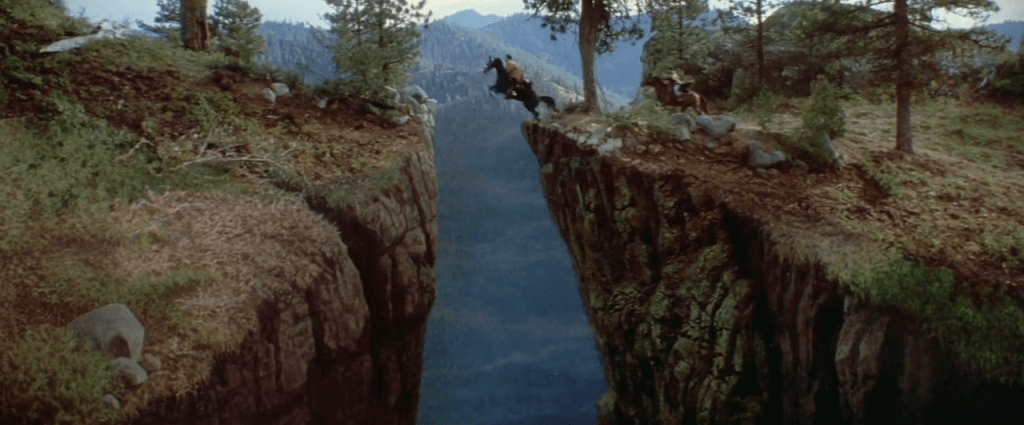
Recently I rewatched “Taken” (Liam Neeson’s original “man-of-action” film from 2008), and it’s incredible how avant-garde it is in its approach to the genre. Neeson’s character has help completing his mission, but only ever from a third-party perspective: there’s no sidekick or fellow war veteran travelling with him at all times (although he does have “fellow war veteran best friends” who do “assist” via telephone). He’s pretty much got the entire thing handled himself once he’s on-the-ground (and there’s no sexy model-of-the-week hanging off his arm either). Taken taught contemporary audiences that it’s OKAY to have one guy (or girl) kick the shit out of all the bad guys by himself (or herself) without the help of a love interest or a buddy. Plus, and I cannot stress this enough: JOAN CHEN IS CHINESE, NOT INDIGINOUS! Therefore, I would have been fine seeing Seagal do the final-third of the picture on his own: get rid of the “Chieftain’s daughter” character and swap Chen for Shattuck (sorry, Shari). It’s too late now, though.
And, with that, let’s wrap this up by talking a bit about that vision sequence. Even more preposterous than the much-touted end-of-film monologue (more like a short lecture) on Big Oil’s impact on wildlife & environmental conservation, midway through Seagal is double-crossed by Caine (no way!) and he is nursed back to health by Chen’s Dad and their First Nation’s commune. Once he’s recovered (following a politically-correct training montage where he does more meditation than sparring), he decides to “take the drink” and go on a spirit quest where he fights Bart the Bear; gets seduced by a half-naked lady (who is promptly denied satisfaction: way to fight temptation, Screen Seagal!); and meets Mother Nature, who heartedly approves of the wholesale slaughter of the movie’s final-third. It truly is a visual representation of the “heart” of Screen Seagal: his “martial arts mysticism”; his Sun Tzu-esque approach to murder, in that you should avoid murder whenever possible; his strength in body, mind, soul, and libido. Sure, this “sidebar” probably could have been shorter but – unlike six seconds of homosexuality in the recent “Harry Potter” joint – actually cutting any of this sequence out would defeat the purpose of the film, which at its core is part pro-ecological fantasy. You can’t take that subtext out, otherwise you remove the quirks that make it unique.
Where do we go from here? Because it ain’t backwards. Does Seagal’s personal history cloud our enjoyment of his films? Screen Seagal is not necessarily the Real Steven. Screen Seagal has been iconized by popular culture. One can watch his most recent films at his largest body-mass-index and draw whatever conclusions they want. But if you can separate the salaciousness from the myth, then On Deadly Ground is worth the time investment.
//jf 5.7.2022
Movie poster sourced from cinematerial.com. Screenshots author obtained.
 theory of a daskeman