A revisionist movie review.

“You have a room where you go inside and you lock the door, and I’m not even allowed in! How come you get a room like that?”
– Samantha Mathis, getting nowhere with River Phoenix about the whole “room” issue
“Well, I’ve lived here for a while, and I enjoy the space, I pay the rent…”

How many of you knew there existed a River Phoenix “gotta be a country music star” movie? That was the primary reason I chose to watch “The Thing Called Love”, controversies aside: it’s a nightmare to find anything I would consider “general viewing” in my house (ie. my wife hogs the TV & often complains about my movie choices). She was a ranch-hand in another life, so to say my spouse is a fan of country music is like saying bananas have potassium. And for the first half of “The Thing Called Love”, I thought I had found a winner: a making-it-big-in-Nashville odyssey with Samantha Mathis (Daisy from the “Super Mario Bros” movie) directed by the “Don of the Down & Dirty” Mr. Bogdanovich (“The Last Picture Show”), with music that my wife actually knew the words to? To say, then, that finishing the movie was disillusioning is pre-emptive, since no one really talks about the film: either as a Phoenix movie (even though it was his last-completed before his death) or a Bogdanovich movie. But I’ll tell you why anyway. It’s hot outside.
At its essence, The Thing Called Love feels like a reverse-engineered “Cabaret“: it’s a three-way, two-guys-one-girl romance. It’s a musical without being overtly a musical (lines aren’t sung outside of their set-pieces). But instead of Nazi Germany burlesque, it’s country music in Nashville. And our main character – Mathis’ mousey, starry-eyed, blond-haired Miranda – has the “Sally Bowles Syndrome” where she’s overbearing to the point of being blinded by her own single-minded pursuit to not be forgotten-about. Only this time, Phoenix is the Rico-Suave Max character of James & Dermot Mulroney channels the timid, lovestruck Brian in his Kyle. Now that I’ve finally seen Cabaret, it has set a precedent: since it’s institutionally considered a classic, then its is a formula to be reproduced – however successfully-or-otherwise.
Thankfully – for the first third, at most – The Thing Called Love’s plot maintains more interest than Cabaret’s did. Who doesn’t like a little drama with their song-writing competition? And what better drama than the back-stabbing that goes on behind the scenes of country music: stealing other people’s songs; fucking around & cheating; lying; drinking; making the same mistakes over & over and swearing you’ll never do them again… just like a good country song, really. Speaking of songs, the music – when isolated from the rest of the picture – is great, if you like country music (some hate country music and like musicals. This one is more country than musical). And Bogdanovich casually tosses-in his patented “grounded” background detail for anyone who cares: he holds a shot of Miranda’s open luggage long enough for the audience to see what’s inside and consider it.
Expectations, then, for the rest of the film were high: a second-act shitstorm of sleeping behind everybody’s back, followed by a third reel filled with drunken, tearful apologies & montages of walking alone down the cold, wet, lonely streets of the city – simultaneously beating yourself up over your guilt & writing the lyrics in your head to the big closing number about beating yourself up. These movies aren’t supposed to be rocket science.

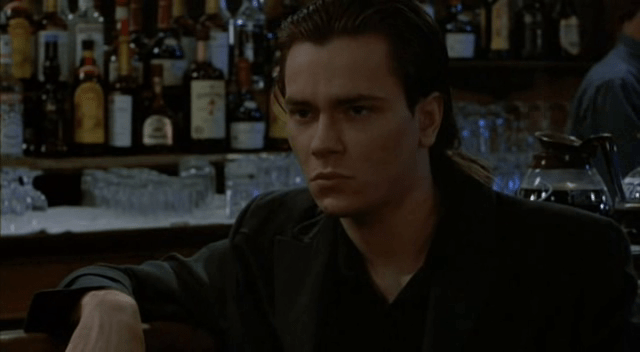
What, then, about River’s presence? As an objective first-time viewer, I can only go off what I can see. And from the first time River is on-screen in The Thing Called Love, it appears that – sadly – his drug addiction is on full-display: he’s not reading his normal-sounding lines “normally”; his face is badly pot-marked & poorly masked; and he’s twitching. Are these things noticeable by a viewer unaware of Phoenix’s personal struggles? Let’s look at it this way: once at her lowest point, Lindsay Lohan was uninsurable (or her premiums were too high, can’t remember which). If you can’t be insured, you don’t work: movie studios aren’t losing a million-dollar investment because they hired an unreliable employee against the wishes of their insurance company. It’s like any other business. So, what if your actor-or-actress with the costly premiums dies during the making of the movie? It could very-well shut down production. What if said-insuree is in the throes of their addiction and are unable to control their bad behavior? For an example of this exact kind of thing, go read up on Paul Schrader’s working relationship with Lohan on “The Canyons”. Bogdanovich had positive things to say about his time directing River. And, to his favor, River still managed to finish the shoot, however over-budget or over-schedule it was. The man did his best.
But despite all that, as I continued to watch The Thing Called Love, I still kept thinking it was going to pull a “Star is Born” trope, and there was nothing. Phoenix’s James is as straightforward a one-dimensional characterization as they come, and that’s the script’s fault. How hard was it to give James some texture? Make him a drug user himself? Or a drunk? Or terminally-ill? Why in God’s name was there no communication between River, Peter, and the film’s writer(s)? Couldn’t they have discussed the inclusion of a scene-or-two to make up for what is inescapable fact? We may never know the answers to any of these questions. I’m sure it all says something about the insidious nature of celebrityism: that we – the public – can’t see past the actor to see the work. Look at what’s happening right now with Johnny Depp & Amber Heard: will we ever see either of them the same way on-screen again? Or, to be more specific, will we – as the viewer – ever see them again for the characters they play?
But this wishy-washy attitude from the filmmakers to just “keep trucking” despite adversity hurts the film more than River’s personal problems ever could have alone. About halfway-through the movie, James & Miranda go on a road trip to Memphis and stop at a gas station. The scene eventually spirals into them getting married on-the-spot blah blah blah but, at the gas pump initially, if there was a ten-second scene where James asks Miranda for money for gas, and she gives it to him & he pockets it instead, THEN I would have confirmation that he’s not a great guy, and that James has justifiable motive to be acting the shady way he is – however implied or unimplied. But there was never ANYTHING really going on behind any of the characters’ motivations: it was all surface-level. Late in the film, Miranda yells at James about how he spends all his time in a locked room “writing”, but we never see what he’s actually doing in the room. Is he writing? Using? Drinking? Stewing? Masturbating? WHAT? WHAT IS JAMES DOING IN THE ROOM, BOGDANOVICH?
Mathis’ performance is also a casualty of these imprecise characterizations: other than the contents of her suitcase and the glossed-over fact that her father’s dead, the only thing I know about her Miranda by the end of the movie is that she likes to eat fruit. I want my drama. Give me my drama!
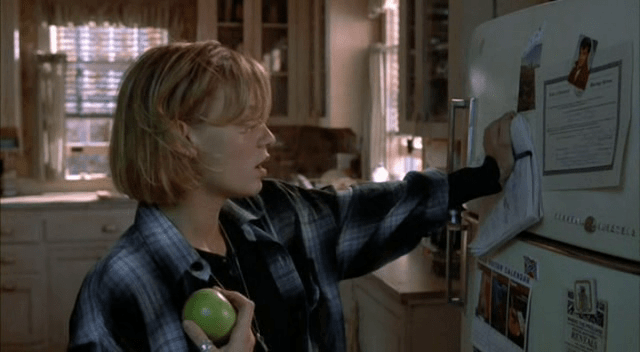
This film severely lacks salt & pepper. Doing the “slice of life” thing that Cabaret did where it’s ultimately just “paths crossing” bullshit is dumb. If you can’t give me something original, just give me something – anything – however generic. Maybe James steals Miranda’s notebook & her songs with it, and that’s how she’s betrayed and gives up on her dream? Nope. Kyle doesn’t even get a girl by the end – not even a hook-up with a young Sandra Bullock playing the overly-friendly Southern belle. His only consolation in the final minutes of the movie is that Trisha Yearwood recorded one of his songs. That may be enough for some people, but not when the film makes it so I’m supposed to care more about the outcome of his romance with Miranda than his career. Poor Dermot Mulroney: his Kyle could have been written out of the movie completely without affecting anything.
This is the second time I’ve bashed a romantic movie for not having more going for it. Doesn’t Lifetime pump this stuff out on a weekly basis without even the advent of “name” stars? “So what is it then that makes a good romance, Jay? If only for future posterity?” Let’s take my favorite “romantic” movie: Jean-Jacques Annaud’s “The Lover”. “Oh my God, really? Isn’t that supposed to be porn?” Yes there’s sex in it, and naked flesh. Passion & intimacy sometimes go hand-in-hand with romance. And yes I think Jane March is physically more evocative than Mathis is (ahem). But Annaud’s film established a visual communication between filmmakers & viewer about March’s character’s precociousness, so even in moments where the dialogue was enigmatic you still knew what was going on and exactly what everyone’s intentions were. The Lover didn’t treat the viewer like an idiot, had a satisfying ending that met audience expectation, and it was an hour-and-a-half long. The Thing Called Love treats the viewer like a bully would – calling you stupid & never giving you actual reasons why – while also being over two-hours-long and ergo wasting your time while it’s pummeling you helpless with its sheer mundaneness.
And that ending. Sheesh. James acts moderately selfish and Miranda leaves him in a tantrum, only for them both to run back to each-other at the Bluebird Café: a real-life Nashville staple that serves as the characters’ central hub. When Miranda enters the bar, Phoenix gives her this look. It’s less “second chances really do come true” and more “are you fucking kidding me?” And I agree: on a road-house waitress’ salary, HOW can she afford to take a Greyhound – that drove day-and-night one-way – only to change her mind and then TAKE A CAB to get back? Where did she get the money? How far away was she from the Bluebird before she decided to retrace her steps? Are you fucking kidding me?
Sadly, unlike Cabaret, I don’t think I can recommend The Thing Called Love on music alone (maybe listen to a soundtrack album on Spotify, if country music is your thing, which you call love). The movie went nowhere, and it achieved nothing, other than giving me a headache. It’s a huge disappointment, and that really has nothing to do with River Phoenix.
//jf 9.3.2022
Movie poster sourced from see-aych.com. Screenshots author-obtained.
 theory of a daskeman