A spoiler-free movie review.
1.5 out of 5
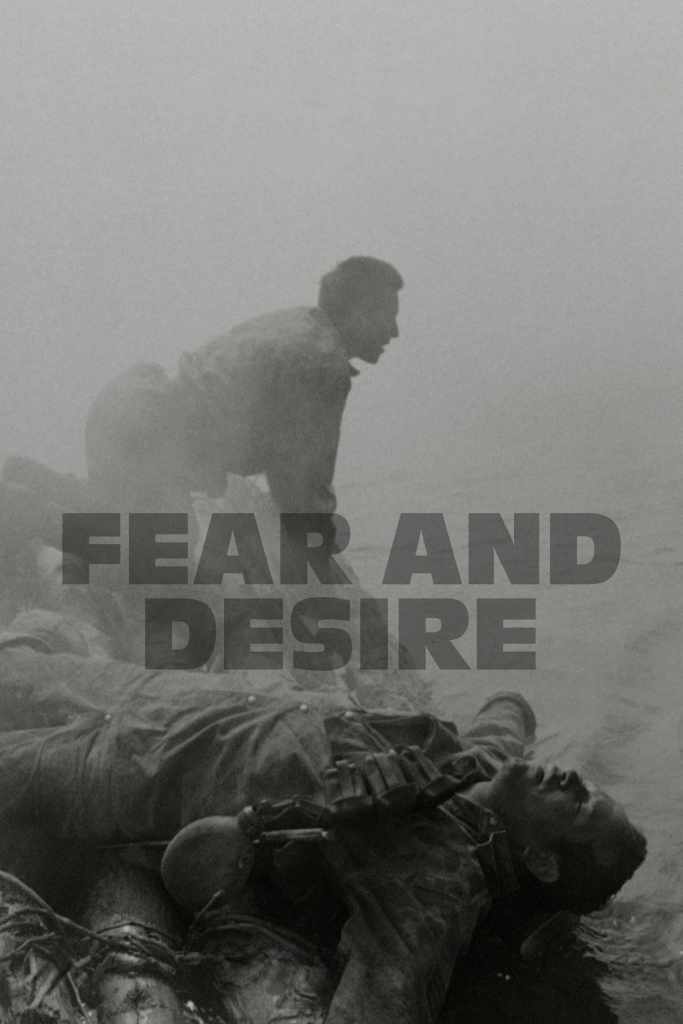
If only Stanley Kubrick knew how, decades later, his acolytes would give credence to his debut feature, when he thought the negative itself should be burned. “Fear and Desire” is a trade photographer’s exercise in the world of narrative film, and of not much value otherwise, were it not for the retrospective knowledge of what its creator would go on to do (and to a different degree its cast, including “Harry & Tonto” director Paul Mazursky in a key role).
Fear and Desire has come back to consciousness with the discovery of the Venice Film Festival cut, longer by a mythical 10 minutes.
OOO! I’d be lying if I said those 10 minutes didn’t make me more interested to see the film than I was initially. Kubrick (particularly “A Clockwork Orange”) was my childhood gateway to “cinema”, but I’d never seen Fear and Desire before. As a result, I watched what I got, which is the widely-available 60-minute version.

At the end of the day, we aren’t talking about “Caligula“: I don’t think 10 extra minutes will do anything to sway the movie one way or the other. Fear and Desire is too artsy to be commercial and without much else to sustain its hour-long running time, let alone an additional 10 minutes.
Plot-wise, its themes of dehumanization in the military are presented far more compellingly in “Full Metal Jacket”, of which Fear and Desire – in the place of Kubrick’s filmography – feels the most opportune for a re-do (character comparisons alone, there’s Mac & Animal Mother; Sidney & Gomer Pyle; and the Lieutenant & Joker). A pointedly-excellent intro – with narration laying out the story’s universality – segues to lots of wandering around in the woods, with characters pontificating either internally or externally about the follies of war and the choices a man makes, and a banal existence versus a glorious death, and blah blah blah. It’s all “student art film” stuff. You know the drill, and it hasn’t changed in 70-plus years either, apparently. Most of this monologuing comes courtesy of Frank Silvera’s Mac who – in my opinion – does the best acting of the ensemble with the material he’s given. Whether he, too, was obliged to do retakes into the hundreds like Tom Cruise in “Eyes Wide Shut” is lost to history.

But dialogue is a screenplay problem, and audiences don’t associate Kubrick with screenwriting & dialogue the same way they do with Quentin Tarantino or Paul Thomas Anderson. Visually, Fear and Desire’s framing isn’t distinct, but it is distinctly Kubrick in its love of sustained facial close-ups; and the few action sequences on-hand are edited quite well – at least enough to hide the production’s zero-budget (I’m reminded of Robert Rodriguez’s bio about the filming of his first film “El Mariachi”, where he would repeat shots of gunfire two or three times in editing to simulate rapid fire). Fear and Desire also cements Kubrick’s world as a ‘boy’s show’ from the very start, with Virginia Leith’s pretty peasant girl left to the mercy of the story in the same way Shelley Duvall’s sniveling wife was in “The Shining”: while the men all have complex portrayals, Leith’s histrionics mask a one-dimensional plot catalyst.

What was really garbage was the audio: it’s funny that Kubrick the Visual Guy would struggle with sound out-of-the-gate, and I’m not talking about Fear and Desire’s overbearing soundtrack. I’m talking about Kubrick’s glaringly-obvious use of ADR (automated dialogue replacement) – or, actors lines recorded after-the-fact and then played back over the footage like a kind of audio white-out, used sometimes if what was looped on the shooting day didn’t sound right. It felt to me like a good 50% of the dialogue in the film (not including voice-over narration) was not recorded at the same time as the footage, which impacted the representation of the performances. When Mazursky’s Sidney has his big mid-movie mental break, his lines are spoken plainly while his visual performance suggests more mania. Boiled-down, the audio sucks: not only the ADR quality and the bombastic, unsubtle music, but the “audio collage” in the film’s first ten minutes (the droning of the troop’s growing malaise as a time-lapse technique) sounds confused & poorly mixed, too.
That’s the Gen-Z take from a Gen-Y: the film sucks. And its director agrees with me, so nyah.
*
What do you think? Are the seeds of Kubrick’s interests as a filmmaker (the centered close-ups; the dissection of male camaraderie; emotionally over-simplistic female characters) enough to redeem a work that is, essentially, a trial run? Do you agree that Fear and Desire is pretty much unwatchable from the perspective of a contemporary, casual viewer; or do these damn ‘casuals’ have to go and ruin everything? There’s a reason for the comment box below: have at ‘er!
Poster sourced from themoviedb.org. Screenshots author-obtained. A free-to-view version of the film is available via archive.org.
 theory of a daskeman