Dub’s Take: Never Let Go (2024)

A spoiler-free mini movie review.


4 out of 5

For all the five-dollar words I throw around here, I don’t think I’ve used discourse yet. Interpreting ‘discourse’ – or, “the meaning that we apply to things” – was a huge component of my first-year art school syllabus, along with learning what a paintbrush & canvas are for. Duh.

Director Alexandre Aja’s cinematic discourse morphs between two categories: horror, for fans of his breakouts “Haute Tension” and 2006’s “The Hills Have Eyes”; contrasted by the modern fables “The 9th Life of Louis Drax” and “Horns”. “Never Let Go”, with its chapter cards and brothers Grimm references, falls squarely into the second camp. While its moral isn’t spelled out, I took it as not losing sight of one’s humanity, even in the face of insurmountable odds – whether those are real or imagined.

Never Let Go is brutal, starting its characters off in deep crisis instigated by decades of off-screen trauma. Halle Berry is a dependable actress playing an unreliable protagonist: the script is aware it can end only one of two ways (or the dreaded third), and plays with the possibilities from its outset. It’s a challenging narrative tightrope, made more disturbing by audacious scenes of child endangerment.

But the ‘ropes’ – despite not being physically long enough to be coherent – are a fascinating thematic snare, and the cinematic framing of the central woodland location and its inhabitants is stellar: the constituents of the forest, which may or may not be hallucinations, unveil their biological horror through the production’s expert use of darkness & shadow. While the story doesn’t conclude with a traditional twist, there’s an excellent wrench thrown in to the plot earlier than anticipated. Shame it opts for the third ending, though.

With regard to the two child stars, I can say from first-hand experience that managing child actors can be incredibly stressful, with the possibility of little reward. Sadly, as in life, children exist, and it’s relieving to say, then, that the two young men here who anchor the film do work that is unworthy of captiousness: they didn’t once take me out of the experience.

Never Let Go had me unsettled, angry, depressed, nervously laughing out-loud, bewildered, and ultimately mesmerized. Shouldn’t that be the discourse of good cinema?
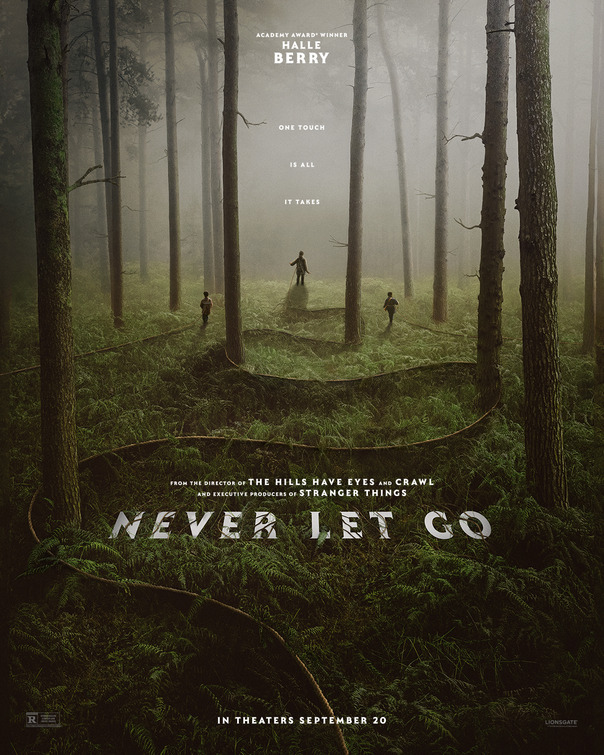

Poster sourced from impawards.com. What do you think? Are you a fan of Aja’s horror movies, his trilogy (at present) of contemporarily-set fairy tales, both, or neither? Do you think Halle Berry puts on a good show regardless of what she’s acting in, or do you think the choice of role reflects the actor and Berry’s inconsistent filmography speaks for itself? What’s your interpretation of “the dreaded third ending”? Leave your comments below!

Dub’s Take: The Front Room (2024)

A spoiler-free mini movie review.


2.5 out of 5

This was a weird one, but not in a Cronenberg way. Personal sidebar: a close friend wants to start going to church. This is not someone who myself, nor any of our mutual friends, thought they would do, but we support their decision. One suggested that they try out different denominations, because if it were up to my friend, they would just continue going to the closest church in walking distance for the sermons and leave at the worship. This particular church’s worship is singing, but it’s different with each and in turn the religion they promote.

While it would be easy for viewers without faith or theological interest to see the speaking-in-tongues and sacred treatment at play in “The Front Room” as ‘crazy’ behaviour, this dramatic revery is typical of Pentecostalism. However, the film doesn’t say this, and while a dichotomy could have existed between Brandy’s Belinda’s study of the Goddess versus the veneration of Kathryn Hunter’s Solange, the central conflict is very vanilla due to this lack of contextualization. On one end it’s problematic, as audiences on the outside shouldn’t be put in a situation where they assume the worst about a belief without all the facts.

On the other end, without seeing Solange as the enemy, there’s no conflict, and ergo no movie. And Front Room would be far different if it didn’t suggest a kind of spiritual deviancy at play, and just concentrated on Solange’s incontinence.

Yes, there is lots of poop and pee in the movie. Front Room seems content hopping genres so I wasn’t sure whether to take this ‘scatalogiquement’ seriously but – having cared for the elderly myself before – it’s no laughing matter when they’re in bed all day, refusing to wear a diaper & covered in C.diff. Front Room puts this front-and-centre, and I have to give props to a film that pans down to surprise diarrhea like Larry Clark to heavy petting, or that properly pays off a shot of a toilet in a care montage, or that brings out those rarely-used squishy sound effects. Speaking of cinematography, the film does look really nice overall, with a dinner scene that jumps the 180 rule most brazenly & a slow zoom-in to a mirror standing out the most.

But audiences will leave remembering the acting, the prominent theremin on the bizarre soundtrack, and the diarrhea.


Poster sourced from impawards.com. What do you think? Could an entertainment property exist in the West where religions with ‘extremist’ worship are given fair treatment (unlike the satire of “Four Lions”), or do you think it isn’t possible for sanitized North American audiences to look passed historical & current context with open-mindedness? Is it fair, then, to compare the far-right Christian beliefs presented in The Front Room with fanaticism? Have a stab at the comments below!

Dub’s Take: Deadpool and Wolverine (2024)

A spoiler-free mini movie review.


NO STAR RATING *

Actor-turned-filmmaker Viggo Mortensen says, “More and more…what passes for critical thinking in terms of reviews… having some understanding of film history, how movies are made—the level is really low. … It matters to me more…than as an actor because the fate of the movie…hangs in the balance as to how it’s received critically.”

On one hand I agree: modern accessibility in media production means that anyone with a passing interest in cinema & an opinion can produce a TikTok video, or free website (ditto), or novel-length Facebook post to showcase it. Film Criticism may be a category of Pulitzer, but Roger Ebert never bragged about his salary like Dan Bilzerian. On the other hand, even if I have the training (I’m a dropout), why would I want to apply Film Theory to a movie that doesn’t justify it?

I could not take one word of “Deadpool 3” seriously, to the extent I feel a shot-by-shot analysis is not necessary – nor do I think homaging “Intolerence” ever crossed the minds of Ryan Reynolds et al while they made it. I could be wrong, but you don’t get more High Concept than a superhero spoof: they’ve been making spoof movies for years, and Marvel needs one now more than ever.

But Deadpool 3 isn’t a spoof. This is a full-fledged Marvel Studios & Disney production, unlike its pre-merger forerunners. And – despite appearances from Jon Favreau’s Happy and the TVA, firmly mounting this instalment in the same canon – it’s so disconnected thematically from the rest, with it’s incessant fourth-wall breaking & non-sequitur humour, sickening violence (the fight in the Honda Odyssey), and litany of profanities, that I have trouble picturing the upcoming “Secret Wars” even using Deadpool at all, unless he’s toned-down by executive order.

Everyone else seems to love this one: “it’s just for fun, Warren”; “it’s some jokes & cameos, stop taking things so seriously.” I’m not a fan of Reynolds’ deadpan improv and that may be part of my problem. But I’m a fan of Hugh Jackman’s, and his appearance here screams a divorce-inspired desire for future financial security. One cameo was fantastic and another appeared stoned the whole time. As a motion picture, it looked, moved, and sounded fine.

No one cares what I think. Deadpool 3 and its box-office success is the contemporary poster-child of ‘critic-proof’.


*this is a reflection of my feelings towards the film’s posterity, and not the film itself. If I were to give D&W a star rating, it’d be a 1.

Poster sourced from impawards.com.

Dub’s Take: Alien Romulus (2024)

A spoiler-free mini movie review.


1 out of 5

The trailer for “Alien 7” supplied plenty of expectations: that it would be another hackneyed interpretation of a beloved franchise’s Greatest Hits from “Evil Dead 2013” director Fede Alvarez (News Flash: it is); that it would have yet another underdeveloped White female character as the lead – unrelated to the others – who grows from meek to mighty by the credits (it does); and that it would favour fan service & exponential antecedence (not just one Facehugger, but a bushel!) over action scenes that last longer than a finger snap, and taking narrative risks like predecessors “Prometheus” & “Covenant” (you betcha).

But never in my wildest dreams could I have predicted what Fede did here with the teased returning (and deceased) legacy actor, brought back with the help of computers (and I’m sure a healthy donation to their late estate) only to serve as a literal talking head, “Futurama”-style. Even after running through all the major players from all six prior Alien movies in my head to guess who it could have been, I never considered the one it ended up being.

However, the real sin of this decision – aside from its contemptuousness – is that, without knocking David Jonsson’s turn as resident ‘synthetic’ Andy, Alvarez missed a huge opportunity in not bringing back Michael Fassbender’s David. The ‘black goo’ from Covenant plays such a crucial part of the story here that this one casting change could have given fans a cross-generational interpolation of both eras of the franchise, as well as a proper placeholder for the true “Covenant” sequel we never got.

Optimism-bias aside, I found Romulus boring. It’s such a pastiche of the prior films that it has no identity of its own, even copying its finale from “Resurrection”. Cailee Spaeny’s heroine Rain is another identical sibling to Katherine Waterston & Noomi Rapace, and just as superficial. New ideas – such as the cocoon sack and Facehugger evasion tactics – are invalidated by the movie’s nonsensical timeline (when did it make the cocoon?) and continuity cock-ups (the Facehugger swarm disappears from one shot to another). And the best summation of the film’s lack of action is that there’s an entire sequence inspired by the Sentry Gun from the inferior, meandering Special Edition of “Aliens”.

Romulus is short on thrills and heavy on dead, reanimated actors. Forget John Krasinski’s Rogers ad: AI will be replacing all y’all soon enough.


Poster sourced from impawards.com. What do you think? Were you baptized into Alien series snobbery by one of your parents, too? Do you hold out hope for Noah Hawley’s upcoming Alien TV series, even though I thought his “Fargo” show fizzled-out with that time-jump halfway through its first season? Have you also seen the first Alien film an excessive amount of times that you never want to see it again? Let us know in the comments, why don’cha?

Dub’s Take: Horizon Chapter 1 (2024)

A spoiler-free mini movie review.


3.5 out of 5

In a 2022 interview, actress Emily Blunt said she’s tired of being offered roles for “strong female leads”: “I’m already out. I’m bored. … you spend the whole time acting tough and saying tough things.”

Blunt is not a candidate for a place in Kevin Costner’s Wild West, where the women hold themselves together in the face of relentless adversity. Of the major players in this, the first part of a planned four-part series, Sienna Miller, Jena Malone, and Abbey Lee leave the greatest acting impressions, even if the film’s three-hour runtime still manages to omit information about their backstories.

The greatest strength, then, of “Horizon Chapter/Part 1” was that I was OK with my questions going unanswered until the next film, or not at all. There’s a “flying by the seat of your pants” quality to the narrative, whereby Costner plunks us in the middle of a juicy patch of land in contentious Aboriginal territory, and lets the plot play itself out. In a way, it’s the perfect continuation of “Dances With Wolves”: there, Kevin rode off mid-mission only for a titlecard to inform viewers that the Indigenous genocide continued unabated. Here, the antagonistic Apaches are represented as a dwindling, dissented tribe, holed-up in the mountains, waiting for fate’s intervention.

In my review for Costner’s 2003 feature “Open Range”, I said it lacked the “Costner Factor”, likely due to a critically-induced restraint. By the Costner Factor, I’m referring to the audacity he shows by having his self-acted characters save women and dogs from drowning, fish dead bucks out of water, and drink their own piss. Say what you want about Kevin’s acting, but he’s fearless as a producer.

Here, Costner’s discipline could be laid at his 69 years, but he still frames shots in the curvature of a prostitute’s bust, gets laid even when his character doesn’t want it, and orchestrates at least two of the tensest scenes of encroaching violence outside of a horror film.

“Yellowstone” was good for about three seasons, coincidentally the number Costner was originally contracted for, but I stopped watching the latest when it was clear the show was spinning its wheels in the writers room. Horizon may be taking its sweet time in this first chapter, but I trust Costner more than Taylor Sheridan to carry me over the finish line.


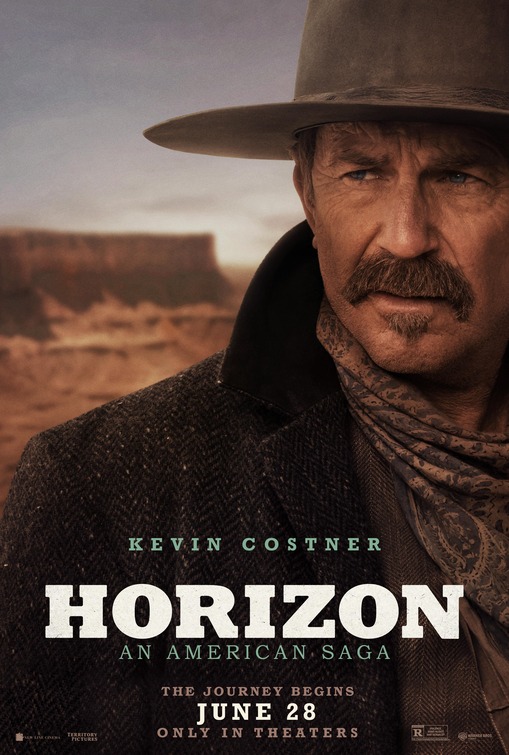
Poster sourced from impawards.com. What do you think? Did you, too, think the “wagon trail” story – despite the promising ensemble of Luke Wilson, Will Patton, and Isabelle Fuhrman – is perfunctory in the face of the ultimate wagon trail simulator that is Taylor Sheridan’s “1883” (even if it was basically garbage)? How many takes of the “boob shot” did Kevin have to do before he got it “just right”? Was it necessary for Costner to use his kid in a short role, only for all the news reports about it to highlight that Kevin “went hard” directing him? Leave your comments below!