Dub’s Take: Godzilla x Kong (2024)

A spoiler-free mini movie review.


I think we’ve confidently reached the point where the “kaiju” in a Godzilla movie can easily hijack the film from its human cast. Never was I more malaise-stricken than during the live-action scenes in “Godzilla x Kong”, where capable actors who put in a good performance every time regardless of pay or cast heading (like Rebecca Hall or Brian Tyree Henry) couldn’t save their loquacious appearances from making-plain the techno-babble that rationalizes the film’s monsters & their “world”, in a language understood by us surface-dwellers.

Who cares? Aside from the parallels between the little deaf tribal girl “who holds the key” and all the non-verbal grunting going on between the titans, scenes with dialogue are quickly shoved under the bed when the Big Boys start stomping around.

These action scenes, with decent special-effects even five movies on, are antithetical to those in the recent “Dune 2”: fights have a beginning, middle, and end, without cutaways; they’re generally framed in-full so viewers can see the blows and their consequences; and they weren’t finely-minced in the editing room. The broad stokes of the production design also seem to have some thought put into it: there’s good squish when Godzilla heat-beams into another beast’s mouth; a bridge of bones over a river of lava; a “mini-Kong” that plays like Gollum to King Kong’s Frodo; and the gangly movements of an “evil-Kong” that recalls the uninhibitedness of Mark Hamill’s Joker from the nineties’ “Batman” animated series.

But it’s all still not very original, isn’t it? How many more of these “Monsterverse” movies (and by extension TV series’) are we going to get before audiences get sick of them, or their diminished budgets start to affect what we see on screen, or are remade again? And while the wider design is fun, the details could have used some work: in the climax, the Great Pyramids seem to get destroyed three times over and yet are still standing in the background by the end of the scene. Considering the work that looks like went to the rest of the picture, that’s a big oversight. Doesn’t change that I was entertained.

2.5 out of 5

Poster sourced from impawards.com. What do you think? Are you a Legendary, or even a Toho, “Monsterverse” fan? Do you think all this talk of “Hollow Earth” dilutes these movies, or is it the most believable alternative to the titans being products of nuclear testing, or extra-terrestrials? Do we even “need” an explanation? And why do audiences seem so concerned with the number of civilian casualties in a superhero movie when even the friendly kaiju seem to take out thousands here (and yes, I know from the “Monarch” show that there’s an Amber Alert in place)? Leave a comment below!

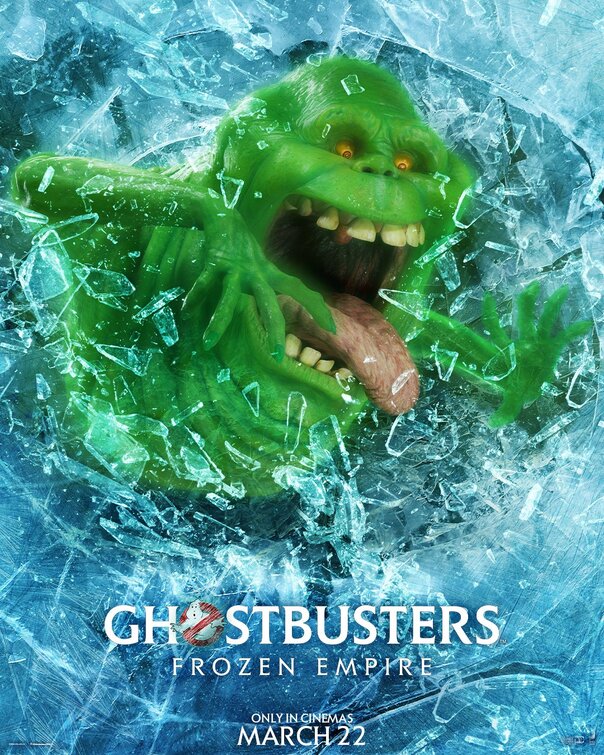
Dub’s Take: Ghostbusters Frozen Empire (2024)

A spoiler-free mini movie review.


I’m not a “Ghostbusters” fan. The first film was not in my childhood rotation, although it was a clever idea that could have only come from the renaissance of ’80s cinema. I did see “Ghostbusters: Afterlife” (2021), but I don’t agree with bringing dead actors back digitally, so I thought the ending was a cheap excuse to wring a wet rag of nostalgia over viewers’ heads. We saw the cast we wanted back (sans Rick Moranis) plus the Ectomobile & proton packs, and the script regurgitated all the flashy pseudo-science that made the first film’s screenwriters Dan Aykroyd & the late Harold Ramis giddy in ’84. And since it made money, now we have ANOTHER ONE.

For the first 75 minutes of “Ghostbusters: Frozen Empire”, you’d be forgiven for thinking it’s a John Cassavetes picture: there’s minimal “busting”; a girl-crush with a ghost; quick flashes of what the old crew is up to; the tribulations of new, inexperienced management taking over an old, established operation; and, ultimately, the triumphant bureaucracy of William Atherton’s Walter Peck. After the small-scale atavism of the last instalment, the only thing producers had to do in this sequel was up the stakes. Yet, so little of consequence actually happens in the first hour-and-a-bit of “Ghostbusters 5” that it feels more like melodrama than the supernatural action-comedy team-up throwback it should be. It’s boring.

It all segues to a big finale that is heavily-spoiled in the trailers. All the new & old actors show up for the one camera shot audiences are all expecting (in uniform walking toward the camera in slow-motion), but the final fight takes place inside the cramped studio corridors of a firehouse when they should be outside in, you know, the world of ice (I thought it was cheaper to shoot against a green screen)? And when our heroes exit to their adoring public in the epilogue, the old actors mysteriously disappear. The final half-hour smells so foul of behind-the-scenes scheduling coordination, and contract negotiation, and cost-saving measures, that its equivalent would be watching a dramatization of the film’s accounting spreadsheet.

Maybe this is all you want out of another Ghostbusters sequel: to see everyone again, one last time. And if they make another one again, then maybe you’ll get to see them all one last time again, forgetting of course we’ve already been through this a few times already. But I’m done with busting. Not that busting ever made me feel good.

1 out of 5

Poster sourced from impawards.com. What do you think? Am I being overly critical? Do I need to chill out more and appreciate that Paul Rudd can turn in a consistent, median-emotion performance whenever he wants? Would you be as awkward as Finn Wolfhard looks in the pre-show interview sitting next to a blond, long-haired Mckenna Grace? Leave a comment down below!

Dub’s Take: Late Night with the Devil (2023)

A spoiler-free mini movie review.


Actor David Dastmalchian is an odd duck. He has a long face weighed down by the pressures his characters carry and the secrets & desires they harbour. Even when his role selection leans toward weirdos & villains (Polka-Dot Man in James Gunn’s “The Suicide Squad”; Piter in “Dune” (2021); Murdoch on TV’s “MacGyver” revival), Dastmalchian’s work sidesteps mockery for sympathy.

David’s casting as a talk show host in “Late Night with the Devil” is inspired, in one of the most “normal” portraitures that I’ve seen out his filmography. However, I think directors the Cairnes brothers do their lead a disservice by making David’s Jack Delroy a Carson competitor, placing the character in the same pantheon as contemporaries Leno & Letterman. Dastmalchian’s subdued Delroy would have played better as a Charlie Rose/ Dick Cavett type, even if that meant no additional texture in the form of a studio audience. I won’t say David’s Delroy is uncharismatic, but maybe a little too first-season Springer for the subject matter (the character deliberately transitioned his show to tabloid trash for ratings, so more cockiness would have played to that).

As someone who enjoys “lo-fi” vaporwave, “Late Night” was an aesthetic feast, with visuals mimicking live television from the 1970s, the on-stage orchestra with its oboes & saxophones, and crusty title-cards. In-between these moments of found-footage were black & white “behind-the-scenes” takes that are framed perhaps too much like a movie and took away from the purity of the “live” footage. Other details – such as the stoic Cavendish ad-reps sitting in the front row, or the boom-mic dipping into shots – counterbalanced the pretence of authenticity.

Does the film succeed as horror? I would say it succeeds at constantly-mounting dread: Ingrid Torelli as Delroy’s young, demon-possessed guest is incredibly cute & effectively spooky, and there’s a brilliant (and earned) sequence involving worms that plays with audience perspective. As far as the ending, it could have gone a number of different ways but I was not disappointed with what the filmmakers chose narratively: only underwhelmed by the out-of-place CGI work and abrupt aspect-ratio change (although it was a very cool creature design in the climax).

Overall, Late Night is effective in healthy fits-and-bursts, it’s a transient 90-minutes-long, and may play better via home streaming than in theatres.

2.5 out of 5

Poster sourced from impawards.com. What do you think? Much like an evil djinn, do you think you need to be very specific when making a deal with the Devil? Wasn’t Ian Bliss’ substitute for the late James Randi a pretty money enactment? What’s your favourite David Dastmalchian role? Do you agree with the Matt Zoller Seitz review that says the film would have been more effective had they left out the documentary-style preamble? Leave a comment below!

Dub’s Take: Ordinary Angels (2024)

A spoiler-free mini movie review.


An uplifting, faith-based drama, with the religious rhetoric dialed way down; and believable performances from a multigenerational cast? Who knew?

At a breezy two hours, “Ordinary Angels” makes for an above-average date night, with some tears; some smiles; some “are you kidding me’s”; and sincere characters making choices based on compassion alone. It’s recommended, despite being completely predictable.

Some notes: Amy Acker should be rescinding the gift basket for her agent. The actress who so-effectively played Root on TV’s “Person Of Interest” has a starring credit as Alan Ritchson’s terminally-ill wife, but only shows up for five minutes right at the start before she dies – we only see her again in photographs. I found this disappointing, because Ritchson – who we know from Amazon’s “Reacher” series – is really good here, but a bit stiff in the prologue with Acker.

What I wanted were more flashbacks between the two, so I’d know if the walls Ritchson put up around his character were maintained consistently with his screen-wife (which would tell viewers either he was always the stoic everyman – even when she was alive – or he was a total suck around his wife when she was living). Even though such a scene never materialized, and his relationship with Hilary Swank’s Sharon remained platonic throughout, Ritchson is still credible as a father willing to do anything for his daughters.

Meanwhile, Swank is as reliable as ever. Regardless of how you feel about “awards”, she’s still won two Oscars and is an intense, committed actress – though not necessarily the first person you think of as a philanthropic hairdresser. Her Sharon Stevens is perpetually propelled forward by an unencumbered desire to help Ritchson’s family and less by the regrets of her own life, though she does have one or two things she is willing to share. Once you get used to the lack of a deep, dark history, Swank as Stevens is the rock that keeps the film from flying away on the wings of apathetic humanitarianism.

Also nice was the film’s excellent use of REM’s “Losing My Religion”. In fact, I’d wager to say it’s so well used here, that the scene it plays over sheds light on Michael Stipe’s otherwise-inscrutable lyrics. Good choices all-around!

4 out of 5

Poster sourced from impawards.com. What do you think? Will you be watching this anytime soon? Are you wondering why I would give this a 4 out of 5 when “Dune 2” only got 1.5? Do you think there is more merit to the aesthetics of modern cinema as opposed to small-scale, done-to-death inspirational stories; or should critics continue to respect the basics of the medium like acting, dialogues, and direction? Comment down below!

Dub’s Take: Dune Part Two (2024)

A spoiler-free mini movie review.


“Dune: Part 2” is the poster-child for “anti-climactic”, in ways other than it being the middle-child of a trilogy. There were fleeting moments when I really thought director Denis Villeneuve had pulled it off (finally), such as Jessica drinking the Water Of Life, or Paul breaking a sandworm. But these sequences of visual & auditory awe are constantly at odds with Villeneuve’s unrestrained desire to cut away from the action, and bring the audience back to the small-scale drama of its core characters: a drama by its very prophetic nature tensionless.

All of what I liked and didn’t about the prequel is back in-force: it’s well framed & shot, but its production design is too distilled for a Strange New World; Hans Zimmer’s soundtrack is campy and borderline plagiaristic of the music from the 1984 movie; and Timothée Chalamet’s “Paul Muad’dib Usul Atreides, Duke of Arrakis” is a blank slate of whiny flippy-flop onto whom the audience can vicariously live out the experience (although credit goes to Timothy’s fight double, who does a pretty-sweet triple roll off Feyd-Rautha in the climax).

This round, however, Villeneuve refuses to allow his action scenes the same breathing room he gives the human story. Yes, there are breathtaking individual shots of the conflict, but no magnifying glass brought up to it. The spectacle is only present long enough for viewers to recognize it as the canvas in which the drama is played out, but not long enough for it to be felt emotionally at the same extent Villeneuve treats the dialogues. Like the prequel, the scope that the story insinuates is lost in favour of the myopic problems of its celebrity actors. For a three-hour, $200-million movie in this day and age, audiences should demand more.

As much as I’m a softie for the ’84 adaptation, I’m the first to admit its patchwork second half (which was never properly finished) is probably not a good representation of the first Dune novel’s denouement. Here, Villeneuve had a limitless opportunity – financially & corporately – to actually conclude some of the story without struggling to condense too much one deemed “narratively important” into a studio-mandated running time. Instead, we got Frank Herbert as sifted through Denis’s litter box.

1.5 out of 5

Poster sourced from impawards.com. What do you think? Are you just looking for eye-candy the same way the theatre full of seniors at my IMAX screening were? Are you sort-of, kind-of interested to see what happens in “Dune Part 3”, considering the only other adaptations were the Sci-Fi Channel miniseries’ from the early 2000s? Did you also get big “Star Child” vibes when Paul talked to his sister? Comment down below!