some days, most without even trying, i take the easy way out:
i get stuck in my thoughts and spin out of control not even paying attention
and soon i’m on my knees in the kitchen hunched over trying to differentiate between months-old droppings and fragments of plastic cheese from the bag of Tex-Mex i just dropped on the floor
because i would rather simply be trying to do nothing at all just laying on the couch but thinking, dreaming, praying of being somewhere else, anywhere, in another dimension, off there somewhere where exists what could have happened –
i’ll have the news on to catch the top stories but after a few minutes it’s purposeless – they’re all the same bullet points from yesterday through a perspection of passing time:
some people died and one famous about to; displaced persons from a camp removal; one’s a terrorist about to be tried; another one biding to be penalized; global warming at an all-time high; random attacks on the rise; car pile-up on the ninety-nine…
by then all i feel is empty inside: it sounds like a Saturday night of gaming than a generation’s place in humankind. i put a CD i’ve heard a thousand times in the drive that doesn’t come standard with new models of that type, because i’d rather hear Morrissey whine than to face my own materiality of being alive.
when my world ends, i don’t want it to be from a shot to the head or an environment that kills me in earnestness or even just peacefully laying in bed:
There is something to be said for texture. You could have the most formulaic theme – like “the ex-super-soldier with a heart of gold” – and innovate it with unconventional dialogue, design, and direction, so long as it’s in service to the movie at-large. Screenwriter Kurt Wimmer’s latest crucible has so much texture that it’s a deliriously overcomplicated melting pot, with flavours of your January-variety Jason Statham release, a pseudo-political conspiracy thriller, a cautionary tale on fake virus alerts (really), and a parable about dispirited parenting, all under high-concept control from David Ayer.
The film derives the majority of its thrills from tense scenes of idiots in rooms minimizing the shit-storm they’re in with Statham’s anonymous vigilante. Ayer convincingly propulses the plot in these ‘quiet’ moments, and “Hunger Games” alum Josh Hutcherson puts his best foot forward as the film’s primary antagonist.
But we’re here for the boom-boom – as showcased in the film’s persuasive trailers, where Statham’s “1 2 3” gassing initially concluded that “The Beekeeper” would be a ratty good time in a month known for disenfranchised movie releases. Statham does indeed kill his way through baddies of increasing eccentricity, and the turbulent editing that dominated the theatrical version of Ayer’s “Suicide Squad” is gone here: every shot of Statham kicking a dude in the face is held just long enough for its impact to be felt by the viewer.
Bottom line: you already saw most of the boom-boom in the trailers. Slower moments – including an implied romantic history & a family connection, which serve as beleaguering texture – could have been cut for pacing. The increasing tiers of henchmen feel too much like boss encounters in a video game. And the climax – infiltrating a party at the evil guy’s mansion – is depressingly doddering & ends abruptly, without any real show-stopping confrontation to close the movie on. Disregarding those cons, it was an excellent watch as part of the Canadian $5 February deal at Cineplex.
3 out of 5
Movie poster sourced from impawards.com. Have you seen “The Beekeeper” yet? Would you if the ticket was only five bucks? Are you a connoisseur of other fine Jason Statham January fare like “Wild Card”, “The Mechanic”, or “Parker”? Are you disappointed when people talk about Jennifer Lopez’s acting career and no one mentions “Blood and Wine”? Leave a comment below!
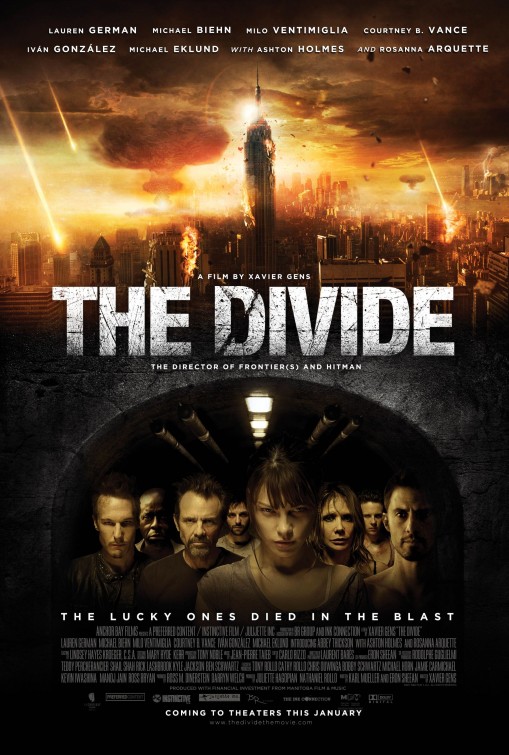
Anyone who wanted less optimism in Netflix’s recent movie “The Furnace” may find the nihilism they’re looking for in “The Divide”. Director Xavier Gens is best known to American audiences for the first “Hitman” adaptation with Timothy Olyphant, but his “Frontier(s)” from the same year is his eminent opus: an ultra-violent allegory about civil unrest in France. The Divide shares commonalities with Frontiers, including subject matter about each person’s “breaking point”, and a remake of its head-shaving scene. Know then that The Divide is not a “happy” movie, though thankfully nowhere near as unwatchable for a general adult audience.
It’s true that not everyone wants to watch a depressing movie these days, despite an influx of downbeat titles on the market – most inspired by current events. I myself am not an optimist and enjoy the occasional morbid movie for escapism. By the same measure, I also want the film to have some other purpose for being – beyond pure cruelty – to not make the whole experience a big waste of time. The Divide locks the viewer in and makes them want to know what happens, which is the greatest compliment I can give it.
It is by no means perfect. Some of its best ideas – such as the ultimate reveal of the third-act villains – come too late in the film. It has a mish-mosh cast, with unrestrained, melodramatic performances by Michael Biehn & Rosanna Arquette. There’s a left-field event a half-hour in that should change the dynamic of the entire film, but left-minded viewers will be disappointed that it never goes back to it when it’s over. And it could have had a tighter second act without diluting the material. Having said all that, it was still compelling, and generated some good discussion between my wife & myself afterward. I wouldn’t ever watch it again.
3 out of 5
Poster sourced from impawards.com. What do you think? Are you the kind of viewer who stays away from thematically half-empty media, or do you like to be challenged in this day & age? That line-dancing scene in The Furnace was money though, am I right? Do you agree with Tarantino when he says a great movie can “own” its use of a song? Let me know your thoughts below!
“A dead egoist is sentenced to Hell and, in one all-in effort, tries to send a message of support to the family he left behind. It doesn’t end well, not that it would.”
Lukas Hassic was an asshole in life, and when he died, he went to Hell. One afternoon, when he was all by himself, he suffered a massive heart attack in his office gym. A soothing voice recited affirmations from his portable speaker, as he lay on his back on the cold hardwood floor next to his weight bench, exacerbating the chills he felt through the sweat that had seeped through his t-shirt.
It was not Luke’s intention to damn his soul – so could say anyone – and his first thoughts out-loud in front of Saint Peter weren’t to ask of the wife and two children left behind in his wake, but why he needed to be reviewed for entry at all. He hooted & hollered and raised a stink at the front of the line before the closed doors of Heaven and its gatekeeper, making sure everyone behind him could hear: he prayed every night with his family; he made sure to work hard in his thirty-four years of painting homes for a corporation; he consciously attempted to remain nonjudgmental, pushing up the people around him; and he canvassed every year for Jeans Day. There was more, but it just didn’t make any sense to him why there was any question he shouldn’t be sanctified.
Lately, Peter had been binging “Judy Justice” on Paradise’s on-demand service – which contained every episode of every court show ever – and he was curt and to-the-point with Luke: he was fake.
“Well that’s not fair.”
“Be quiet! I’m speaking!” The ground in the four-feet around them began to shake under the tremor of Peter’s voice. As quickly as they were needed, flashes of moments Luke had fogged with his own narcissism played before him as clearly as if they had just happened: moments that, when they are reflected on for what they are, temporarily break a man’s defences in their afterglow.
The brief silence that followed was disrupted by Peter, who enjoyed the privilege of calling Luke “a piece of shit” without repercussion, said goodbye, and then pulled a wooden lever to his side that disappeared into the clouds underneath him, triggering a mechanical system which opened a trap door beneath where the answerable stood, sending Luke plummeting towards the depths of the non-denominational Underworld, where the likes of Adolph Hitler, Robert Pickton, and the child molester down the street from you, all reside.




 theory of a daskeman