or, “Buying-In to the Confusion”: A spoiler-free mini movie review.
3 out of 5
While my wife would call me a “gamer”, I don’t clock nearly as many hours as when I was a kid: life gets in the way. So when I do play, it’s almost exclusively ‘arcade-style’ games that I can disconnect from quickly – physically & mentally – and there must be a Pause button.
Though I can’t attest, “Until Dawn” seems regarded as one of the premier, Western-made, story-driven video games of the previous console generation: a group of disposable teens trying to survive a throng of wendigos, with a branching narrative based on player interaction. “Until Dawn: The Movie” swaps out the choose-your-own-adventure input for a “Groundhog Day” esque time-loop, with some other surprises meant to mimic the discovery a player would get from the game.
My surprise was palpable. Though lacking the original’s star-power (which featured Rami Malek & Hayden Panettiere), the movie’s twenty-something players do a convincing job and, tonically, all five are spotlighted equally throughout the script. The savagery is effective, including a show-stopping water tower sequence & a close-up of a crushed face that gave me “Irréversible” flashbacks. The dialogue isn’t bad either, often breaking the fourth-wall to cheekily address the core plot’s uninspiredness, or the suicidal inclinations of its protagonists to reset the loop & try again.
or, “Doing Away with the Chiller in the Thriller”: A spoiler-free mini movie review.
2 out of 5
I remember the trailer for Conclave last autumn, and I didn’t want to see it then, either.
Between the super-serious ensemble of Ralph Fiennes, John Lithgow, and Stanley Tucci all speaking in soft whispers; to the frequent high-angle framing of old White men in robes walking briskly through courtyards; to the punctuated explosion, it simply did not look like a good time. It looked like someone, somewhere was trying too hard.
Lo-and-behold, Conclave’s advertising & creative choices are misrepresentational – this isn’t a nail-biter: it’s a procedural about what happens when the Pope dies, and finding the right person to replace them.
The subject matter at-large joins The Program & The International as a movie with a rich topic worth edu-telling the viewer. But here, that knowledge is at the expense of wasting my time! (with an overdramatized aesthetic suggesting a core mystery that doesn’t actually exist)
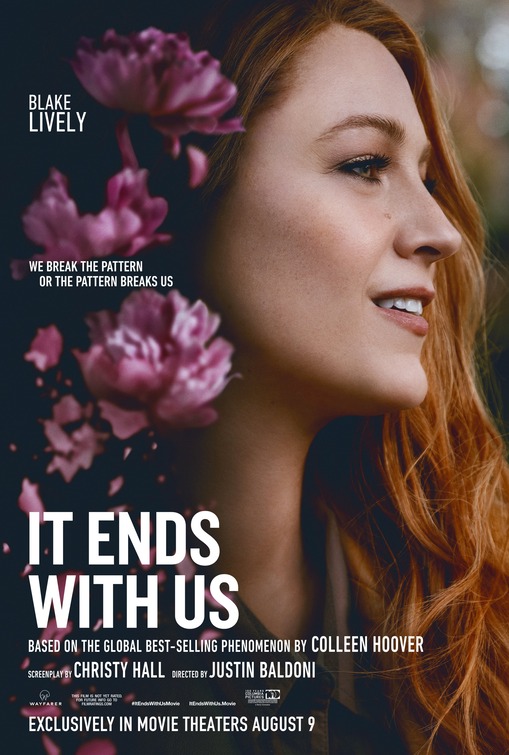
You are forgiven for thinking “It Ends With Us” (aka. IEWU) is an ‘important’ movie, what with all the rigamarole behind its scenes. Trust me to tell you like it is, and IEWU did not end soon enough.
Lion’s share of blame is awarded to director/star Justin Baldoni, and not for the same reasons as his now-mangled future career prospects: long passages are staged & shot flatly like community theatre, with a never-ending rooftop meet-cute beheading the pacing right out of the gate; line-readings recall Hulu’s “The Handmaid’s Tale,” built on plot reaction rather than action; and Blake Lively’s Lily Bloom is fitted into tight, sexy tops that certainly made me envious of her current beau Ryan Reynolds, but are a betrayal of the self-taught defences of her character on-screen.
Original author Colleen Hoover ain’t no saint neither, and IEWU’s greatest fault is its disingenuous take on domestic violence. These handful of scenes are told with an unreliable presentation, tricking the audience into wondering whether Baldoni’s toxic neurosurgeon Ryle isn’t such a bad guy… until the contemptuous slow-motion reveal in the third-act spells it out.
It’s hard to say whether IEWU would have benefitted from an unflinching eye opposed to the choppy PG-13 implications we got here instead. What’s crystal-clear, however, is both leads’ reverse dramatic-irony that would be overanalyzed in literary form (such as Ryle’s shoulder-shrugging in the climax) lands here with a thud because of the meandering cinematic handling of the core narrative. The hot & heavy courting Lily puts Ryle through is starkly contrasted to how easily triggered she is, despite his adamance of love, and neither’s behaviour is ever studied beyond its broad strokes.
This isn’t to fault Lively’s performance, which is about as good as the material will allow, but I only ever had empathy for Amy Morton’s underused Mama Bloom. Certain people in life continue to make poor choices despite being compulsively aware of the signs, but a romance centered around these otherwise well-educated, well-intentioned one-percenters who all run their own businesses is perhaps the wrong podium.
It Ends With Us is an overlong message movie that fails in its amateur, sanitized telling. Only you, the potential viewer, know whether you would have paid full price to see this in theatres. At what point can I walk out and still get a refund?
Poster sourced from impawards.com.What do you think? Keeping up with all the drama, I was expecting an oral sex scene after Lively’s lawsuit mentioned that Baldoni wanted more, only to find there wasn’t any simulated sex in the movie at all. Are you telling me that Justin wanted an oral sex scene just because? Does its feuding leads impact your impressions of the film itself? Are you like me, and the drama is the reason you decided to watch it in the first place? Let us know in the comments below!
“The Wild Robot” was emotionally touching enough to earn my tears: that alone is worth a minimum star rating. But I thought I would be getting a wholesome, feel-good family film for general audiences, without any intercalated adult ‘baggage’ – would you believe producers found a way to sexualize one of the villains here, too? But I don’t have the word count to go over everything.
I cannot stress this enough: Wild Robot contains a vast amount of dialogue about death & dying, played mostly for laughs. Characters commiserate whether or not they’re about to croak on a minute-to-minute basis. A family of possums ask if they’ll be “murdered” before one of them is killed off-screen. For my 36-year-old self, it was extremely noticeable.
Sidebar: back in grade school, I wrote a play for a class Christmas concert. My first draft was rejected because the teacher didn’t like the bad guy telling the good guys he was going to “kill” them. But one of my favourite Xmas movies is “Home Alone”, and they spoke similarly in that movie, didn’t they? Worse, even: Joe Pesci says he’s going to bite Macaulay Culkin’s fingers off, and it was rated PG.
Obviously Home Alone isn’t germane to that teacher’s holiday movie marathon, but the real takeaway was that every parent has a different idea of what’s appropriate for their child and what isn’t – in their experience/opinion. I understand that Wild Robot’s story transpires in the untamed outdoors, and that finding your place in the circle of life – how & while you can – is a theme of the film, but there’s a difference between an effective implication of danger versus the definitiveness of death.
The only reason to keep regurgitating something in scripted lines is to underline to the audience how important it is. Today’s prepubescents can’t be so uneducated that a nice family movie already containing potent scenes of peril should have to push nonexistence to the front of their consciousness, too. Certainly the film’s trailers didn’t foreshadow it.
Wild Robot has one shot where the heroes are looking for survivors of a snowstorm, and silently, it conveys that what they found isn’t good. It’s less than ten whole seconds, but does a better job of communicating grief to an impressionable group, without forcing anything, than the other 90 minutes do. A shame, that.
Poster sourced from impawards.com. What do you think? Imagine this scenario: you have two family movies (not Wild Robot). Both movies have a main character die off-screen, and both will inevitably inspire a difficult conversation between (a) parent(s) & their child(ren). In one movie, the death is constantly referred to non-stop in the dialogue after it happens, reinforcing that this person is no longer around. The other movie implies the other characters’ sorrow & grief through facial expressions & behaviour, though their true, vocalized emotion is ultimately left up to audience interpretation. Which movie would you rather have incited the conversation with your child? Let’s talk in the comments below.
“The Crow 2024” is metal: something I don’t think anyone expected.
Director Rupert Sanders doesn’t have a prolific filmmaking career, but he did helm 2017’s live-action “Ghost in the Shell”, which wasn’t terrible, and his Crow reboot isn’t terrible either, despite taking two years after shooting to show up in theatres.
Delays like that could mean all sorts of things, usually negative: a lack of faith behind-the-scenes from the people with the money. Howbeit this is odd, since Crow – which started out as a comic series in the late-eighties – has bounced back a few times in media from the tragedy of Brandon Lee’s death while filming the first film adaptation.
How much of the property’s enduring popularity, then, can be attributed to the singular act of Lee’s passing, or the straightforward immediacy of the source material? Rewatching the 1994 film, I was taken aback by how out-of-place its comedic relief resonated – particularly in the pawn shop scene – at the expense of thematic consistency. I’ve never read the comic so correct me if I’m wrong, but those one-liners felt more like additions to coalesce with the Lee family idiom * than to move the plot forward in a congruent way.
In complete contrast, 2024’s Crow doesn’t have any tonal brevity: it’s as emo as the tattoos on Bill Skarsgård’s face, and that could be one piece to its ultimate box-office demise. The film is so committed to its core concept that there’s hardly any fun to be had for passive viewers.
If you can roll with that, Crow is as much solid, stand-alone, yet disposable entertainment as “Madame Web” was back in February: I submitted to Skarsgård’s charisma; the reliable Danny Huston as the antagonist; the script’s spiritual leanings; and the central romance with a convincing FKA twigs. Holding it back from first-class territory were a truncated courting montage – which could have been longer to increase my empathy for the heroes – and some lame CGI in the finale that made me long for the classic squib work of someone like Paul Verhoeven.
In the film, twigs calls Skarsgård “brilliantly broken”, and I believed it. It’s a testament, then, to everyone’s craft that The Crow’s sixth outing to the screen (including the TV series) didn’t end up as another wounded bird.
*see my review of Brandon’s “Rapid Fire” for supplementary impressions.
Poster sourced from impawards.com. Did you know that you can click on the posters in my recent reviews to link directly to the film’s IMDB page? Wicked Cool, and saves you from typing! Leave your suggestions for other unavailing accessibility options for the site in the comments below!




 theory of a daskeman