A spoiler-free mini movie review.
1 out of 5
Watching “The Unbreakable Boy” (aka. UB) reminded me of Ben Stiller’s 2008 comedy “Tropic Thunder”, and Robert Downey Jr’s immortal words: “Never go full retard.”
Vulgarity aside, RDJ’s line signified that actors playing overly-challenged characters weren’t likely to win audience recognition. In the Real World, compassion is everything.
That being said, and with all due respect to real-life autistic/brittle-bone sufferer Austin LeRette (“Auz-Man”), the lisping imitation from actor Jacob Laval is so off-putting – transcending ‘cute’ into piteousness – that I couldn’t set aside my disbelief.
‘Uplifting’ genre flicks like this inspire pre-viewing expectations: maybe some bullying; some falling down stairs (like in Shyamalan’s “Unbreakable”)… I will give it to director Jon Gunn that he knows how to film scenes of bones breaking, as my wife & I both flinched at each mini-disaster and ones in-waiting.
But the third-act bullying is where I was done, and not because it was too cruel. Whether-or-not how the sequence plays out on-screen is actually what transpired between Auz-Man’s older brother Logan & the school bully ‘who became one of his best friends,’ it is the soppiest, most untenable bit of Hallmark reality ever. Logan should have just kicked the shit out of him and been done with it.
Laval’s representation of Auz-Man is dwarfed by Zachary Levi (both “Shazam’s”) as LaRette’s father. I wondered whether Levi could carry a serious movie with a belied filmography…
And he can’t, instead playing the hollow-headed goof we’ve seen from him time-and-time again. Not only that, but watch how much difficulty he has with sincerity in his climactic apology scene! Sorry, Zach: you don’t have the sauce.
There was kerfuffle with the new Captain America that it didn’t delve deeper into the modern zeitgeist (like its triple-the-length prequel miniseries). Indeed, my wife was adamant her main takeaway from UB was to be inspired by Auz-Man and fly her own freak-flag high.
UB doesn’t have goals of being disposable entertainment: it wants to be an important movie about faith & resilience. So why doesn’t it study some of the dad’s autistic traits more? Why does it give a middle-aged man an imaginary friend, and cutaways of his OCD & restless leg, without exploring them beyond passive freakishness?
The Unbreakable Boy is too timid to answer the big questions it asks, but calculated against the viewer constituting their own empathy. Never go full retard.
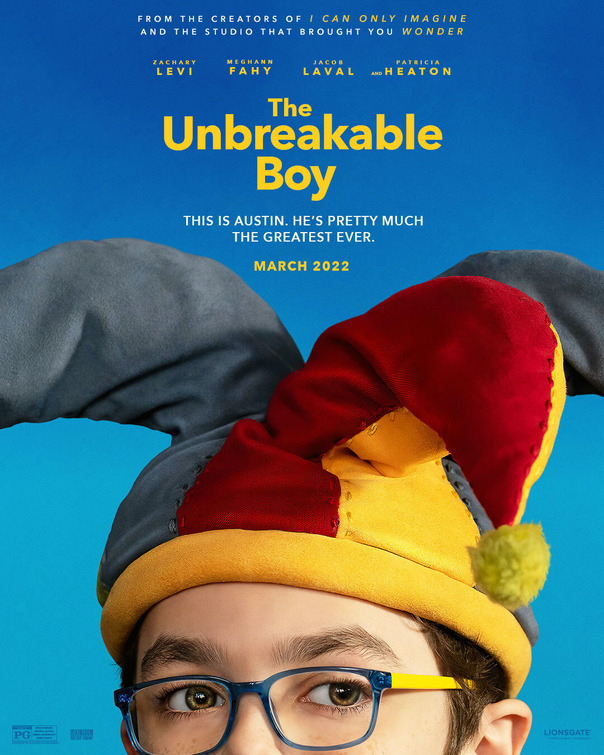
Poster sourced from impawards.com. What do you think? Are you choked that Patricia Clarkson & Amy Acker both went underused (again)? Are you surprised the finished film went three years without a release? Do you think Zachary Levi should get another chance at a dramatic leading role? And probably the most important question of all: as a viewer, do you lose empathy for characters that demand it? Let us know in the comments below!

 theory of a daskeman