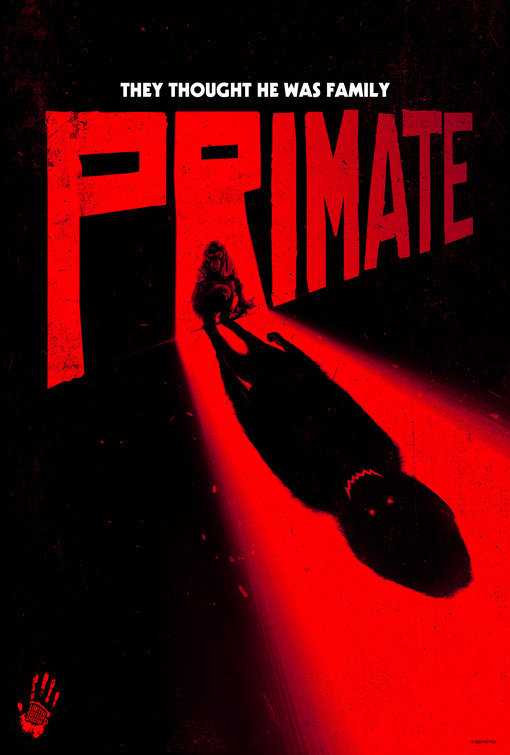
or, “Johannes and the Terrible, No Good, Very Bad Monkey Movie”: A spoiler-free mini movie review.
1 out of 5
‘Pacing’ is certainly a thing: attributed to no one, it’s an essential part of any entertainment. Audiences won’t notice the spacetime something occupies in their lives unless they’re bored, or they totally disagree with what they’re experiencing.
As an example, halfway through Michael Haneke’s 1997 art-horror “Funny Games”, there’s a long, unbroken take assumed as decompression for its characters. That part is so slow that the first time I watched, I fast-forwarded through it.
But skipping “FG’s” depiction of grief also meant reinforcing its themes of desensitization. Once it clicked, it’s a rare movie scene where something simple blossoms within a spacial indiscipline.
On the other hand, skipping scenes in Johannes Roberts’ “Primate” won’t reveal the dark side of its audience, but it will get you to the credits faster.
In Tom Tykwer’s 2009 thriller The International, there’s a two minute scene explaining banking for laymen. Being now middle-aged, I get that financial institutions profit off interest, but, 16-years-ago & raised without financial skills, some surprise edu-tainment was appreciated.
Same goes for Lance Armstrong biopic The Program: Guillaume Canet as moustache-twirling Dr. Ferrari breaks down the science of steroids for a non-sports guy like myself within a few well-delivered lines.
If there’s one thing to admire about the film, it’s this streamlined structure: we start with Armstrong’s first Tour de France, and stay largely with the Tour and Lance’s first-hand experiences with cycling culture – including doping – in a linear narrative.
Ben Foster is the perfect lead for this creative direction: he exudes determination, even in his Lance’s moments of weakness. This vulnerability very rarely materializes under the narcissism, leading to some genuine – albeit cringey – humour, like a break-up message from Nike, or whispered threats to his competitors mid-race.
Awkward levity is par-for-the-course for High Fidelity director Stephen Frears, who also brings a digital, documentary quality to the film’s images, which work in favour of the lengthy, zestful racing scenes.
Alas, the film also feels the need to pivot to The IT Crowd’s Chris O’Dowd as David Walsh – a real-life journalist skeptical of Armstrong’s wins & author of the non-fiction book the film is based on. The Program may maintain a sprightly momentum its entire duration, but that includes the numerous office scenes with O’Dowd, which are visually edited so haphazardly they took me out of Golden Topping Land. Chris is good as the character, but viewers already follow a first-hand account in Lance himself, rendering O’Dowd’s role & the scenes it inhabits narratively supererogatory.
Usually I’m a champion of shorter movies, but The Program’s ninety minutes end too abruptly, where there would traditionally be a third-act courtroom climax. The post-film text alludes to events not-yet-transpired, suggesting the movie was made while Armstrong’s fate was still in litigation. Had producers waited, and exchanged O’Dowd’s material for more about Lance’s personal life (his wife’s meet-cute is blocked like a fling, but in the next scene they’re married), I may not have been disconnected from the material as often.
In spite of that, The Program is still worth watching for the knowledge gained, the racing, and Ben Foster’s performance.
Poster sourced from impawards.com. As of publication, The Program is available to watch for free in Western Canada on Tubi (unsponsored).What do you think? Leave us a comment below!
You’ve heard of Disney animators slipping naughty easter-eggs into their features. These were blink-and-you’ll-miss-‘em moments you’d catch on repeat viewings: there was no way anything more than a few milliseconds of indiscretion could make it passed pre-2000 executives; a ratings board; test audiences; and any other stop-gaps preceding a theatrical release.
But Disney doesn’t ride today’s market solo anymore, and – speaking generally – the competition is becoming more shameless for your dollar. This isn’t to say modern family movies are inundated with sex & violence: I’m not that out of touch. But you can crack a specially-worded joke in a diplomatic way and still keep your coveted PG rating.
Case-in-point: “Despicable Me 4″‘s Poppy. As voiced by Joey King (who just headlined Netflix’s “Uglies”), Poppy is a bratty, overprivileged redhead, sporting a skirt; braces; freckles; and a lisp, and who blackmails & uses Gru… for a heist! Poppy’s age isn’t explicitly stated but I trust my ten-second Google search that labelled her 14.
King’s voice work is chipper and snotty: just how it needs to be. But Poppy doesn’t speak until three-scenes-in, after she’s already thrown Gru knowing glances that communicate, as per the plot, that she knows his secret identity. But all I saw in these lingering shots were Alicia Silverstone from “The Crush” or Drew Barrymore from “Poison Ivy”: villains from a special androcentristic subsection of 90’s erotic thrillers that revolved around psychotic, hypersexual adolescent homewreckers.
My post-secondary discipline was live-action film – not animation. The closest my practice ever got was having to re-record dialogue when a covert HVAC system went off in the background of a shot. In that case, the intention of the scene had already been established. We just did the audio again: somewhere quiet, and hopefully to the same level of emotion as the video. What I want to know then is whether DM4’s visual creatives told King about their non-verbal goals for Poppy before she recorded the dialogue, or if King found out what they did at the premiere while everyone around her made the same lewd joke about what they were seeing.
There’s no way an innocent kid in the audience is detecting a sexual undercurrent in their new Minions movie. That’s just for us mature adult credit card holders.
Poster sourced from impawards.com. If you even care at this point, the overall movie was fine: the Minions do their thing; voice-leads Steve Carell & Will Ferrell do their thing; and there’s a madcap energy that keeps the pace moving even when the comedy fell on the ears of the wrong demographic. If I had to give it a proper star rating, I’d throw it a 2 out of 5. Anything to add to the conversation? That’s what the comment box below is for!
This was a weird one, but not in a Cronenberg way. Personal sidebar: a close friend wants to start going to church. This is not someone who myself, nor any of our mutual friends, thought they would do, but we support their decision. One suggested that they try out different denominations, because if it were up to my friend, they would just continue going to the closest church in walking distance for the sermons and leave at the worship. This particular church’s worship is singing, but it’s different with each and in turn the religion they promote.
While it would be easy for viewers without faith or theological interest to see the speaking-in-tongues and sacred treatment at play in “The Front Room” as ‘crazy’ behaviour, this dramatic revery is typical of Pentecostalism. However, the film doesn’t say this, and while a dichotomy could have existed between Brandy’s Belinda’s study of the Goddess versus the veneration of Kathryn Hunter’s Solange, the central conflict is very vanilla due to this lack of contextualization. On one end it’s problematic, as audiences on the outside shouldn’t be put in a situation where they assume the worst about a belief without all the facts.
On the other end, without seeing Solange as the enemy, there’s no conflict, and ergo no movie. And Front Room would be far different if it didn’t suggest a kind of spiritual deviancy at play, and just concentrated on Solange’s incontinence.
Yes, there is lots of poop and pee in the movie. Front Room seems content hopping genres so I wasn’t sure whether to take this ‘scatalogiquement’ seriously but – having cared for the elderly myself before – it’s no laughing matter when they’re in bed all day, refusing to wear a diaper & covered in C.diff. Front Room puts this front-and-centre, and I have to give props to a film that pans down to surprise diarrhea like Larry Clark to heavy petting, or that properly pays off a shot of a toilet in a care montage, or that brings out those rarely-used squishy sound effects. Speaking of cinematography, the film does look really nice overall, with a dinner scene that jumps the 180 rule most brazenly & a slow zoom-in to a mirror standing out the most.
But audiences will leave remembering the acting, the prominent theremin on the bizarre soundtrack, and the diarrhea.
Poster sourced from impawards.com. What do you think? Could an entertainment property exist in the West where religions with ‘extremist’ worship are given fair treatment (unlike the satire of “Four Lions”), or do you think it isn’t possible for sanitized North American audiences to look passed historical & current context with open-mindedness? Is it fair, then, to compare the far-right Christian beliefs presented in The Front Room with fanaticism? Have a stab at the comments below!