Dub’s Take: The Wild Robot (2024)

A spoiler-free mini movie review.


3 out of 5

“The Wild Robot” was emotionally touching enough to earn my tears: that alone is worth a minimum star rating. But I thought I would be getting a wholesome, feel-good family film for general audiences, without any intercalated adult ‘baggage’ – would you believe producers found a way to sexualize one of the villains here, too? But I don’t have the word count to go over everything.

I cannot stress this enough: Wild Robot contains a vast amount of dialogue about death & dying, played mostly for laughs. Characters commiserate whether or not they’re about to croak on a minute-to-minute basis. A family of possums ask if they’ll be “murdered” before one of them is killed off-screen. For my 36-year-old self, it was extremely noticeable.

Sidebar: back in grade school, I wrote a play for a class Christmas concert. My first draft was rejected because the teacher didn’t like the bad guy telling the good guys he was going to “kill” them. But one of my favourite Xmas movies is “Home Alone”, and they spoke similarly in that movie, didn’t they? Worse, even: Joe Pesci says he’s going to bite Macaulay Culkin’s fingers off, and it was rated PG.

Obviously Home Alone isn’t germane to that teacher’s holiday movie marathon, but the real takeaway was that every parent has a different idea of what’s appropriate for their child and what isn’t – in their experience/opinion. I understand that Wild Robot’s story transpires in the untamed outdoors, and that finding your place in the circle of life – how & while you can – is a theme of the film, but there’s a difference between an effective implication of danger versus the definitiveness of death.

The only reason to keep regurgitating something in scripted lines is to underline to the audience how important it is. Today’s prepubescents can’t be so uneducated that a nice family movie already containing potent scenes of peril should have to push nonexistence to the front of their consciousness, too. Certainly the film’s trailers didn’t foreshadow it.

Wild Robot has one shot where the heroes are looking for survivors of a snowstorm, and silently, it conveys that what they found isn’t good. It’s less than ten whole seconds, but does a better job of communicating grief to an impressionable group, without forcing anything, than the other 90 minutes do. A shame, that.


Poster sourced from impawards.com. What do you think? Imagine this scenario: you have two family movies (not Wild Robot). Both movies have a main character die off-screen, and both will inevitably inspire a difficult conversation between (a) parent(s) & their child(ren). In one movie, the death is constantly referred to non-stop in the dialogue after it happens, reinforcing that this person is no longer around. The other movie implies the other characters’ sorrow & grief through facial expressions & behaviour, though their true, vocalized emotion is ultimately left up to audience interpretation. Which movie would you rather have incited the conversation with your child? Let’s talk in the comments below.

Dub’s Take: Despicable Me 4 (2024)

A spoiler-free mini movie review.


NO STAR RATING

Poppy Prescott gives me impure thoughts.

You’ve heard of Disney animators slipping naughty easter-eggs into their features. These were blink-and-you’ll-miss-‘em moments you’d catch on repeat viewings: there was no way anything more than a few milliseconds of indiscretion could make it passed pre-2000 executives; a ratings board; test audiences; and any other stop-gaps preceding a theatrical release.

But Disney doesn’t ride today’s market solo anymore, and – speaking generally – the competition is becoming more shameless for your dollar. This isn’t to say modern family movies are inundated with sex & violence: I’m not that out of touch. But you can crack a specially-worded joke in a diplomatic way and still keep your coveted PG rating.

Case-in-point: “Despicable Me 4″‘s Poppy. As voiced by Joey King (who just headlined Netflix’s “Uglies”), Poppy is a bratty, overprivileged redhead, sporting a skirt; braces; freckles; and a lisp, and who blackmails & uses Gru… for a heist! Poppy’s age isn’t explicitly stated but I trust my ten-second Google search that labelled her 14.

King’s voice work is chipper and snotty: just how it needs to be. But Poppy doesn’t speak until three-scenes-in, after she’s already thrown Gru knowing glances that communicate, as per the plot, that she knows his secret identity. But all I saw in these lingering shots were Alicia Silverstone from “The Crush” or Drew Barrymore from “Poison Ivy”: villains from a special androcentristic subsection of 90’s erotic thrillers that revolved around psychotic, hypersexual adolescent homewreckers.

My post-secondary discipline was live-action film – not animation. The closest my practice ever got was having to re-record dialogue when a covert HVAC system went off in the background of a shot. In that case, the intention of the scene had already been established. We just did the audio again: somewhere quiet, and hopefully to the same level of emotion as the video. What I want to know then is whether DM4’s visual creatives told King about their non-verbal goals for Poppy before she recorded the dialogue, or if King found out what they did at the premiere while everyone around her made the same lewd joke about what they were seeing.

There’s no way an innocent kid in the audience is detecting a sexual undercurrent in their new Minions movie. That’s just for us mature adult credit card holders.


Poster sourced from impawards.com. If you even care at this point, the overall movie was fine: the Minions do their thing; voice-leads Steve Carell & Will Ferrell do their thing; and there’s a madcap energy that keeps the pace moving even when the comedy fell on the ears of the wrong demographic. If I had to give it a proper star rating, I’d throw it a 2 out of 5. Anything to add to the conversation? That’s what the comment box below is for!

Dub’s Take: Color of Night (1994)

A spoiler-free mini movie review.


1 out of 5

Have you had a conviction so strong that it was a shock to be disproven?

Case-in-point: “Color of Night” (or CON) was declared as having “The Hottest Movie Sex Scene of All-Time” in 2015 by men’s periodical Maxim. Sorry to break it to you: CON has one (1) sex scene in it – or sex ‘chunk’ – totalling less than five minutes of the well-over two-hour runtime of the Director’s Cut I watched.

By last decade’s standards, what is here for sex is hardly pervasive. Maxim’s writer asked, what man wouldn’t love being cooked a steak by a nude Jane March? True, but that’s “sexy”: not “sex”. And if we take sex out of the critique now completely, it still leaves quite a bit of movie behind to try and stand on its own merit.

CON plays comparably to your studio-made, 90’s-produced erotic thriller, with its own twists that will-or-won’t pay off for obsequious viewers. The script by Billy Ray (who later penned Bruce Willis’ 2002 film “Hart’s War”) is about the masks people wear & the moments we catch ourselves in our truth, and he uses group therapy as a story device to bring our oddball group of suspects together & point the finger.

But Willis’ protagonist also interrogates each group member individually, and these scenes grind like similar sequences from detective video games (think “L.A. Noire”), which is only fun for the people actually participating.

Truly, both of Ray’s scripts have the same problem. While Hart’s War lacked thematic focus – jumping incoherently between genres – CON lacks narrative focus: the group therapy scenes are enough to make me suspect each character without the “keyhole” into everyone’s life; the protagonist’s hook of psychosomatic colourblindness isn’t used assertively enough in the plot; and the ending is nihilistic, and problematic when viewed through a modern lens of gender inclusion.

Putting CON on a pedestal like Maxim did imposes certain audience presuppositions, possibly even that it’s some sort of sleazy, forgotten cult-classic. Certainly the cast is full of eclectic performers doing what they do best, the cinematography – heavy on split diopter shots – is intriguing, and late director Richard Rush’s familiarity with complex stories (like his “The Stunt Man” from 1980) meant that I was never unintentionally confused as a viewer.

But overall, Color of Night is too long and fails to fully capitalize on its best ideas.


Poster sourced from impawards.com. Even the Wayback Machine couldn’t fix whatever issue Maxim’s website has with the article, so you’ll just have to trust that I’ve read it before. Leave your nomination for “The Hottest Mainstream Movie Sex Scene of All-Time” in the comment section below!

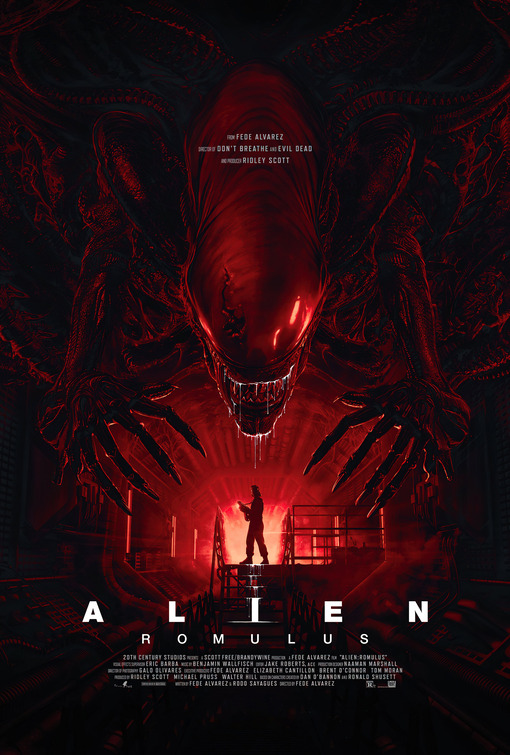
Double-U’s Double-Take: Alien Romulus

A spoiler-lite mini movie re-review.


Leave it to “Alien 2” director-cum-marine biologist James Cameron to tell it like it is: “The trolls will have it that nobody gives a shit … then they see the movie again and go, ‘Oh, okay, excuse me, let me just shut the fuck up right now.’ ”

He was, of course, referencing his first “Avatar”. Some will say that Avatar’s purpose was/is entertainment and, yes, millions of people can’t be wrong. But I’ve reluctantly seen the first film three times, and re-watching it twice over didn’t make me value what Cameron had accomplished any more: it just made me numb to it. I can’t appreciate the pretty picture if it serves a vapid purpose.

While Cameron has the privilege of an unlimited budget & complete creative control, the “Alien” franchise has consistently reinvented itself over the decades, accented by shrinking returns under different directors who, largely, have all have brought something new to the table – but to no lasting conformist appeal.

I have now digested “Alien 7” twice. I used to think seeing any movie more than once at full-price was a sign of constancy (“The Island“) – now I’ve apparently entered the life phase of keeping my mouth shut while I tolerate an afternoon with my curmudgeonly dad and he says he wants to see something.

My greatest detachment this second spell came from how we are seven movies in to this series – not including the various spin-offs – and producers still haven’t indulged audiences with a more thorough study of the xenomorph social structure, or how they go about plastering all that sticky gunk to the walls. Director Fede Alvarez’s team introduces cocooning, but how the Hell was it forged in the span of a few minutes? I would have even taken a cheesy shot of the baby xenomorph spitting black goo at the wall and just have the whole thing appear out of nowhere. A slimy new bit of set-dec of its own accord is not compelling anymore – not in this series.

Rather than existing as its own entity within the ‘Alien cinematic universe’, Romulus is Alvarez pulling a de Sade, using his own blood to scribble all the things he loved about the films that came before onto toilet paper, and all the ways he thought he could make them better.

Click here for the original review.


Poster sourced from impawards.com. Despite trying to go in with no expectations this time around, I still couldn’t help hypothesizing alternate scenarios to the reanimation of Ian Holm: couldn’t they have used Lance Henriksen instead? Wouldn’t Bishop have been the ‘hot, new’ synthetic, going off Romulus’ place in the series chronology? Wouldn’t Henriksen – who’s made a career playing literally anyone in anything – have jumped at the opportunity to approach the role from a more maniacal angle, such as his own Weiland from “AVP”? Could you help picturing the ‘Dream Team’ of Fassbender & Henriksen instead of Jonsson & Not-Holm, or did you even care? Let me know in the comments!