or, “A Big Studio Budget Retained for Payroll”: A spoiler-free mini movie review.
1 out of 5
Snow White 2025 is as much a product for consumer consumption as it is a snapshot of Disney’s current socioeconomic agenda – from Lion King’s Pride Rock in the background of their vanity card; to bookending sequences so similar to Beauty and the Beast’s you’d swear copycat if they didn’t both originate from the same company; to Dopey’s now-curable neurodivergence.
It attempts to redux the material as a feminocentric Robin Hood with a protagonist who’s ‘her own woman,’ but she’ll still drop everything to jubilate musically about her new White beau.
As the titular character, Rachel Zegler opts for the Queen of the High School Drama Department approach: she’s kinda hot and can carry a tune, but emotionally empty from crying about her now off-again boyfriend right before showtime. Watch her strain during the movie’s one big moment for her to act: like Zachary Levi’s recent dramatic try in The Unbreakable Boy, Zegler lacks the skill required to convincingly portray painful remorse. Go do some indies and get back to us.
For all the five-dollar words I throw around here, I don’t think I’ve used discourse yet. Interpreting ‘discourse’ – or, “the meaning that we apply to things” – was a huge component of my first-year art school syllabus, along with learning what a paintbrush & canvas are for. Duh.
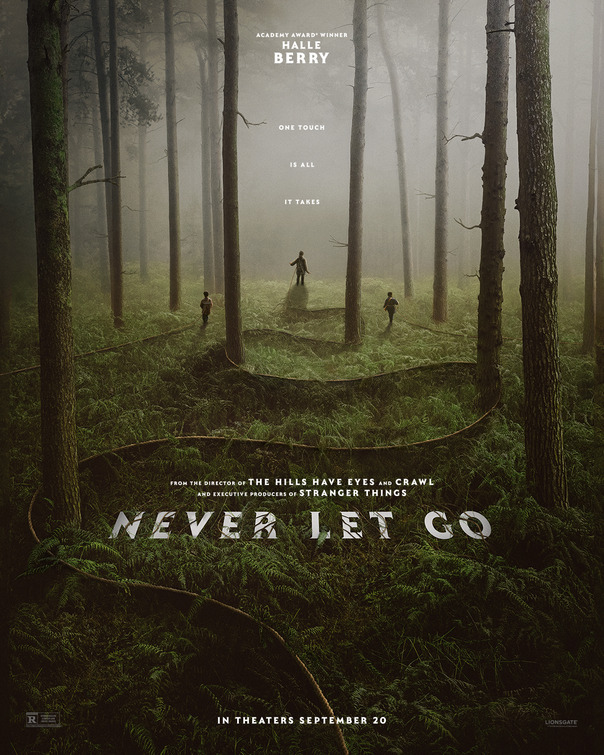
Director Alexandre Aja’s cinematic discourse morphs between two categories: horror, for fans of his breakouts “Haute Tension” and 2006’s “The Hills Have Eyes”; contrasted by the modern fables “The 9th Life of Louis Drax” and “Horns”. “Never Let Go”, with its chapter cards and brothers Grimm references, falls squarely into the second camp. While its moral isn’t spelled out, I took it as not losing sight of one’s humanity, even in the face of insurmountable odds – whether those are real or imagined.
Never Let Go is brutal, starting its characters off in deep crisis instigated by decades of off-screen trauma. Halle Berry is a dependable actress playing an unreliable protagonist: the script is aware it can end only one of two ways (or the dreaded third), and plays with the possibilities from its outset. It’s a challenging narrative tightrope, made more disturbing by audacious scenes of child endangerment.
But the ‘ropes’ – despite not being physically long enough to be coherent – are a fascinating thematic snare, and the cinematic framing of the central woodland location and its inhabitants is stellar: the constituents of the forest, which may or may not be hallucinations, unveil their biological horror through the production’s expert use of darkness & shadow. While the story doesn’t conclude with a traditional twist, there’s an excellent wrench thrown in to the plot earlier than anticipated. Shame it opts for the third ending, though.
With regard to the two child stars, I can say from first-hand experience that managing child actors can be incredibly stressful, with the possibility of little reward. Sadly, as in life, children exist, and it’s relieving to say, then, that the two young men here who anchor the film do work that is unworthy of captiousness: they didn’t once take me out of the experience.
Never Let Go had me unsettled, angry, depressed, nervously laughing out-loud, bewildered, and ultimately mesmerized. Shouldn’t that be the discourse of good cinema?
Poster sourced from impawards.com. What do you think? Are you a fan of Aja’s horror movies, his trilogy (at present) of contemporarily-set fairy tales, both, or neither? Do you think Halle Berry puts on a good show regardless of what she’s acting in, or do you think the choice of role reflects the actor and Berry’s inconsistent filmography speaks for itself? What’s your interpretation of “the dreaded third ending”? Leave your comments below!

 theory of a daskeman