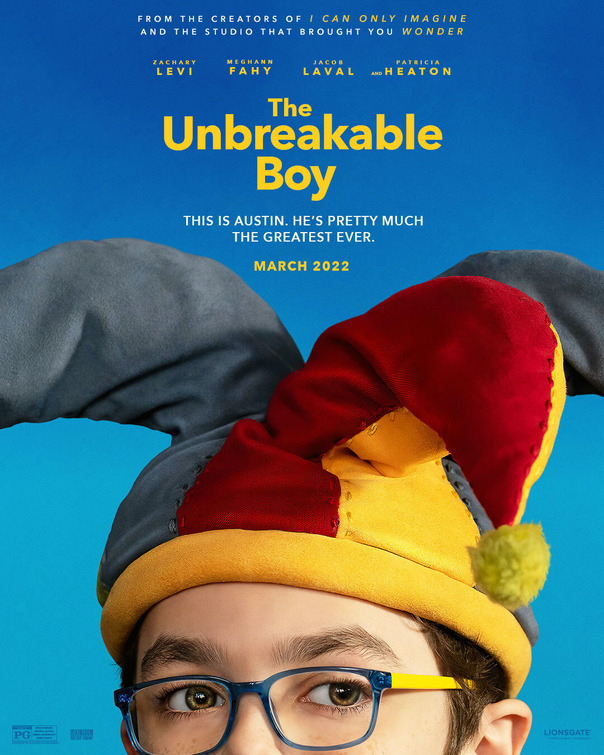
Dub’s Take: The Unbreakable Boy (2025)

A spoiler-free mini movie review.


1 out of 5

Watching “The Unbreakable Boy” (aka. UB) reminded me of Ben Stiller’s 2008 comedy “Tropic Thunder”, and Robert Downey Jr’s immortal words: “Never go full retard.”

Vulgarity aside, RDJ’s line signified that actors playing overly-challenged characters weren’t likely to win audience recognition. In the Real World, compassion is everything.

That being said, and with all due respect to real-life autistic/brittle-bone sufferer Austin LeRette (“Auz-Man”), the lisping imitation from actor Jacob Laval is so off-putting – transcending ‘cute’ into piteousness – that I couldn’t set aside my disbelief.

‘Uplifting’ genre flicks like this inspire pre-viewing expectations: maybe some bullying; some falling down stairs (like in Shyamalan’s “Unbreakable”)… I will give it to director Jon Gunn that he knows how to film scenes of bones breaking, as my wife & I both flinched at each mini-disaster and ones in-waiting.

But the third-act bullying is where I was done, and not because it was too cruel. Whether-or-not how the sequence plays out on-screen is actually what transpired between Auz-Man’s older brother Logan & the school bully ‘who became one of his best friends,’ it is the soppiest, most untenable bit of Hallmark reality ever. Logan should have just kicked the shit out of him and been done with it.

Laval’s representation of Auz-Man is dwarfed by Zachary Levi (both “Shazam’s”) as LaRette’s father. I wondered whether Levi could carry a serious movie with a belied filmography…

And he can’t, instead playing the hollow-headed goof we’ve seen from him time-and-time again. Not only that, but watch how much difficulty he has with sincerity in his climactic apology scene! Sorry, Zach: you don’t have the sauce.

There was kerfuffle with the new Captain America that it didn’t delve deeper into the modern zeitgeist (like its triple-the-length prequel miniseries). Indeed, my wife was adamant her main takeaway from UB was to be inspired by Auz-Man and fly her own freak-flag high.

UB doesn’t have goals of being disposable entertainment: it wants to be an important movie about faith & resilience. So why doesn’t it study some of the dad’s autistic traits more? Why does it give a middle-aged man an imaginary friend, and cutaways of his OCD & restless leg, without exploring them beyond passive freakishness?

The Unbreakable Boy is too timid to answer the big questions it asks, but calculated against the viewer constituting their own empathy. Never go full retard.

Poster sourced from impawards.com. What do you think? Are you choked that Patricia Clarkson & Amy Acker both went underused (again)? Are you surprised the finished film went three years without a release? Do you think Zachary Levi should get another chance at a dramatic leading role? And probably the most important question of all: as a viewer, do you lose empathy for characters that demand it? Let us know in the comments below!

Dub’s Take: The Wild Robot (2024)

A spoiler-free mini movie review.


3 out of 5

“The Wild Robot” was emotionally touching enough to earn my tears: that alone is worth a minimum star rating. But I thought I would be getting a wholesome, feel-good family film for general audiences, without any intercalated adult ‘baggage’ – would you believe producers found a way to sexualize one of the villains here, too? But I don’t have the word count to go over everything.

I cannot stress this enough: Wild Robot contains a vast amount of dialogue about death & dying, played mostly for laughs. Characters commiserate whether or not they’re about to croak on a minute-to-minute basis. A family of possums ask if they’ll be “murdered” before one of them is killed off-screen. For my 36-year-old self, it was extremely noticeable.

Sidebar: back in grade school, I wrote a play for a class Christmas concert. My first draft was rejected because the teacher didn’t like the bad guy telling the good guys he was going to “kill” them. But one of my favourite Xmas movies is “Home Alone”, and they spoke similarly in that movie, didn’t they? Worse, even: Joe Pesci says he’s going to bite Macaulay Culkin’s fingers off, and it was rated PG.

Obviously Home Alone isn’t germane to that teacher’s holiday movie marathon, but the real takeaway was that every parent has a different idea of what’s appropriate for their child and what isn’t – in their experience/opinion. I understand that Wild Robot’s story transpires in the untamed outdoors, and that finding your place in the circle of life – how & while you can – is a theme of the film, but there’s a difference between an effective implication of danger versus the definitiveness of death.

The only reason to keep regurgitating something in scripted lines is to underline to the audience how important it is. Today’s prepubescents can’t be so uneducated that a nice family movie already containing potent scenes of peril should have to push nonexistence to the front of their consciousness, too. Certainly the film’s trailers didn’t foreshadow it.

Wild Robot has one shot where the heroes are looking for survivors of a snowstorm, and silently, it conveys that what they found isn’t good. It’s less than ten whole seconds, but does a better job of communicating grief to an impressionable group, without forcing anything, than the other 90 minutes do. A shame, that.


Poster sourced from impawards.com. What do you think? Imagine this scenario: you have two family movies (not Wild Robot). Both movies have a main character die off-screen, and both will inevitably inspire a difficult conversation between (a) parent(s) & their child(ren). In one movie, the death is constantly referred to non-stop in the dialogue after it happens, reinforcing that this person is no longer around. The other movie implies the other characters’ sorrow & grief through facial expressions & behaviour, though their true, vocalized emotion is ultimately left up to audience interpretation. Which movie would you rather have incited the conversation with your child? Let’s talk in the comments below.

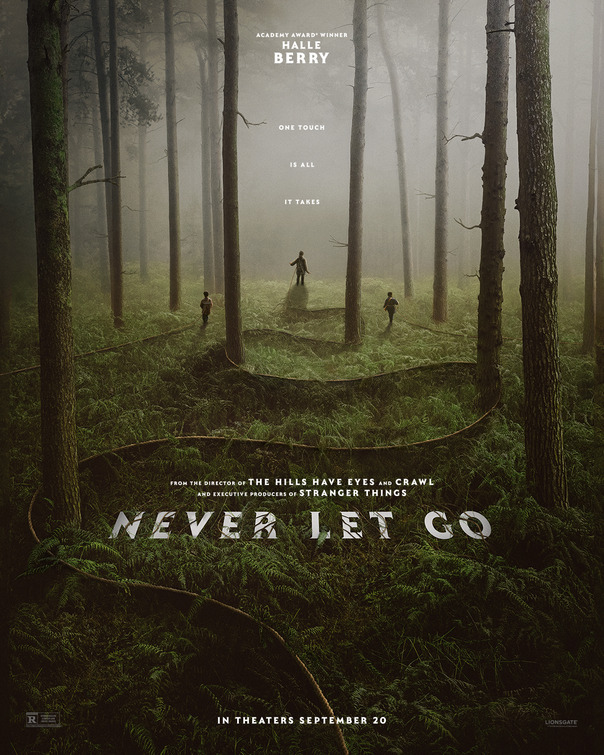
Dub’s Take: Never Let Go (2024)

A spoiler-free mini movie review.


4 out of 5

For all the five-dollar words I throw around here, I don’t think I’ve used discourse yet. Interpreting ‘discourse’ – or, “the meaning that we apply to things” – was a huge component of my first-year art school syllabus, along with learning what a paintbrush & canvas are for. Duh.

Director Alexandre Aja’s cinematic discourse morphs between two categories: horror, for fans of his breakouts “Haute Tension” and 2006’s “The Hills Have Eyes”; contrasted by the modern fables “The 9th Life of Louis Drax” and “Horns”. “Never Let Go”, with its chapter cards and brothers Grimm references, falls squarely into the second camp. While its moral isn’t spelled out, I took it as not losing sight of one’s humanity, even in the face of insurmountable odds – whether those are real or imagined.

Never Let Go is brutal, starting its characters off in deep crisis instigated by decades of off-screen trauma. Halle Berry is a dependable actress playing an unreliable protagonist: the script is aware it can end only one of two ways (or the dreaded third), and plays with the possibilities from its outset. It’s a challenging narrative tightrope, made more disturbing by audacious scenes of child endangerment.

But the ‘ropes’ – despite not being physically long enough to be coherent – are a fascinating thematic snare, and the cinematic framing of the central woodland location and its inhabitants is stellar: the constituents of the forest, which may or may not be hallucinations, unveil their biological horror through the production’s expert use of darkness & shadow. While the story doesn’t conclude with a traditional twist, there’s an excellent wrench thrown in to the plot earlier than anticipated. Shame it opts for the third ending, though.

With regard to the two child stars, I can say from first-hand experience that managing child actors can be incredibly stressful, with the possibility of little reward. Sadly, as in life, children exist, and it’s relieving to say, then, that the two young men here who anchor the film do work that is unworthy of captiousness: they didn’t once take me out of the experience.

Never Let Go had me unsettled, angry, depressed, nervously laughing out-loud, bewildered, and ultimately mesmerized. Shouldn’t that be the discourse of good cinema?


Poster sourced from impawards.com. What do you think? Are you a fan of Aja’s horror movies, his trilogy (at present) of contemporarily-set fairy tales, both, or neither? Do you think Halle Berry puts on a good show regardless of what she’s acting in, or do you think the choice of role reflects the actor and Berry’s inconsistent filmography speaks for itself? What’s your interpretation of “the dreaded third ending”? Leave your comments below!

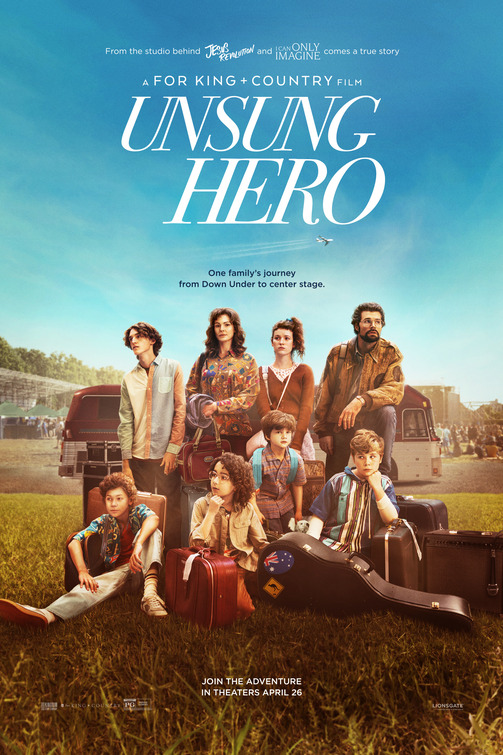
Dub’s Take: Unsung Hero (2024)

A spoiler-free mini movie review.


2.5 out of 5

“Unsung Hero” – the much-anticipated faith-based family drama inspired by the lives of, and produced by, the boys from “for KING + COUNTRY” – is a perfectly middle-of-the-road motion picture. There’s your one-sentence Kojima-style review right there.

Viewer mileage will largely depend on their opinion of FKAC: you’ve probably heard one-or-two of the Christian pop-duo’s crossover hits on Top-40 radio. My wife is a fan and we attended their 2023 Christmas concert, where half the intermission was taken up with promoting Unsung Hero. Their stamp is all over it: its namesake song off their 2022 album “What Are We Waiting For” is the film’s theme; Joel Smallbone steps into the shoes of his Job-like father; and the young actors playing Joel & Luke as children are in the background of scenes ten-times more than the other adolescents, even making sly jabs at their eventual rise to stardom, despite the film’s focus being the awakening of their older sister’s singing career (Rebecca St. James).

A perfect example of the movie’s internal struggle to balance corny cheese with heart-tugging worship can be found in its climax: Dad has one last chance to redeem his music management career, by presenting Rebecca to his rock-star neighbour Eddie Degarmo. While Kirrilee Berger’s singing as Rebecca is enduring, we keep cutting back to Degarmo’s reaction, and “General Hospital” ‘s Jonathan Jackson wears a stupid wig that cessates any sincerity the scene earns otherwise. I can’t think of any other way the filmmakers could have avoided this (Jackson’s acting is fine) other than not cutting to his reaction until the end.

Other bits of movie dissimulation include a trip to the playground that ends in a heavy-handed metaphor about moving on, and at least two of the seven siblings barely getting any screentime. But there’s at least one stand-out moment for Joel’s patriarch when he’s at his lowest, and I appreciated the script not skimping over the financial intervention of Lucas Black’s overly-generous co-congregant. The movie is presented professionally, but workmanlike. There isn’t anything stand-out about its plot or themes, nor anything so egregious it doesn’t deserve a recommendation if you’re into this sort of thing.

Unsung Hero’s faults are cancelled out by its positives & vice-versa, resulting in an average time at the movies. I can’t say I was disappointed, since it was exactly what it said it would be on its label.


Poster sourced from impawards.com.

Jay’s Take: 100% Wolf

A movie review.

100-wolf-148207

Picture this: it’s Tuesday night. Tuesdays in my neck-of-the-woods means Cheap Movie Day at my local multiplexes (both makes). Not only is it Cheap Movie Day, but – quite clearly in a desperate & disparate state – it’s buy-one-get-one, as both brands mid-pandemic have fought long-and-hard over my email Spam folder to see which one has irritated me enough into going there. Let’s look at our options. On one hand, there’s “Landmark”: reasonably-priced food (except the pizza); electronic recliner seats; and reserved seating, clearly-marked with enough light on the row & seat to find your place. On the other, there’s “Cineplex”: outrageously-priced food (especially in the colossal failure that is their VIP lounge); old-school stadium-style rocker seats spaced close-enough together that anyone can use your shoulders as a footrest; and reserved seating – earmarked by Little Jimmy in Grade 11 and his Michael’s-brand label maker – where you can never see any of the row or seat numbers because the theatre lighting hasn’t been adjusted for the change and the seat stickers don’t stay on well to the plastic chairs and are literally peeling off. It’s a frightening state-of-affairs: not only has my local Cineplex all-but-ignored renovating since its VIP & D-BOX upgrades almost 10-years-ago, but 10% of its square-footage sits unused since the start of the pandemic; and its these malnourished arcade machines that formed the backbone of their new horizontally-converged “Rec Room” line they announced last year, and then subsequently forgot about. How do you keep those things clean? You don’t: half the appeal of going into an arcade now is scrutinizing what it was exactly you just touched.

Continue reading