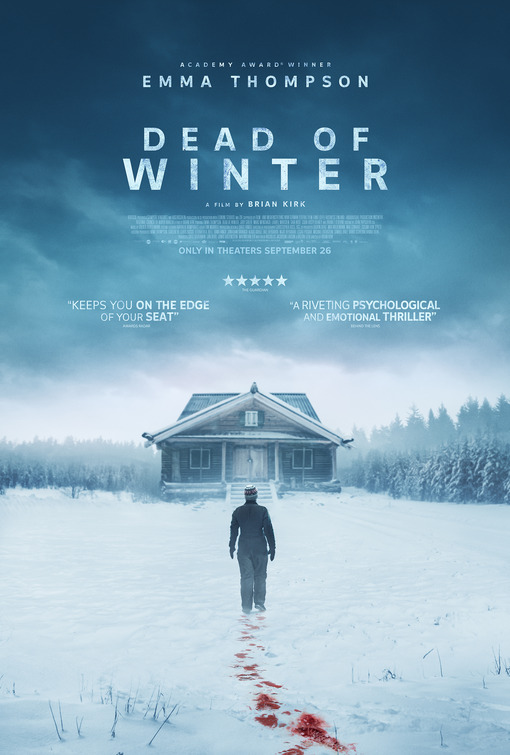
400 Words on: Dead of Winter (2025)

or, “The Five Stages of Grieving Wasted Time”:
A spoiler-free mini movie review.


1 out of 5

“Dead of Winter” (or DOW) is the antithesis to ‘Golden Topping Land:’ a movie you are actively conscious of while watching; an unremarkable composition that will pass from your brain as quickly as consumed, like cinematic Benefiber.

1. DENIAL

Actress Emma Thompson has had a robust & trustworthy career, and here, she plays the unlikely heroine of a kidnapping thriller. An Executive Producer credit ensured her creative autonomy, lest we forget she also won a screenwriting Oscar.

2. ANGER

With control comes accountability – ergo, no one else is responsible for today’s wretched protagonist, except for Thompson.

[cont’d]

Continue reading

Dub’s Take: The Program (2015)

A spoiler-free mini movie review.


3 out of 5

In Tom Tykwer’s 2009 thriller The International, there’s a two minute scene explaining banking for laymen. Being now middle-aged, I get that financial institutions profit off interest, but, 16-years-ago & raised without financial skills, some surprise edu-tainment was appreciated.

Same goes for Lance Armstrong biopic The Program: Guillaume Canet as moustache-twirling Dr. Ferrari breaks down the science of steroids for a non-sports guy like myself within a few well-delivered lines.

If there’s one thing to admire about the film, it’s this streamlined structure: we start with Armstrong’s first Tour de France, and stay largely with the Tour and Lance’s first-hand experiences with cycling culture – including doping – in a linear narrative.

Ben Foster is the perfect lead for this creative direction: he exudes determination, even in his Lance’s moments of weakness. This vulnerability very rarely materializes under the narcissism, leading to some genuine – albeit cringey – humour, like a break-up message from Nike, or whispered threats to his competitors mid-race.

Awkward levity is par-for-the-course for High Fidelity director Stephen Frears, who also brings a digital, documentary quality to the film’s images, which work in favour of the lengthy, zestful racing scenes.

Alas, the film also feels the need to pivot to The IT Crowd’s Chris O’Dowd as David Walsh – a real-life journalist skeptical of Armstrong’s wins & author of the non-fiction book the film is based on. The Program may maintain a sprightly momentum its entire duration, but that includes the numerous office scenes with O’Dowd, which are visually edited so haphazardly they took me out of Golden Topping Land. Chris is good as the character, but viewers already follow a first-hand account in Lance himself, rendering O’Dowd’s role & the scenes it inhabits narratively supererogatory.

Usually I’m a champion of shorter movies, but The Program’s ninety minutes end too abruptly, where there would traditionally be a third-act courtroom climax. The post-film text alludes to events not-yet-transpired, suggesting the movie was made while Armstrong’s fate was still in litigation. Had producers waited, and exchanged O’Dowd’s material for more about Lance’s personal life (his wife’s meet-cute is blocked like a fling, but in the next scene they’re married), I may not have been disconnected from the material as often.

In spite of that, The Program is still worth watching for the knowledge gained, the racing, and Ben Foster’s performance.

Poster sourced from impawards.com. As of publication, The Program is available to watch for free in Western Canada on Tubi (unsponsored). What do you think? Leave us a comment below!

Dub’s Take: Subservience (2024)

A spoiler-free mini movie review.


4 out of 5

My 2007 grip & gaffing instructor Dave Gordon used the term “Golden Topping Land” (after the artificial popcorn butter) to denote a cinema audience’s suspension of disbelief, so long as nothing dumb happens in the story, or a microphone dips into the shot. It’s to “Subservience’s” credit that it had me in Golden Topping Land its whole duration, save two key points: trying to pass a black Tesla off as an electric Mustang, and Megan Fox’s lack of neck make-up.

I’m a chauvinist: there I was the morning after watching, recommending it to someone as “the Megan Fox sex-bot movie on Netflix”. Yes, Megan pretty-much shows as much of her body here that a R-rating & no-nipple clause will allow. But Subservience has more up its sleeve than mere sleeze, not the least of which its three leads: all of whom put out intense performances like they’re out to prove something.

It’s been easy to write off Megan’s acting career as ostentatious, but she does try serious work when & where the industry will allow (“Passion Play”; “Midnight in the Switchgrass”) and she presents great value to the role here, despite it being a robot, and another vessel in a filmography defined by transfixing the male gaze. Her gender-swapped body double Michele Morrone (“365 Days”) is here as well, playing Megan’s stooge, and Madeline Zima as Mike’s terminally-ill wife. Madeline shocked me since, growing up with “The Nanny,” I wasn’t prepared to see little Gracie fully grown & fully naked. She puts on a persuasive show, though, and could find work in more erotic thrillers moving forward, if that’s what she decides.

The most pronounced flaw is in the film’s otherwise-strong script, which introduces dynamic world-building that plays a passive second to the movie’s main focus, which is Megan usurping the family. A subplot about a construction crew being replaced raises valid questions about the world’s future labour force, but it doesn’t go anywhere narratively except to illustrate that Megan has murderous tendencies, when the same point is already proven in her attempts to kill Madeline.

Subservience’s on-the-nose dialogue about modern relationships is compelling enough without being overcomplicated by empty lore, or its two endings. Producers could have saved some money, too, had they just concentrated on the sex-bot in the house. That part of the movie is good, for reasons other than solely Megan, Michele, or Madeline’s smokey stares.


Poster sourced from impawards.com. I never thought I would say this, but Subservience’s broader strokes may have played better had the film been a limited series instead. What do you think? Why are the surgeons’ mouths sealed shut? What is the social structure of a society where all labour is replaced by automation? Just ‘what’ were those things on the soles of Megan’s shoes? Leave your thoughts in the comments below!