Dub’s Take: The Crow (2024)

A spoiler-free mini movie review.


4 out of 5

“The Crow 2024” is metal: something I don’t think anyone expected.

Director Rupert Sanders doesn’t have a prolific filmmaking career, but he did helm 2017’s live-action “Ghost in the Shell”, which wasn’t terrible, and his Crow reboot isn’t terrible either, despite taking two years after shooting to show up in theatres.

Delays like that could mean all sorts of things, usually negative: a lack of faith behind-the-scenes from the people with the money. Howbeit this is odd, since Crow – which started out as a comic series in the late-eighties – has bounced back a few times in media from the tragedy of Brandon Lee’s death while filming the first film adaptation.

How much of the property’s enduring popularity, then, can be attributed to the singular act of Lee’s passing, or the straightforward immediacy of the source material? Rewatching the 1994 film, I was taken aback by how out-of-place its comedic relief resonated – particularly in the pawn shop scene – at the expense of thematic consistency. I’ve never read the comic so correct me if I’m wrong, but those one-liners felt more like additions to coalesce with the Lee family idiom * than to move the plot forward in a congruent way.

In complete contrast, 2024’s Crow doesn’t have any tonal brevity: it’s as emo as the tattoos on Bill Skarsgård’s face, and that could be one piece to its ultimate box-office demise. The film is so committed to its core concept that there’s hardly any fun to be had for passive viewers.

If you can roll with that, Crow is as much solid, stand-alone, yet disposable entertainment as “Madame Web” was back in February: I submitted to Skarsgård’s charisma; the reliable Danny Huston as the antagonist; the script’s spiritual leanings; and the central romance with a convincing FKA twigs. Holding it back from first-class territory were a truncated courting montage – which could have been longer to increase my empathy for the heroes – and some lame CGI in the finale that made me long for the classic squib work of someone like Paul Verhoeven.

In the film, twigs calls Skarsgård “brilliantly broken”, and I believed it. It’s a testament, then, to everyone’s craft that The Crow’s sixth outing to the screen (including the TV series) didn’t end up as another wounded bird.


*see my review of Brandon’s “Rapid Fire” for supplementary impressions.

Poster sourced from impawards.com. Did you know that you can click on the posters in my recent reviews to link directly to the film’s IMDB page? Wicked Cool, and saves you from typing! Leave your suggestions for other unavailing accessibility options for the site in the comments below!

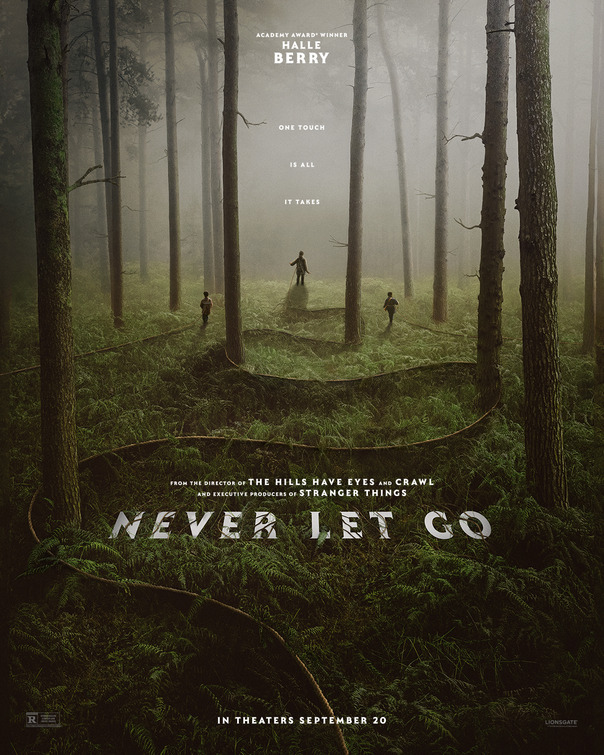
Dub’s Take: Never Let Go (2024)

A spoiler-free mini movie review.


4 out of 5

For all the five-dollar words I throw around here, I don’t think I’ve used discourse yet. Interpreting ‘discourse’ – or, “the meaning that we apply to things” – was a huge component of my first-year art school syllabus, along with learning what a paintbrush & canvas are for. Duh.

Director Alexandre Aja’s cinematic discourse morphs between two categories: horror, for fans of his breakouts “Haute Tension” and 2006’s “The Hills Have Eyes”; contrasted by the modern fables “The 9th Life of Louis Drax” and “Horns”. “Never Let Go”, with its chapter cards and brothers Grimm references, falls squarely into the second camp. While its moral isn’t spelled out, I took it as not losing sight of one’s humanity, even in the face of insurmountable odds – whether those are real or imagined.

Never Let Go is brutal, starting its characters off in deep crisis instigated by decades of off-screen trauma. Halle Berry is a dependable actress playing an unreliable protagonist: the script is aware it can end only one of two ways (or the dreaded third), and plays with the possibilities from its outset. It’s a challenging narrative tightrope, made more disturbing by audacious scenes of child endangerment.

But the ‘ropes’ – despite not being physically long enough to be coherent – are a fascinating thematic snare, and the cinematic framing of the central woodland location and its inhabitants is stellar: the constituents of the forest, which may or may not be hallucinations, unveil their biological horror through the production’s expert use of darkness & shadow. While the story doesn’t conclude with a traditional twist, there’s an excellent wrench thrown in to the plot earlier than anticipated. Shame it opts for the third ending, though.

With regard to the two child stars, I can say from first-hand experience that managing child actors can be incredibly stressful, with the possibility of little reward. Sadly, as in life, children exist, and it’s relieving to say, then, that the two young men here who anchor the film do work that is unworthy of captiousness: they didn’t once take me out of the experience.

Never Let Go had me unsettled, angry, depressed, nervously laughing out-loud, bewildered, and ultimately mesmerized. Shouldn’t that be the discourse of good cinema?


Poster sourced from impawards.com. What do you think? Are you a fan of Aja’s horror movies, his trilogy (at present) of contemporarily-set fairy tales, both, or neither? Do you think Halle Berry puts on a good show regardless of what she’s acting in, or do you think the choice of role reflects the actor and Berry’s inconsistent filmography speaks for itself? What’s your interpretation of “the dreaded third ending”? Leave your comments below!

Double-U’s Double-Take: Alien Romulus

A spoiler-lite mini movie re-review.


Leave it to “Alien 2” director-cum-marine biologist James Cameron to tell it like it is: “The trolls will have it that nobody gives a shit … then they see the movie again and go, ‘Oh, okay, excuse me, let me just shut the fuck up right now.’ ”

He was, of course, referencing his first “Avatar”. Some will say that Avatar’s purpose was/is entertainment and, yes, millions of people can’t be wrong. But I’ve reluctantly seen the first film three times, and re-watching it twice over didn’t make me value what Cameron had accomplished any more: it just made me numb to it. I can’t appreciate the pretty picture if it serves a vapid purpose.

While Cameron has the privilege of an unlimited budget & complete creative control, the “Alien” franchise has consistently reinvented itself over the decades, accented by shrinking returns under different directors who, largely, have all have brought something new to the table – but to no lasting conformist appeal.

I have now digested “Alien 7” twice. I used to think seeing any movie more than once at full-price was a sign of constancy (“The Island“) – now I’ve apparently entered the life phase of keeping my mouth shut while I tolerate an afternoon with my curmudgeonly dad and he says he wants to see something.

My greatest detachment this second spell came from how we are seven movies in to this series – not including the various spin-offs – and producers still haven’t indulged audiences with a more thorough study of the xenomorph social structure, or how they go about plastering all that sticky gunk to the walls. Director Fede Alvarez’s team introduces cocooning, but how the Hell was it forged in the span of a few minutes? I would have even taken a cheesy shot of the baby xenomorph spitting black goo at the wall and just have the whole thing appear out of nowhere. A slimy new bit of set-dec of its own accord is not compelling anymore – not in this series.

Rather than existing as its own entity within the ‘Alien cinematic universe’, Romulus is Alvarez pulling a de Sade, using his own blood to scribble all the things he loved about the films that came before onto toilet paper, and all the ways he thought he could make them better.

Click here for the original review.


Poster sourced from impawards.com. Despite trying to go in with no expectations this time around, I still couldn’t help hypothesizing alternate scenarios to the reanimation of Ian Holm: couldn’t they have used Lance Henriksen instead? Wouldn’t Bishop have been the ‘hot, new’ synthetic, going off Romulus’ place in the series chronology? Wouldn’t Henriksen – who’s made a career playing literally anyone in anything – have jumped at the opportunity to approach the role from a more maniacal angle, such as his own Weiland from “AVP”? Could you help picturing the ‘Dream Team’ of Fassbender & Henriksen instead of Jonsson & Not-Holm, or did you even care? Let me know in the comments!

Dub’s Take: The Front Room (2024)

A spoiler-free mini movie review.


2.5 out of 5

This was a weird one, but not in a Cronenberg way. Personal sidebar: a close friend wants to start going to church. This is not someone who myself, nor any of our mutual friends, thought they would do, but we support their decision. One suggested that they try out different denominations, because if it were up to my friend, they would just continue going to the closest church in walking distance for the sermons and leave at the worship. This particular church’s worship is singing, but it’s different with each and in turn the religion they promote.

While it would be easy for viewers without faith or theological interest to see the speaking-in-tongues and sacred treatment at play in “The Front Room” as ‘crazy’ behaviour, this dramatic revery is typical of Pentecostalism. However, the film doesn’t say this, and while a dichotomy could have existed between Brandy’s Belinda’s study of the Goddess versus the veneration of Kathryn Hunter’s Solange, the central conflict is very vanilla due to this lack of contextualization. On one end it’s problematic, as audiences on the outside shouldn’t be put in a situation where they assume the worst about a belief without all the facts.

On the other end, without seeing Solange as the enemy, there’s no conflict, and ergo no movie. And Front Room would be far different if it didn’t suggest a kind of spiritual deviancy at play, and just concentrated on Solange’s incontinence.

Yes, there is lots of poop and pee in the movie. Front Room seems content hopping genres so I wasn’t sure whether to take this ‘scatalogiquement’ seriously but – having cared for the elderly myself before – it’s no laughing matter when they’re in bed all day, refusing to wear a diaper & covered in C.diff. Front Room puts this front-and-centre, and I have to give props to a film that pans down to surprise diarrhea like Larry Clark to heavy petting, or that properly pays off a shot of a toilet in a care montage, or that brings out those rarely-used squishy sound effects. Speaking of cinematography, the film does look really nice overall, with a dinner scene that jumps the 180 rule most brazenly & a slow zoom-in to a mirror standing out the most.

But audiences will leave remembering the acting, the prominent theremin on the bizarre soundtrack, and the diarrhea.


Poster sourced from impawards.com. What do you think? Could an entertainment property exist in the West where religions with ‘extremist’ worship are given fair treatment (unlike the satire of “Four Lions”), or do you think it isn’t possible for sanitized North American audiences to look passed historical & current context with open-mindedness? Is it fair, then, to compare the far-right Christian beliefs presented in The Front Room with fanaticism? Have a stab at the comments below!

Dub’s Take: The Blair Witch Project (1999)

A spoiler-free mini movie review.


5 out of 5

Sidebar: when “Blair Witch 3” came out in 2016, there was an article from ‘reputable’ site Bloody Disgusting claiming it would “leave viewers shaking to their core”, in the opinion of its author. Certainly one could make that distinction about the original, but there was no way audiences were getting an out-of-the-blue sequel, sixteen years after the last, without any kind of prerelease hype, was there? Especially not after the wealth of viral marketing that went into pumping the first & second pictures.

Turns out, that review was the hype, because Blair Witch 3 was forgettable. Why spend the kind of money the original producers did in the late-nineties, making whole fake behind-the-scenes documentaries about the fake myths behind the fakery, when you just need to post something online that sounds credible? That review was probably my inaugural experience getting fooled by clickbait, other than being sixteen-years-old and watching Kevin Trudeau informercials for the first time.

But I really wanted to believe 3 was going to be good. The original is good. Great, even: often cloned but never imitated. Surely if you’re from that generation, you will have already formed your own opinion. My wife’s is that the handheld camerawork is stomach-churning, although I’ve never had that problem (I wish my stomach was in 4DX, not).

But what struck me on this recent viewing wasn’t how little Burkittsville lore is actually featured in the opening act (although what ‘facts’ are, all have payoffs) or how well-paced the film’s brief 80-minute runtime is as I imprudently watched on a work night. It was how relatable all three of its main characters are, and how the film never goes out of its way – nor needs – to textually individualize any of them, despite how much background the supplemental material may contain. The movie itself is delightfully uncluttered: Heather is believably headstrong; Mike is believably cautious; Josh is believably aggravated; and there isn’t one choice made by the characters stemming from these traits – not even Mike’s fragmented decision-making at the midway point – that didn’t feel convincing under the narrative circumstances.

And it’s scary. Maybe not as scary as it was when I was twelve, watching it for the first time, but unnerving, with a splendidly abrupt ending devoid of the time-stretching tactics of contemporaries like “Paranormal Activity”. Mwah! Chef’s Kiss!


Poster sourced from impawards.com. An upcoming 25th anniversary Blu-ray edition, supervised by the filmmakers & purported to present the film without the post-production processing from original distributor Lionsgate, is available through Second Sight Films (unsponsored).