Dub’s Take: Alien Romulus (2024)

A spoiler-free mini movie review.

1 out of 5

The trailer for “Alien 7” supplied plenty of expectations: that it would be another hackneyed interpretation of a beloved franchise’s Greatest Hits from “Evil Dead 2013” director Fede Alvarez (News Flash: it is); that it would have yet another underdeveloped White female character as the lead – unrelated to the others – who grows from meek to mighty by the credits (it does); and that it would favour fan service & exponential antecedence (not just one Facehugger, but a bushel!) over action scenes that last longer than a finger snap, and taking narrative risks like predecessors “Prometheus” & “Covenant” (you betcha).

But never in my wildest dreams could I have predicted what Fede did here with the teased returning (and deceased) legacy actor, brought back with the help of computers (and I’m sure a healthy donation to their late estate) only to serve as a literal talking head, “Futurama”-style. Even after running through all the major players from all six prior Alien movies in my head to guess who it could have been, I never considered the one it ended up being.

However, the real sin of this decision – aside from its contemptuousness – is that, without knocking David Jonsson’s turn as resident ‘synthetic’ Andy, Alvarez missed a huge opportunity in not bringing back Michael Fassbender’s David. The ‘black goo’ from Covenant plays such a crucial part of the story here that this one casting change could have given fans a cross-generational interpolation of both eras of the franchise, as well as a proper placeholder for the true “Covenant” sequel we never got.

Optimism-bias aside, I found Romulus boring. It’s such a pastiche of the prior films that it has no identity of its own, even copying its finale from “Resurrection”. Cailee Spaeny’s heroine Rain is another identical sibling to Katherine Waterston & Noomi Rapace, and just as superficial. New ideas – such as the cocoon sack and Facehugger evasion tactics – are invalidated by the movie’s nonsensical timeline (when did it make the cocoon?) and continuity cock-ups (the Facehugger swarm disappears from one shot to another). And the best summation of the film’s lack of action is that there’s an entire sequence inspired by the Sentry Gun from the inferior, meandering Special Edition of “Aliens”.

Romulus is short on thrills and heavy on dead, reanimated actors. Forget John Krasinski’s Rogers ad: AI will be replacing all y’all soon enough.


Poster sourced from impawards.com. What do you think? Were you baptized into Alien series snobbery by one of your parents, too? Do you hold out hope for Noah Hawley’s upcoming Alien TV series, even though I thought his “Fargo” show fizzled-out with that time-jump halfway through its first season? Have you also seen the first Alien film an excessive amount of times that you never want to see it again? Let us know in the comments, why don’cha?

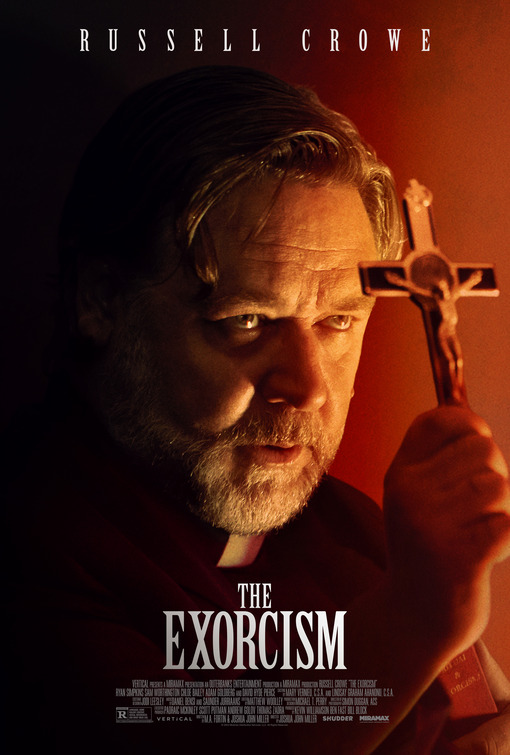
Dub’s Take: The Exorcism (2024)

A spoiler-free mini movie review.


1 out of 5

For “Kingdom of the Planet of the Apes”, I wrote it was this movie season’s poster child for needing an apathetic studio executive to mercifully cut 45 minutes off the overlong film like amputating gangrene. Today’s “The Exorcism” is what happens when you cut too much: it’s abrupt; obfuscating; and, frankly, embarrassing.

The whole time I was trying to put my finger on exactly what wasn’t working: some lousy dialogue and CGI. But I wasn’t expecting a masterpiece: surely a one-star review cheesy lines & VFX does not make?

Nevertheless, events in The Exorcism transpire almost transitionlessly: Russell Crowe’s disgraced actor Tony Miller goes from recovering alcoholic to back on the bottle, and possessed, all in the first act; Samantha Mathis shows up for less than a minute as the executive for the comeback film Miller is working on, and ditto for Sam Worthington as his co-star; and the less said about the slapdash finale with a wasted David Hyde Pierce, the better.

There seemed to be enough working ingredients that either the story should have been told as drama (concentrating on the strained relationship between Miller and his estranged daughter in-and-around environments non-conducive to healing, like a movie set) or as a harder version of what we got here. For instance, Miller isn’t fired from the meta-film for almost three weeks, and by then he’s so far gone that he’s full-on contorting. Why wasn’t he let go sooner? This could have been solved by having a scene with Mathis saying they’re “over-budget and over-schedule” and another delay would kill the film, but it’s not here.

The Exorcism reeks of being hacked to pieces in post-production, when someone in a suit told the editors to concentrate on the horror instead of the plot. I’m not saying that a longer version actually exists, or that it would be better than what we got in the end: movies lose scenes in the filmmaking process all the time, and the public isn’t always privileged to the DVD leftovers. But I imagine another movie ten-times better lost in a warehouse somewhere: an allegory about moviemaking and how the script becomes its own monster and feasts on the egos of those involved, with Adam Goldberg (doing great work here as the meta-film’s director) the Machiavellian ringmaster.

There’s a more interesting film here that’s had its textured ends removed like calf testicles.


Poster sourced from impawards.com. What do you think? Were you also confused by The Exorcism’s humdrum poster & marketing? Did you, too, consider that it could be a sequel to Crowe’s other horror project from last year “The Pope’s Exorcist”? Is Russell Crowe still enough of a draw for you now that he’s in his career’s third act, that you’ll see a new movie of his based on his huge mug dominating the ads? Do you agree that Hyde Pierce’s amazing performance in 2010’s “The Perfect Host” means he could’ve, should’ve done a more convincing job here? Leave a comment below!

Dub’s Take: Late Night with the Devil (2023)

A spoiler-free mini movie review.


Actor David Dastmalchian is an odd duck. He has a long face weighed down by the pressures his characters carry and the secrets & desires they harbour. Even when his role selection leans toward weirdos & villains (Polka-Dot Man in James Gunn’s “The Suicide Squad”; Piter in “Dune” (2021); Murdoch on TV’s “MacGyver” revival), Dastmalchian’s work sidesteps mockery for sympathy.

David’s casting as a talk show host in “Late Night with the Devil” is inspired, in one of the most “normal” portraitures that I’ve seen out his filmography. However, I think directors the Cairnes brothers do their lead a disservice by making David’s Jack Delroy a Carson competitor, placing the character in the same pantheon as contemporaries Leno & Letterman. Dastmalchian’s subdued Delroy would have played better as a Charlie Rose/ Dick Cavett type, even if that meant no additional texture in the form of a studio audience. I won’t say David’s Delroy is uncharismatic, but maybe a little too first-season Springer for the subject matter (the character deliberately transitioned his show to tabloid trash for ratings, so more cockiness would have played to that).

As someone who enjoys “lo-fi” vaporwave, “Late Night” was an aesthetic feast, with visuals mimicking live television from the 1970s, the on-stage orchestra with its oboes & saxophones, and crusty title-cards. In-between these moments of found-footage were black & white “behind-the-scenes” takes that are framed perhaps too much like a movie and took away from the purity of the “live” footage. Other details – such as the stoic Cavendish ad-reps sitting in the front row, or the boom-mic dipping into shots – counterbalanced the pretence of authenticity.

Does the film succeed as horror? I would say it succeeds at constantly-mounting dread: Ingrid Torelli as Delroy’s young, demon-possessed guest is incredibly cute & effectively spooky, and there’s a brilliant (and earned) sequence involving worms that plays with audience perspective. As far as the ending, it could have gone a number of different ways but I was not disappointed with what the filmmakers chose narratively: only underwhelmed by the out-of-place CGI work and abrupt aspect-ratio change (although it was a very cool creature design in the climax).

Overall, Late Night is effective in healthy fits-and-bursts, it’s a transient 90-minutes-long, and may play better via home streaming than in theatres.

2.5 out of 5

Poster sourced from impawards.com. What do you think? Much like an evil djinn, do you think you need to be very specific when making a deal with the Devil? Wasn’t Ian Bliss’ substitute for the late James Randi a pretty money enactment? What’s your favourite David Dastmalchian role? Do you agree with the Matt Zoller Seitz review that says the film would have been more effective had they left out the documentary-style preamble? Leave a comment below!

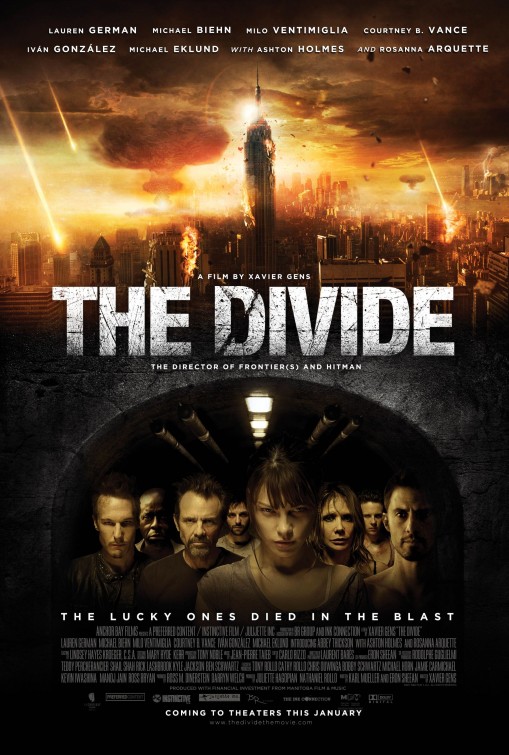
Dub’s Take: The Divide (2011)

A spoiler-free mini movie review.


Anyone who wanted less optimism in Netflix’s recent movie “The Furnace” may find the nihilism they’re looking for in “The Divide”. Director Xavier Gens is best known to American audiences for the first “Hitman” adaptation with Timothy Olyphant, but his “Frontier(s)” from the same year is his eminent opus: an ultra-violent allegory about civil unrest in France. The Divide shares commonalities with Frontiers, including subject matter about each person’s “breaking point”, and a remake of its head-shaving scene. Know then that The Divide is not a “happy” movie, though thankfully nowhere near as unwatchable for a general adult audience.

It’s true that not everyone wants to watch a depressing movie these days, despite an influx of downbeat titles on the market – most inspired by current events. I myself am not an optimist and enjoy the occasional morbid movie for escapism. By the same measure, I also want the film to have some other purpose for being – beyond pure cruelty – to not make the whole experience a big waste of time. The Divide locks the viewer in and makes them want to know what happens, which is the greatest compliment I can give it.

It is by no means perfect. Some of its best ideas – such as the ultimate reveal of the third-act villains – come too late in the film. It has a mish-mosh cast, with unrestrained, melodramatic performances by Michael Biehn & Rosanna Arquette. There’s a left-field event a half-hour in that should change the dynamic of the entire film, but left-minded viewers will be disappointed that it never goes back to it when it’s over. And it could have had a tighter second act without diluting the material. Having said all that, it was still compelling, and generated some good discussion between my wife & myself afterward. I wouldn’t ever watch it again.

3 out of 5

Poster sourced from impawards.com. What do you think? Are you the kind of viewer who stays away from thematically half-empty media, or do you like to be challenged in this day & age? That line-dancing scene in The Furnace was money though, am I right? Do you agree with Tarantino when he says a great movie can “own” its use of a song? Let me know your thoughts below!