Dub’s Take: Ordinary Angels (2024)

A spoiler-free mini movie review.


An uplifting, faith-based drama, with the religious rhetoric dialed way down; and believable performances from a multigenerational cast? Who knew?

At a breezy two hours, “Ordinary Angels” makes for an above-average date night, with some tears; some smiles; some “are you kidding me’s”; and sincere characters making choices based on compassion alone. It’s recommended, despite being completely predictable.

Some notes: Amy Acker should be rescinding the gift basket for her agent. The actress who so-effectively played Root on TV’s “Person Of Interest” has a starring credit as Alan Ritchson’s terminally-ill wife, but only shows up for five minutes right at the start before she dies – we only see her again in photographs. I found this disappointing, because Ritchson – who we know from Amazon’s “Reacher” series – is really good here, but a bit stiff in the prologue with Acker.

What I wanted were more flashbacks between the two, so I’d know if the walls Ritchson put up around his character were maintained consistently with his screen-wife (which would tell viewers either he was always the stoic everyman – even when she was alive – or he was a total suck around his wife when she was living). Even though such a scene never materialized, and his relationship with Hilary Swank’s Sharon remained platonic throughout, Ritchson is still credible as a father willing to do anything for his daughters.

Meanwhile, Swank is as reliable as ever. Regardless of how you feel about “awards”, she’s still won two Oscars and is an intense, committed actress – though not necessarily the first person you think of as a philanthropic hairdresser. Her Sharon Stevens is perpetually propelled forward by an unencumbered desire to help Ritchson’s family and less by the regrets of her own life, though she does have one or two things she is willing to share. Once you get used to the lack of a deep, dark history, Swank as Stevens is the rock that keeps the film from flying away on the wings of apathetic humanitarianism.

Also nice was the film’s excellent use of REM’s “Losing My Religion”. In fact, I’d wager to say it’s so well used here, that the scene it plays over sheds light on Michael Stipe’s otherwise-inscrutable lyrics. Good choices all-around!

4 out of 5

Poster sourced from impawards.com. What do you think? Will you be watching this anytime soon? Are you wondering why I would give this a 4 out of 5 when “Dune 2” only got 1.5? Do you think there is more merit to the aesthetics of modern cinema as opposed to small-scale, done-to-death inspirational stories; or should critics continue to respect the basics of the medium like acting, dialogues, and direction? Comment down below!

Dub’s Take: Dune Part Two (2024)

A spoiler-free mini movie review.


“Dune: Part 2” is the poster-child for “anti-climactic”, in ways other than it being the middle-child of a trilogy. There were fleeting moments when I really thought director Denis Villeneuve had pulled it off (finally), such as Jessica drinking the Water Of Life, or Paul breaking a sandworm. But these sequences of visual & auditory awe are constantly at odds with Villeneuve’s unrestrained desire to cut away from the action, and bring the audience back to the small-scale drama of its core characters: a drama by its very prophetic nature tensionless.

All of what I liked and didn’t about the prequel is back in-force: it’s well framed & shot, but its production design is too distilled for a Strange New World; Hans Zimmer’s soundtrack is campy and borderline plagiaristic of the music from the 1984 movie; and Timothée Chalamet’s “Paul Muad’dib Usul Atreides, Duke of Arrakis” is a blank slate of whiny flippy-flop onto whom the audience can vicariously live out the experience (although credit goes to Timothy’s fight double, who does a pretty-sweet triple roll off Feyd-Rautha in the climax).

This round, however, Villeneuve refuses to allow his action scenes the same breathing room he gives the human story. Yes, there are breathtaking individual shots of the conflict, but no magnifying glass brought up to it. The spectacle is only present long enough for viewers to recognize it as the canvas in which the drama is played out, but not long enough for it to be felt emotionally at the same extent Villeneuve treats the dialogues. Like the prequel, the scope that the story insinuates is lost in favour of the myopic problems of its celebrity actors. For a three-hour, $200-million movie in this day and age, audiences should demand more.

As much as I’m a softie for the ’84 adaptation, I’m the first to admit its patchwork second half (which was never properly finished) is probably not a good representation of the first Dune novel’s denouement. Here, Villeneuve had a limitless opportunity – financially & corporately – to actually conclude some of the story without struggling to condense too much one deemed “narratively important” into a studio-mandated running time. Instead, we got Frank Herbert as sifted through Denis’s litter box.

1.5 out of 5

Poster sourced from impawards.com. What do you think? Are you just looking for eye-candy the same way the theatre full of seniors at my IMAX screening were? Are you sort-of, kind-of interested to see what happens in “Dune Part 3”, considering the only other adaptations were the Sci-Fi Channel miniseries’ from the early 2000s? Did you also get big “Star Child” vibes when Paul talked to his sister? Comment down below!

Dub’s Take: Dune (2021)

A spoiler-free mini movie review.


Biases in the open: David Lynch’s 1984 movie adaptation of “Dune” is a childhood classic of mine, and I’ve never seen a Denis Villeneuve movie that I’ve liked. Denis’ films are “aesthetically pleasing” and favour “showing” rather than “telling” (all the Film School buzz words), but their runtimes are artificially inflated with superfluous texture, narratively esoteric, and none I’ve seen have satisfactory endings. “Dune Part 1” will impress Gen-Z yuppies who prefer style over substance, but it lacks the “space oddity” of Lynch’s version. Gone is grim but lush production design that suggests the evolution of man through the spice, and in its place sleek, clean CGI and “practical effects” you won’t notice surrounding a bunch of dusty celebrities.

In Lynch’s Dune, Kyle MacLachlan plays Paul as a young man who accepts his destiny and leans into myth: not the most considered arc, but there is never any question that he wasn’t ready for his responsibility. Timothée Chalamet’s Paul is an emo teen burdened by his birthright, who has no control over his actions because why bother if his future is already written? Timothy could have laid the angst on thicker rather than being so rigid and passive: look at the scene between Paul and his mother in the tent between performances and it’s clear who comes out as the born leader.

While I’m complaining: for a guy who said he’d stop scoring superhero movies, every Hans Zimmer-composed soundtrack since 2016 sounds like Batman music. Here, Zimmer layers on the tribal throat-yodelling that lets you know what you’re watching is really, really important (including such instant classics as the “I Will Miss Water” theme when we leave Caladan) while simultaneously sounding way too similar to Toto’s music from the ’84 film. And the movie’s final third of fishing for a good spot to put a cliffhanger ending is disrespectful of the viewer’s time: I’d have much rather had the fight with Jamis held-over, thus leaving the under-developed spiritual angle of the story for the sequel.

Frank Herbert’s original book came out in 1965. It’s ignorant to think that the movie industry isn’t going to remake or reboot properties for subsequent generations. It’s equally ignorant to think that new generations won’t latch on to what’s current and trending, and discount what’s old and lame. Dune Part 1 is acceptable, but it’s cold & distant in ways Lynch’s interpretation is not. If I had my way – rather than going with the wife – I would be skipping Part 2.

2 out of 5

Poster sourced from impawards.com. What do you think? Are you a big Denis Villeneuve fan, and his making a Dune movie a dream for both him to make, and you to “experience”? Do you want to tell me to go watch “Enemy” or “Polytechnique” and then come back and still say I don’t like his movies? What else could you do to convince me that it wasn’t dumb as Hell to tie up “Blade Runner 2” with A.I. Sean Young & Harrison Ford? Didn’t Harrison say he hated working on “Blade Runner 1”? Comment, comment, comment!

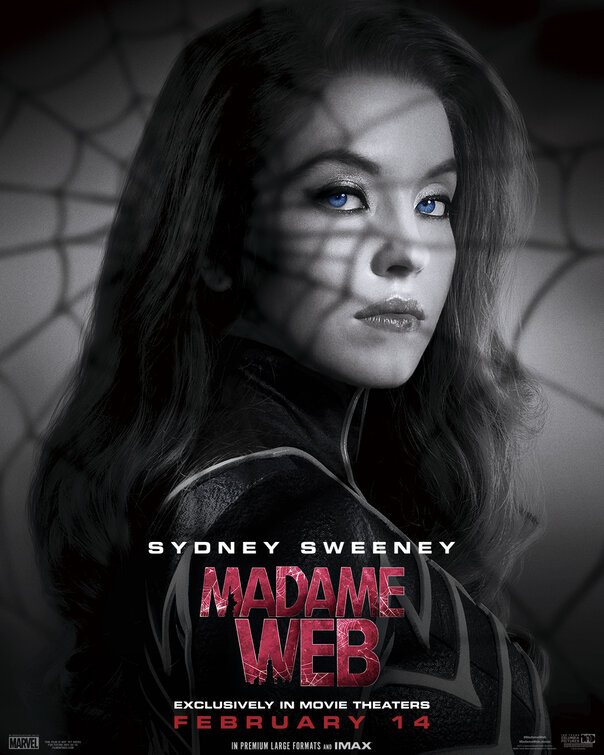
Dub’s Take: Madame Web

A spoiler-free mini movie review.


“Madame Web” is way more watchable than what has been suggested. Omitting the lack of hype, subdued marketing, and languorous comments from its lead star, the movie is mindless, low-impact entertainment, thankfully devoid of any Marvel movie baggage, and anchored by a solid leading lady who has nothing to be ashamed of.

To casual viewers, director SJ Clarkson – a TV veteran whom this is their first major feature – may seem like they’re playing the filmmaking side of things too safe, but I found the frame mercifully non-convoluted with the excess texture that drags most modern superhero movies down for me. In place of your effects-laden Marvel “extravaganza”, Madame Web’s shot structure & editing suggest themes of time & perspective in a refreshingly grounded, fluid, Mike Figgis-esque way (except perhaps including more single CCTV shots). All I was really left wanting was less cutting to the reaction, rather than letting the movement breathe, in the action scenes.

The obvious difference of opinion will be over Dakota Johnson’s insouciant performance. In the Cineplex pre-show, she says she took the role because she was interested in the idea of a woman “whose superpower is her mind.” Johnson’s last big gig was the “Fifty Shades” trilogy, and Cassandra Webb is another empowering role ripe for a feminist performer to tackle. Here, with her strong, self-sufficient interpretation – and looking good with her long, dark hair, red leather jacket, and Levis – Johnson is poised to become some little girl’s role model and a pre-pubescent male comic book film fan’s first female fantasy.

The film is nimbly paced and ends at the perfect point, except perhaps by five minutes, with an epilogue that eludes logic. Sony’s live-action Spider-verse expansion might not happen if Madame Web doesn’t gain more traction through streaming, but the climax isn’t clear enough to foreshadow everything the film throws at us visually in that final scene. It looks ridiculous, but is probably comic-book accurate.

4 out of 5

Poster sourced from impawards.com. What do you think? Was Johnson the right casting choice, or did Cassie need to be played by someone with more range? What about Emma Roberts? Considering her minor supporting role here, does an alternate timeline exist where Roberts & Johnson switch characters? Or are you one of the millions on the bandwagon ragging on the poor movie at the moment and you think I must have some ulterior motive for a positive review? Let me know in the comments below!

Dub’s Take: Argylle

A spoiler-free mini movie review.


In an age of debating whether movie studios like Warner have the moral right to destroy unreleased films like their “Coyote vs. Acme” and “Batgirl”, here we have “Argylle”: a movie that didn’t need to be made at all.

Director Matthew Vaughn also helmed all three “Kingsman” movies. Both Kingsman 1 & 3 (“The King’s Man”) were fun and non-conformist, with well-textured characters and believable dialogue that injected some juj into their otherwise-boilerplate spy-caper stories. And where Kingsman 1 leaned towards comedy, Kingsman 3 was effectively dramatic. The reason that absurdist humour in Kingsman 1 and those unexpected tragic beats in 3 worked so well was because the movies were good and had earned your disbelief.

Vaughn is obviously capable, so it’s perplexing that Argylle inspires no audience empathy. Its narrative coalescence is predictable & uninspired. Its special effects are functionally on the level of a television pilot. The all-star cast – from Sam Rockwell to Bryan Cranston to Catherine O’Hara – does exactly what you expect them to with neither subtlety nor relish. And, no surprise, it’s too long, with a final third that introduces an assembly line of misdirection that ends with a dance number, all of which plays like it was written during an endless night of bong tokes.

It is these workmanlike qualities that suggest everyone on Argylle was just doing it for the money: it’s exactly what you expect and nothing more. Vaughn made an inoffensive “Kingsman for Girls”, which will serve its purpose as disposable entertainment for its audience and as a tax write off for its executives. The actors knew that no one was winning any awards: they all showed up with their lines memorized (we hope), did their job, and went home. You will guess all the twists. Your partner will laugh at the cat. And there’s so much leg n’ boob from Bryce Howard & Dua Lipa that you can see what they had for breakfast.

1.5 out of 5

Poster sourced from impawards.com. What do you think? Did this review come across a little too “Red Letter Media”? Where was the cat’s gas mask in the finale? Is that like the “lorem ipsum” being left in the “Last of Us Part 2” PS5 remaster? Do you feel that there is a lack of attention-to-detail in these contemporary corporate-led media releases when there needs to be more scrutiny? Do you see that box below? Leave a comment!