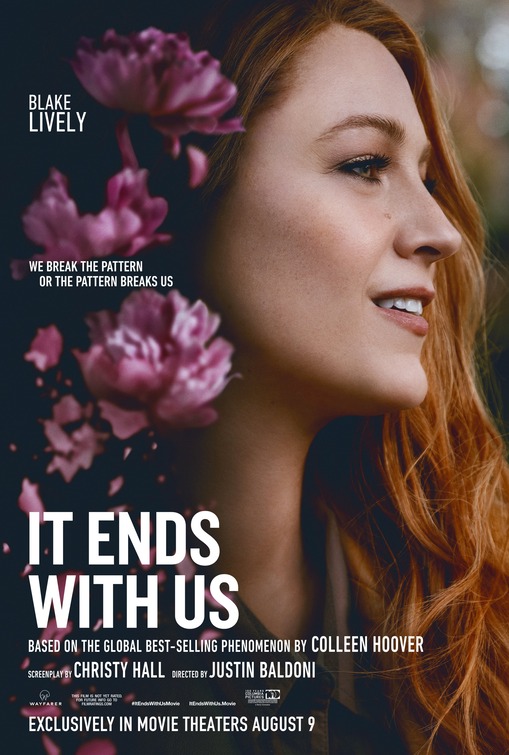
Dub’s Take: It Ends With Us (2024)

A spoiler-free mini movie review.

1 out of 5

You are forgiven for thinking “It Ends With Us” (aka. IEWU) is an ‘important’ movie, what with all the rigamarole behind its scenes. Trust me to tell you like it is, and IEWU did not end soon enough.

Lion’s share of blame is awarded to director/star Justin Baldoni, and not for the same reasons as his now-mangled future career prospects: long passages are staged & shot flatly like community theatre, with a never-ending rooftop meet-cute beheading the pacing right out of the gate; line-readings recall Hulu’s “The Handmaid’s Tale,” built on plot reaction rather than action; and Blake Lively’s Lily Bloom is fitted into tight, sexy tops that certainly made me envious of her current beau Ryan Reynolds, but are a betrayal of the self-taught defences of her character on-screen.

Original author Colleen Hoover ain’t no saint neither, and IEWU’s greatest fault is its disingenuous take on domestic violence. These handful of scenes are told with an unreliable presentation, tricking the audience into wondering whether Baldoni’s toxic neurosurgeon Ryle isn’t such a bad guy… until the contemptuous slow-motion reveal in the third-act spells it out.

It’s hard to say whether IEWU would have benefitted from an unflinching eye opposed to the choppy PG-13 implications we got here instead. What’s crystal-clear, however, is both leads’ reverse dramatic-irony that would be overanalyzed in literary form (such as Ryle’s shoulder-shrugging in the climax) lands here with a thud because of the meandering cinematic handling of the core narrative. The hot & heavy courting Lily puts Ryle through is starkly contrasted to how easily triggered she is, despite his adamance of love, and neither’s behaviour is ever studied beyond its broad strokes.

This isn’t to fault Lively’s performance, which is about as good as the material will allow, but I only ever had empathy for Amy Morton’s underused Mama Bloom. Certain people in life continue to make poor choices despite being compulsively aware of the signs, but a romance centered around these otherwise well-educated, well-intentioned one-percenters who all run their own businesses is perhaps the wrong podium.

It Ends With Us is an overlong message movie that fails in its amateur, sanitized telling. Only you, the potential viewer, know whether you would have paid full price to see this in theatres. At what point can I walk out and still get a refund?


Poster sourced from impawards.com. What do you think? Keeping up with all the drama, I was expecting an oral sex scene after Lively’s lawsuit mentioned that Baldoni wanted more, only to find there wasn’t any simulated sex in the movie at all. Are you telling me that Justin wanted an oral sex scene just because? Does its feuding leads impact your impressions of the film itself? Are you like me, and the drama is the reason you decided to watch it in the first place? Let us know in the comments below!

Dub’s Take: Kraven The Hunter (2024)

A spoiler-free mini movie review.


1 out of 5

Remember in “Back to the Future”, when Marty is auditioning for the Battle of the Bands and Huey Lewis tells him he’s “too darn loud?” So quiet & subdued 80% of “Kraven The Hunter” was, that I could clearly hear the shakey leg of the phobic teenager sitting in the row behind me with their 10-person family entourage. They wanted to be anywhere else, too.

Let’s draw the same comparisons every other review is: between this & Chris Nolan’s “Batman Begins”. While their narrative direction differs, Batman’s opening salvo is tightly edited, dynamically paced, and Hans Zimmer’s soundtrack effectively ‘mickey-mouses’ every scene.

After Kraven’s prologue (freely-available to view on YouTube), there’s a twenty-minute passage with no music, no action, and non-stop dialogue. Aaron Taylor-Johnson eventually bites someone’s cheek off in a fountain of CGI gore, but it segues to another long section with tedious exposition, and Aaron’s incessant fourth-wall mugging.

Legacy director Quentin Tarantino says there are no more movie stars in modern Hollywood, and Aaron is a good thesis. He’s handsome, charismatic, and clearly committed to the role (physically-speaking), but the self-awareness of his line readings betrays the serious tone of the rest of the picture – particularly in Russell Crowe & Alessandro Nivola’s sobering villains. A dozen buffalo are graphically killed by poachers, but all Aaron has for them are poster quips.

Kraven betrays its audience in more overt ways than merely contemptuous acting & a lack of trust. Poor pacing may be covered-up in post-production, but bad timing is entirely a director’s fault, and J.C. Chandor (“A Most Violent Year”) has no clue how to stage action for the mainstream. At one point, a phase-shifting antagonist appears behind someone to shoot them, but when we cut to the reveal, it’s a full beat before the trigger is pulled. Why wait so long? Why is a ten-second throwaway bar shootout halfway through framed clearer than a climactic scene in a monastery? Why is a CGI cutaway of Aaron jumping out a thirty-floor window the most exciting single sequence?

Kraven’s two hours are only passingly engaging, no one looks like they’re having a good time except Aaron (and at the viewer’s expense), and Chandor is more concerned with pretentious drama than Christmas entertainment for the masses. I wanted to like it, but Kraven is lifeless, and not loud enough.


Movie poster sourced from impawards.com. What do you think? Are you glad the Sony-verse of Spider-Man villain origin stories are over, for now? Do you think Aaron’s smugness will play better should he be hired as the next James Bond? Did you like Kraven’s CGI fuzz (including a tank of a lion, an inquisitive eagle, and a very hairy Russian bear) as much as my wife & I did? Leave your comments below, and Happy Holidays!

Dub’s Take: Subservience (2024)

A spoiler-free mini movie review.


4 out of 5

My 2007 grip & gaffing instructor Dave Gordon used the term “Golden Topping Land” (after the artificial popcorn butter) to denote a cinema audience’s suspension of disbelief, so long as nothing dumb happens in the story, or a microphone dips into the shot. It’s to “Subservience’s” credit that it had me in Golden Topping Land its whole duration, save two key points: trying to pass a black Tesla off as an electric Mustang, and Megan Fox’s lack of neck make-up.

I’m a chauvinist: there I was the morning after watching, recommending it to someone as “the Megan Fox sex-bot movie on Netflix”. Yes, Megan pretty-much shows as much of her body here that a R-rating & no-nipple clause will allow. But Subservience has more up its sleeve than mere sleeze, not the least of which its three leads: all of whom put out intense performances like they’re out to prove something.

It’s been easy to write off Megan’s acting career as ostentatious, but she does try serious work when & where the industry will allow (“Passion Play”; “Midnight in the Switchgrass”) and she presents great value to the role here, despite it being a robot, and another vessel in a filmography defined by transfixing the male gaze. Her gender-swapped body double Michele Morrone (“365 Days”) is here as well, playing Megan’s stooge, and Madeline Zima as Mike’s terminally-ill wife. Madeline shocked me since, growing up with “The Nanny,” I wasn’t prepared to see little Gracie fully grown & fully naked. She puts on a persuasive show, though, and could find work in more erotic thrillers moving forward, if that’s what she decides.

The most pronounced flaw is in the film’s otherwise-strong script, which introduces dynamic world-building that plays a passive second to the movie’s main focus, which is Megan usurping the family. A subplot about a construction crew being replaced raises valid questions about the world’s future labour force, but it doesn’t go anywhere narratively except to illustrate that Megan has murderous tendencies, when the same point is already proven in her attempts to kill Madeline.

Subservience’s on-the-nose dialogue about modern relationships is compelling enough without being overcomplicated by empty lore, or its two endings. Producers could have saved some money, too, had they just concentrated on the sex-bot in the house. That part of the movie is good, for reasons other than solely Megan, Michele, or Madeline’s smokey stares.


Poster sourced from impawards.com. I never thought I would say this, but Subservience’s broader strokes may have played better had the film been a limited series instead. What do you think? Why are the surgeons’ mouths sealed shut? What is the social structure of a society where all labour is replaced by automation? Just ‘what’ were those things on the soles of Megan’s shoes? Leave your thoughts in the comments below!

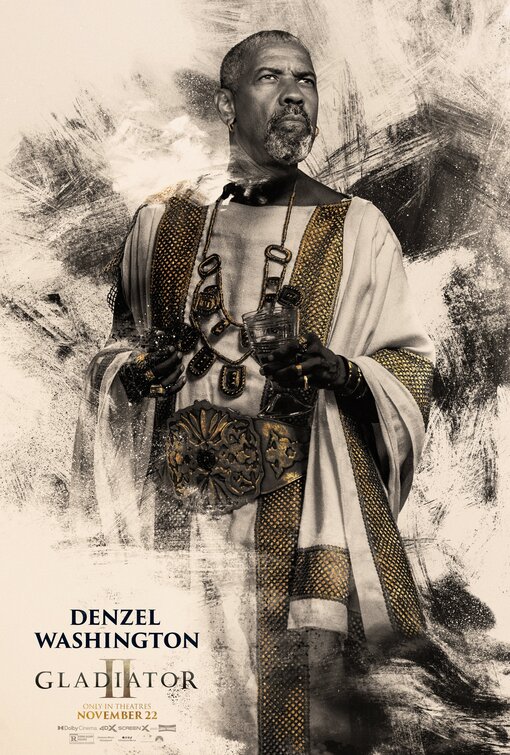
Dub’s Take: Gladiator II (2024)

A spoiler-free mini movie review.


4.5 out of 5

Some may read “Gladiator 2” (aka. G2) star and newcomer Paul Mescal’s story about his first-day interaction with director Ridley Scott as a stormtrooper’s royal rejuvenation, and others as the exclamation of a stubborn octogenarian: Mescal was nervous, and Sir Ridley came up to him brandishing a cigar and bellowed, “Your nerves are no good to me!”

I was in the latter camp. I’ve argued before that the 86-year-old’s recent output – in a career that has dipped into every genre other than musicals & animation – has felt like a sell-out when contrasted against the era of “Alien” & “Blade Runner 1″. These new projects have released too close together and are a roller-coaster of inconsistent quality (2021’s “House of Gucci” is 2 stars at most, while the same year’s “The Last Duel” is borderline 5). On top of that, he’s been talking about rehiring creepy-guy & Kremlin-espouser Gérard Depardieu to redub “1492”: a sign the auteur is experiencing some revisionist blues in his autumn years.

But G2 is so good, it made me rethink my pessimistic opinion toward Scott’s oeuvre. Director-of-photography John Mathieson was ‘misquoted’ in an interview, calling Scott “lazy” because he rushes through takes & shoots multi-cam. Surely, Scott has just uncovered the Grand Unifying Theory of filming quick & cheap on the studio’s dime: something the turbulent, cash-hemorrhaged industry post-COVID has been foraging for. All that’s left is Steven Soderbergh editing backstage and your $300-million historical epic will be done in a wisp.

Without taking away the throwback CGI & some script revisions, G2 could be a straight remake of the 2000 original. It’s huge in scope but easy to follow, with enough grue to satisfy my masculine desire, and a motley crew of supporting actors (Peter Mensah; Tim McInnerny; Matt Smith) who made me happy to see working.

The half-star deduction, believe-it-or-not, is predominantly against Denzel Washington. Don’t get me wrong, I’m glad to see he’s enjoying his semi-retirement, but for a character who’s so integral to the movie’s denouement, Washington plays him superficially guileful: listen to how he pronounces “power” & “politics” at key points. And don’t get me started on that stupid monkey, and the one-too-many speeches at the tail-end.

Otherwise, from a technical perspective, Gladiator 2 is flawless. Film-stock purists should be documenting Scott’s methods for staying on-schedule & on-budget instead of deriding them: it’s the future.


Poster sourced from impawards.com. What do you think? Was a “Gladiator” sequel pointless, or justified? Are you impressed that it went from script-to-screen in a year (not including the 23 it took to develop)? Were the flashback clips alienating, or a handy reminder? Was Tim McInnerny the one Denzel was talking about when he said he kissed a guy “full on the lips”? Do you think Peter Mensah’s role will be expanded in the inevitable Director’s Cut release? And, possibly most important, do you think we’re headed for a period when, finally, we won’t have to hear about Pedro Pascal for at least a year, or do you think his MCU casting ensures he’ll dominate our screens into the foreseeable future? Leave you comments below!

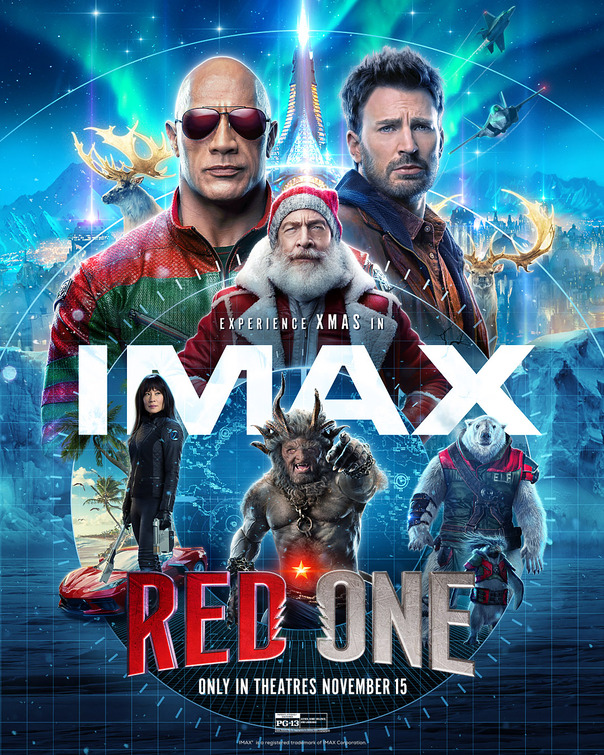
Dub’s Take: Red One (2024)

A spoiler-free mini movie review.


1.5 out of 5

Al Pacino’s been in the press promoting his new autobiography, and in a Variety interview, he discussed his divisive work choices in the 2000s: “…When you make $10 million dollars for a film … it’s $4.5 million (net) in your pocket. But you’re living above that because you’re high on the hog. And that’s how you lose it.”

I hadn’t seen a single trailer for “Red One” (aka. RO) before release: not in theatres, nor on any of my subscribed streaming services. All I had was what I’d read in the press: two conflicting pieces about producer/star Dwayne Johnson being unprofessional & overly generous on-set (despite floating the idea of RO in the first place); and an opinion piece about Chris Evans’ post-Avengers career torpedoing his “Captain America” legacy.

It’s unlikely Dwayne & Chris’ NDAs will let them admit the truth anytime soon. But this all created an interesting convergence of critical opinion & celebrityism in the public sphere, into my own assumptions as a potential viewer: I saw one leading man working to cultivate his image, and the other his lifestyle.

But RO’s first act played better than reviews suggested: a campy take on the action buddy-comedy through a Christmas lens. There was even a point I was prepared to put it on my 4-star Shelf Of Shame along with “Madame Web” & “The Crow”: two other widely-panned 2024 releases that I kinda, sorta liked a lot. How could you not like a movie with the line, “her ass punished us with its obscene wind”?

But whether it was the behind-the-scenes controversies, a creative lapse by director Jake Kasdan, or a masochistic storm of both, Kasdan can’t help recalling the airy, non-directional pacing of his 1998 debut “Zero Effect” instead of the manic, feature-length energy of his two “Jumanji” sequels. Rather than jumping systematically point-to-point like a tentpole picture should, Kasdan’s textured beats eventually sabotage the blockbuster nature of the two-hour film, for which the ultimate goal should be to get audiences in and out of the theatre as quickly as possible.

Don’t get me wrong: I love Zero Effect – so much so, I plagiarized part of it for a high school English assignment. But ZE is about characters with no social skills, and Red One is supposed to be a madcap, high-concept Holiday smash. What it is, is boring, and that’s low-key devastating.


Poster sourced from impawards.com. What do you think? Are audiences headed for a new renaissance of Holiday pictures, or is the Golden Age over and all Christmas movies after 2010 forgettable filler? Aren’t seasonal movies filler by definition, or are there some like “Home Alone” that you can watch all year long? Do you side with my wife and think the talking polar bear & Krampus were enough to make Red One a classic? Leave your opinion in the comments below!