Dub’s Take: Despicable Me 4 (2024)

A spoiler-free mini movie review.


NO STAR RATING

Poppy Prescott gives me impure thoughts.

You’ve heard of Disney animators slipping naughty easter-eggs into their features. These were blink-and-you’ll-miss-‘em moments you’d catch on repeat viewings: there was no way anything more than a few milliseconds of indiscretion could make it passed pre-2000 executives; a ratings board; test audiences; and any other stop-gaps preceding a theatrical release.

But Disney doesn’t ride today’s market solo anymore, and – speaking generally – the competition is becoming more shameless for your dollar. This isn’t to say modern family movies are inundated with sex & violence: I’m not that out of touch. But you can crack a specially-worded joke in a diplomatic way and still keep your coveted PG rating.

Case-in-point: “Despicable Me 4″‘s Poppy. As voiced by Joey King (who just headlined Netflix’s “Uglies”), Poppy is a bratty, overprivileged redhead, sporting a skirt; braces; freckles; and a lisp, and who blackmails & uses Gru… for a heist! Poppy’s age isn’t explicitly stated but I trust my ten-second Google search that labelled her 14.

King’s voice work is chipper and snotty: just how it needs to be. But Poppy doesn’t speak until three-scenes-in, after she’s already thrown Gru knowing glances that communicate, as per the plot, that she knows his secret identity. But all I saw in these lingering shots were Alicia Silverstone from “The Crush” or Drew Barrymore from “Poison Ivy”: villains from a special androcentristic subsection of 90’s erotic thrillers that revolved around psychotic, hypersexual adolescent homewreckers.

My post-secondary discipline was live-action film – not animation. The closest my practice ever got was having to re-record dialogue when a covert HVAC system went off in the background of a shot. In that case, the intention of the scene had already been established. We just did the audio again: somewhere quiet, and hopefully to the same level of emotion as the video. What I want to know then is whether DM4’s visual creatives told King about their non-verbal goals for Poppy before she recorded the dialogue, or if King found out what they did at the premiere while everyone around her made the same lewd joke about what they were seeing.

There’s no way an innocent kid in the audience is detecting a sexual undercurrent in their new Minions movie. That’s just for us mature adult credit card holders.


Poster sourced from impawards.com. If you even care at this point, the overall movie was fine: the Minions do their thing; voice-leads Steve Carell & Will Ferrell do their thing; and there’s a madcap energy that keeps the pace moving even when the comedy fell on the ears of the wrong demographic. If I had to give it a proper star rating, I’d throw it a 2 out of 5. Anything to add to the conversation? That’s what the comment box below is for!

Dub’s Take: Color of Night (1994)

A spoiler-free mini movie review.


1 out of 5

Have you had a conviction so strong that it was a shock to be disproven?

Case-in-point: “Color of Night” (or CON) was declared as having “The Hottest Movie Sex Scene of All-Time” in 2015 by men’s periodical Maxim. Sorry to break it to you: CON has one (1) sex scene in it – or sex ‘chunk’ – totalling less than five minutes of the well-over two-hour runtime of the Director’s Cut I watched.

By last decade’s standards, what is here for sex is hardly pervasive. Maxim’s writer asked, what man wouldn’t love being cooked a steak by a nude Jane March? True, but that’s “sexy”: not “sex”. And if we take sex out of the critique now completely, it still leaves quite a bit of movie behind to try and stand on its own merit.

CON plays comparably to your studio-made, 90’s-produced erotic thriller, with its own twists that will-or-won’t pay off for obsequious viewers. The script by Billy Ray (who later penned Bruce Willis’ 2002 film “Hart’s War”) is about the masks people wear & the moments we catch ourselves in our truth, and he uses group therapy as a story device to bring our oddball group of suspects together & point the finger.

But Willis’ protagonist also interrogates each group member individually, and these scenes grind like similar sequences from detective video games (think “L.A. Noire”), which is only fun for the people actually participating.

Truly, both of Ray’s scripts have the same problem. While Hart’s War lacked thematic focus – jumping incoherently between genres – CON lacks narrative focus: the group therapy scenes are enough to make me suspect each character without the “keyhole” into everyone’s life; the protagonist’s hook of psychosomatic colourblindness isn’t used assertively enough in the plot; and the ending is nihilistic, and problematic when viewed through a modern lens of gender inclusion.

Putting CON on a pedestal like Maxim did imposes certain audience presuppositions, possibly even that it’s some sort of sleazy, forgotten cult-classic. Certainly the cast is full of eclectic performers doing what they do best, the cinematography – heavy on split diopter shots – is intriguing, and late director Richard Rush’s familiarity with complex stories (like his “The Stunt Man” from 1980) meant that I was never unintentionally confused as a viewer.

But overall, Color of Night is too long and fails to fully capitalize on its best ideas.


Poster sourced from impawards.com. Even the Wayback Machine couldn’t fix whatever issue Maxim’s website has with the article, so you’ll just have to trust that I’ve read it before. Leave your nomination for “The Hottest Mainstream Movie Sex Scene of All-Time” in the comment section below!

Dub’s Take: The Crow (2024)

A spoiler-free mini movie review.


4 out of 5

“The Crow 2024” is metal: something I don’t think anyone expected.

Director Rupert Sanders doesn’t have a prolific filmmaking career, but he did helm 2017’s live-action “Ghost in the Shell”, which wasn’t terrible, and his Crow reboot isn’t terrible either, despite taking two years after shooting to show up in theatres.

Delays like that could mean all sorts of things, usually negative: a lack of faith behind-the-scenes from the people with the money. Howbeit this is odd, since Crow – which started out as a comic series in the late-eighties – has bounced back a few times in media from the tragedy of Brandon Lee’s death while filming the first film adaptation.

How much of the property’s enduring popularity, then, can be attributed to the singular act of Lee’s passing, or the straightforward immediacy of the source material? Rewatching the 1994 film, I was taken aback by how out-of-place its comedic relief resonated – particularly in the pawn shop scene – at the expense of thematic consistency. I’ve never read the comic so correct me if I’m wrong, but those one-liners felt more like additions to coalesce with the Lee family idiom * than to move the plot forward in a congruent way.

In complete contrast, 2024’s Crow doesn’t have any tonal brevity: it’s as emo as the tattoos on Bill Skarsgård’s face, and that could be one piece to its ultimate box-office demise. The film is so committed to its core concept that there’s hardly any fun to be had for passive viewers.

If you can roll with that, Crow is as much solid, stand-alone, yet disposable entertainment as “Madame Web” was back in February: I submitted to Skarsgård’s charisma; the reliable Danny Huston as the antagonist; the script’s spiritual leanings; and the central romance with a convincing FKA twigs. Holding it back from first-class territory were a truncated courting montage – which could have been longer to increase my empathy for the heroes – and some lame CGI in the finale that made me long for the classic squib work of someone like Paul Verhoeven.

In the film, twigs calls Skarsgård “brilliantly broken”, and I believed it. It’s a testament, then, to everyone’s craft that The Crow’s sixth outing to the screen (including the TV series) didn’t end up as another wounded bird.


*see my review of Brandon’s “Rapid Fire” for supplementary impressions.

Poster sourced from impawards.com. Did you know that you can click on the posters in my recent reviews to link directly to the film’s IMDB page? Wicked Cool, and saves you from typing! Leave your suggestions for other unavailing accessibility options for the site in the comments below!

Dub’s Take: Never Let Go (2024)

A spoiler-free mini movie review.


4 out of 5

For all the five-dollar words I throw around here, I don’t think I’ve used discourse yet. Interpreting ‘discourse’ – or, “the meaning that we apply to things” – was a huge component of my first-year art school syllabus, along with learning what a paintbrush & canvas are for. Duh.

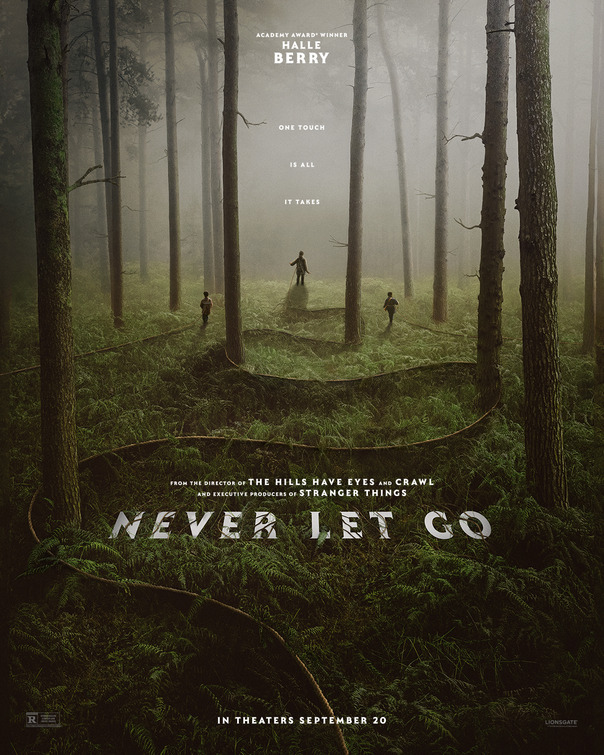
Director Alexandre Aja’s cinematic discourse morphs between two categories: horror, for fans of his breakouts “Haute Tension” and 2006’s “The Hills Have Eyes”; contrasted by the modern fables “The 9th Life of Louis Drax” and “Horns”. “Never Let Go”, with its chapter cards and brothers Grimm references, falls squarely into the second camp. While its moral isn’t spelled out, I took it as not losing sight of one’s humanity, even in the face of insurmountable odds – whether those are real or imagined.

Never Let Go is brutal, starting its characters off in deep crisis instigated by decades of off-screen trauma. Halle Berry is a dependable actress playing an unreliable protagonist: the script is aware it can end only one of two ways (or the dreaded third), and plays with the possibilities from its outset. It’s a challenging narrative tightrope, made more disturbing by audacious scenes of child endangerment.

But the ‘ropes’ – despite not being physically long enough to be coherent – are a fascinating thematic snare, and the cinematic framing of the central woodland location and its inhabitants is stellar: the constituents of the forest, which may or may not be hallucinations, unveil their biological horror through the production’s expert use of darkness & shadow. While the story doesn’t conclude with a traditional twist, there’s an excellent wrench thrown in to the plot earlier than anticipated. Shame it opts for the third ending, though.

With regard to the two child stars, I can say from first-hand experience that managing child actors can be incredibly stressful, with the possibility of little reward. Sadly, as in life, children exist, and it’s relieving to say, then, that the two young men here who anchor the film do work that is unworthy of captiousness: they didn’t once take me out of the experience.

Never Let Go had me unsettled, angry, depressed, nervously laughing out-loud, bewildered, and ultimately mesmerized. Shouldn’t that be the discourse of good cinema?


Poster sourced from impawards.com. What do you think? Are you a fan of Aja’s horror movies, his trilogy (at present) of contemporarily-set fairy tales, both, or neither? Do you think Halle Berry puts on a good show regardless of what she’s acting in, or do you think the choice of role reflects the actor and Berry’s inconsistent filmography speaks for itself? What’s your interpretation of “the dreaded third ending”? Leave your comments below!

Double-U’s Double-Take: Alien Romulus

A spoiler-lite mini movie re-review.


Leave it to “Alien 2” director-cum-marine biologist James Cameron to tell it like it is: “The trolls will have it that nobody gives a shit … then they see the movie again and go, ‘Oh, okay, excuse me, let me just shut the fuck up right now.’ ”

He was, of course, referencing his first “Avatar”. Some will say that Avatar’s purpose was/is entertainment and, yes, millions of people can’t be wrong. But I’ve reluctantly seen the first film three times, and re-watching it twice over didn’t make me value what Cameron had accomplished any more: it just made me numb to it. I can’t appreciate the pretty picture if it serves a vapid purpose.

While Cameron has the privilege of an unlimited budget & complete creative control, the “Alien” franchise has consistently reinvented itself over the decades, accented by shrinking returns under different directors who, largely, have all have brought something new to the table – but to no lasting conformist appeal.

I have now digested “Alien 7” twice. I used to think seeing any movie more than once at full-price was a sign of constancy (“The Island“) – now I’ve apparently entered the life phase of keeping my mouth shut while I tolerate an afternoon with my curmudgeonly dad and he says he wants to see something.

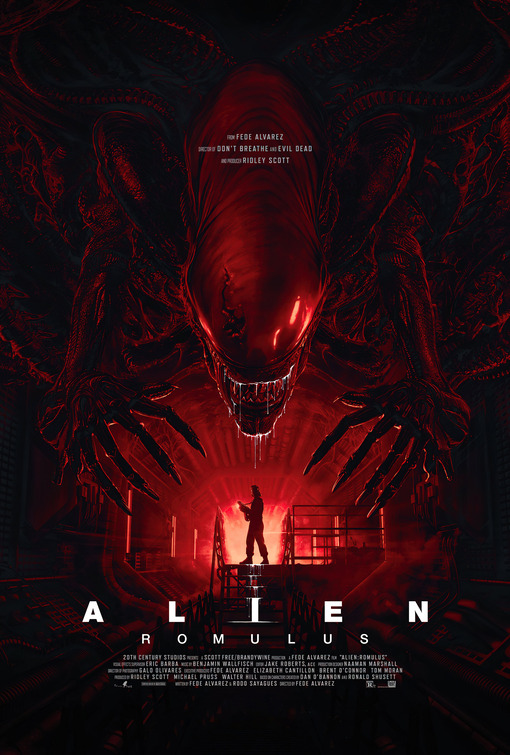
My greatest detachment this second spell came from how we are seven movies in to this series – not including the various spin-offs – and producers still haven’t indulged audiences with a more thorough study of the xenomorph social structure, or how they go about plastering all that sticky gunk to the walls. Director Fede Alvarez’s team introduces cocooning, but how the Hell was it forged in the span of a few minutes? I would have even taken a cheesy shot of the baby xenomorph spitting black goo at the wall and just have the whole thing appear out of nowhere. A slimy new bit of set-dec of its own accord is not compelling anymore – not in this series.

Rather than existing as its own entity within the ‘Alien cinematic universe’, Romulus is Alvarez pulling a de Sade, using his own blood to scribble all the things he loved about the films that came before onto toilet paper, and all the ways he thought he could make them better.

Click here for the original review.


Poster sourced from impawards.com. Despite trying to go in with no expectations this time around, I still couldn’t help hypothesizing alternate scenarios to the reanimation of Ian Holm: couldn’t they have used Lance Henriksen instead? Wouldn’t Bishop have been the ‘hot, new’ synthetic, going off Romulus’ place in the series chronology? Wouldn’t Henriksen – who’s made a career playing literally anyone in anything – have jumped at the opportunity to approach the role from a more maniacal angle, such as his own Weiland from “AVP”? Could you help picturing the ‘Dream Team’ of Fassbender & Henriksen instead of Jonsson & Not-Holm, or did you even care? Let me know in the comments!