A spoiler-free mini movie review.
1 out of 5
You are forgiven for thinking “It Ends With Us” (aka. IEWU) is an ‘important’ movie, what with all the rigamarole behind its scenes. Trust me to tell you like it is, and IEWU did not end soon enough.
Lion’s share of blame is awarded to director/star Justin Baldoni, and not for the same reasons as his now-mangled future career prospects: long passages are staged & shot flatly like community theatre, with a never-ending rooftop meet-cute beheading the pacing right out of the gate; line-readings recall Hulu’s “The Handmaid’s Tale,” built on plot reaction rather than action; and Blake Lively’s Lily Bloom is fitted into tight, sexy tops that certainly made me envious of her current beau Ryan Reynolds, but are a betrayal of the self-taught defences of her character on-screen.
Original author Colleen Hoover ain’t no saint neither, and IEWU’s greatest fault is its disingenuous take on domestic violence. These handful of scenes are told with an unreliable presentation, tricking the audience into wondering whether Baldoni’s toxic neurosurgeon Ryle isn’t such a bad guy… until the contemptuous slow-motion reveal in the third-act spells it out.
It’s hard to say whether IEWU would have benefitted from an unflinching eye opposed to the choppy PG-13 implications we got here instead. What’s crystal-clear, however, is both leads’ reverse dramatic-irony that would be overanalyzed in literary form (such as Ryle’s shoulder-shrugging in the climax) lands here with a thud because of the meandering cinematic handling of the core narrative. The hot & heavy courting Lily puts Ryle through is starkly contrasted to how easily triggered she is, despite his adamance of love, and neither’s behaviour is ever studied beyond its broad strokes.
This isn’t to fault Lively’s performance, which is about as good as the material will allow, but I only ever had empathy for Amy Morton’s underused Mama Bloom. Certain people in life continue to make poor choices despite being compulsively aware of the signs, but a romance centered around these otherwise well-educated, well-intentioned one-percenters who all run their own businesses is perhaps the wrong podium.
It Ends With Us is an overlong message movie that fails in its amateur, sanitized telling. Only you, the potential viewer, know whether you would have paid full price to see this in theatres. At what point can I walk out and still get a refund?
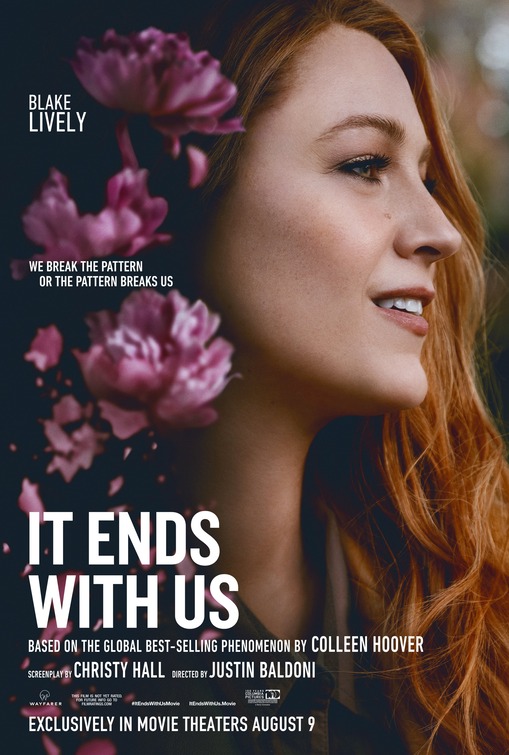
Poster sourced from impawards.com. What do you think? Keeping up with all the drama, I was expecting an oral sex scene after Lively’s lawsuit mentioned that Baldoni wanted more, only to find there wasn’t any simulated sex in the movie at all. Are you telling me that Justin wanted an oral sex scene just because? Does its feuding leads impact your impressions of the film itself? Are you like me, and the drama is the reason you decided to watch it in the first place? Let us know in the comments below!

 theory of a daskeman