Dub’s Take: Flight Risk (2025)

A spoiler-free mini movie review.


1 out of 5

I think it was “Plastic Bag” & “99 Homes” director Ramin Bahrani who said he hasn’t use for narrative over-explication, since audiences statistically weren’t going to show up for his movie unless they’d seen a trailer first.

With that in mind, if you’ve seen the trailer for “Flight Risk,” you don’t need to show up at all: there are no additional story twists; a sleepy soundtrack; a reliance on juvenile humour; obvious acting; and zero flair from a director I expected more from.

For the second time this year already, I ask: what the Hell happened? Mel Gibson may strike malaise in the hearts of certain cinephiles, but he’s still directed some bangers. Similar to Kevin Costner’s self-produced features, Gibson indulges in unhinged hero worship at the centre of large-scale story conflict.

Flight Risk, then, offered Mel the chance not only to follow his first female protagonist, but to attempt a ‘bottle feature:’ just a handful of actors in one location. Sadly, he doesn’t deliver on the juj Flight Risk’s predictable, placid plotting needs.

Take the reveal that Mark Wahlberg’s psychotic hitman is actually balding: rather than pay homage to Hitchcock’s “Psycho” and overplay the moment, it’s a throwaway image lacking luridness or camp. Had the production shot some alternate takes with hair so the bald head was a surprise, my reaction may have differed, but drab also sums up composer Antonio Pinto’s sparse soundtrack, which should be driving the story during the frequent moments it can’t carry itself.

Joining Mark are “Downton Abbey’s” Michelle Dockery, whose pastiche of stoic cop tropes forgets the Aviators – which she pulls out an hour too late for her arc – along with poor Topher Grace as a sharp-tongued, pushing-50 Eric Forman. Maybe Netflix audiences new to “That 70’s Show” will find his schtick appealing, but I’ve watched Topher play the same character now for almost thirty years. I’m done.

The film starts getting good in its final 10, which crams 90-minutes worth of action – that should have been evenly spaced throughout the rest of the picture – all into the climax, including one unexpectedly juicy bit of gore just because. If you fall asleep or turn it off before that, though, I won’t blame you.

Watching Flight Risk is to learn the hard way that Mel Gibson’s directorial idiom shouldn’t be through a macro lens.


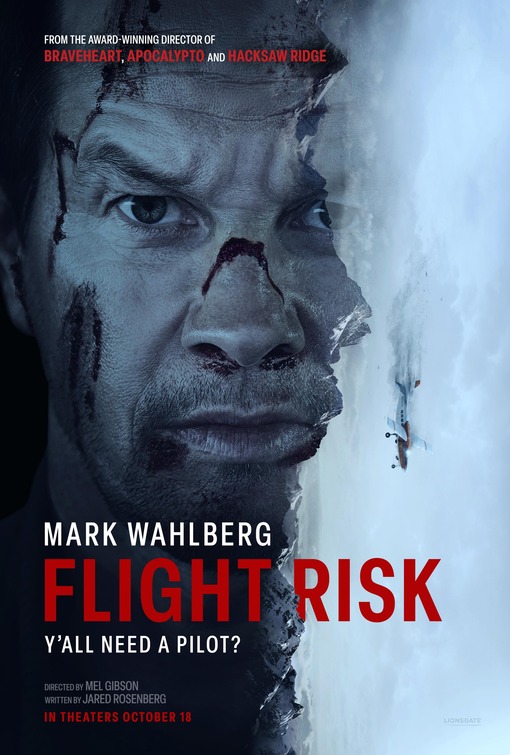
Poster sourced from impawards.com. What do you think? Could Flight Risk’s advertising have benefitted from some Marvel Studios-style misdirection, even extending to shooting certain pivotal scenes more than once? Would the film have been more engaging had Topher Grace recycled his serial killer from 2010’s “Predators” and played the villain here instead? Will Michelle Dockery even still have a career after this, besides the recently-announced “Downton Abbey 3?” Are YOU stoked for “The Passion 2?” Let us know in the comments below!

Dub’s Take: Subservience (2024)

A spoiler-free mini movie review.


4 out of 5

My 2007 grip & gaffing instructor Dave Gordon used the term “Golden Topping Land” (after the artificial popcorn butter) to denote a cinema audience’s suspension of disbelief, so long as nothing dumb happens in the story, or a microphone dips into the shot. It’s to “Subservience’s” credit that it had me in Golden Topping Land its whole duration, save two key points: trying to pass a black Tesla off as an electric Mustang, and Megan Fox’s lack of neck make-up.

I’m a chauvinist: there I was the morning after watching, recommending it to someone as “the Megan Fox sex-bot movie on Netflix”. Yes, Megan pretty-much shows as much of her body here that a R-rating & no-nipple clause will allow. But Subservience has more up its sleeve than mere sleeze, not the least of which its three leads: all of whom put out intense performances like they’re out to prove something.

It’s been easy to write off Megan’s acting career as ostentatious, but she does try serious work when & where the industry will allow (“Passion Play”; “Midnight in the Switchgrass”) and she presents great value to the role here, despite it being a robot, and another vessel in a filmography defined by transfixing the male gaze. Her gender-swapped body double Michele Morrone (“365 Days”) is here as well, playing Megan’s stooge, and Madeline Zima as Mike’s terminally-ill wife. Madeline shocked me since, growing up with “The Nanny,” I wasn’t prepared to see little Gracie fully grown & fully naked. She puts on a persuasive show, though, and could find work in more erotic thrillers moving forward, if that’s what she decides.

The most pronounced flaw is in the film’s otherwise-strong script, which introduces dynamic world-building that plays a passive second to the movie’s main focus, which is Megan usurping the family. A subplot about a construction crew being replaced raises valid questions about the world’s future labour force, but it doesn’t go anywhere narratively except to illustrate that Megan has murderous tendencies, when the same point is already proven in her attempts to kill Madeline.

Subservience’s on-the-nose dialogue about modern relationships is compelling enough without being overcomplicated by empty lore, or its two endings. Producers could have saved some money, too, had they just concentrated on the sex-bot in the house. That part of the movie is good, for reasons other than solely Megan, Michele, or Madeline’s smokey stares.
Poster sourced from impawards.com. I never thought I would say this, but Subservience’s broader strokes may have played better had the film been a limited series instead. What do you think? Why are the surgeons’ mouths sealed shut? What is the social structure of a society where all labour is replaced by automation? Just ‘what’ were those things on the soles of Megan’s shoes? Leave your thoughts in the comments below!

Dub’s Take: Color of Night (1994)

A spoiler-free mini movie review.


1 out of 5

Have you had a conviction so strong that it was a shock to be disproven?

Case-in-point: “Color of Night” (or CON) was declared as having “The Hottest Movie Sex Scene of All-Time” in 2015 by men’s periodical Maxim. Sorry to break it to you: CON has one (1) sex scene in it – or sex ‘chunk’ – totalling less than five minutes of the well-over two-hour runtime of the Director’s Cut I watched.

By last decade’s standards, what is here for sex is hardly pervasive. Maxim’s writer asked, what man wouldn’t love being cooked a steak by a nude Jane March? True, but that’s “sexy”: not “sex”. And if we take sex out of the critique now completely, it still leaves quite a bit of movie behind to try and stand on its own merit.

CON plays comparably to your studio-made, 90’s-produced erotic thriller, with its own twists that will-or-won’t pay off for obsequious viewers. The script by Billy Ray (who later penned Bruce Willis’ 2002 film “Hart’s War”) is about the masks people wear & the moments we catch ourselves in our truth, and he uses group therapy as a story device to bring our oddball group of suspects together & point the finger.

But Willis’ protagonist also interrogates each group member individually, and these scenes grind like similar sequences from detective video games (think “L.A. Noire”), which is only fun for the people actually participating.

Truly, both of Ray’s scripts have the same problem. While Hart’s War lacked thematic focus – jumping incoherently between genres – CON lacks narrative focus: the group therapy scenes are enough to make me suspect each character without the “keyhole” into everyone’s life; the protagonist’s hook of psychosomatic colourblindness isn’t used assertively enough in the plot; and the ending is nihilistic, and problematic when viewed through a modern lens of gender inclusion.

Putting CON on a pedestal like Maxim did imposes certain audience presuppositions, possibly even that it’s some sort of sleazy, forgotten cult-classic. Certainly the cast is full of eclectic performers doing what they do best, the cinematography – heavy on split diopter shots – is intriguing, and late director Richard Rush’s familiarity with complex stories (like his “The Stunt Man” from 1980) meant that I was never unintentionally confused as a viewer.

But overall, Color of Night is too long and fails to fully capitalize on its best ideas.


Poster sourced from impawards.com. Even the Wayback Machine couldn’t fix whatever issue Maxim’s website has with the article, so you’ll just have to trust that I’ve read it before. Leave your nomination for “The Hottest Mainstream Movie Sex Scene of All-Time” in the comment section below!

Dub’s Take: Killer’s Kiss (1955)

A spoiler-free movie review.


2 out of 5

It’s a mistake to confuse pity with love.

Stanley Kubrick’s second narrative feature “Killer’s Kiss” is a remarkable step-up in quality from his first film “Fear and Desire”, but it still ain’t no Georgia peach.

We’re talking about movies that are closer now to their centennial anniversaries than ever before, and unless you’re a Film Major in post-sec, or doing research, or you’re an old soul & actually enjoy watching older movies (the minority), or a senior (the majority), as we move further and further into the foreseeable future, it’s less likely that ensuing generations will seek out a black & white film from the 1950s, out of a largely-chauvinistic & misogynistic body of work, even if it IS a Kubrick film. Why watch this when you could watch “Full Metal Jacket” again, and possibly catch something you missed the first dozen times around? Is there even a reason to watch Killer’s Kiss in the 2020s other than what I mentioned, or possibly to farm content for a humble blog? Hmm? Read on to find out!

Continue reading