Dub’s Take: Forsaken (2015)

A spoiler-free mini movie review.


2.5 out of 5

Let’s consider the contentiousness between celebrity parents & their offspring: the Voigt/Jolie/Pitt’s; the O’Neal’s; the Barrymore’s…

The public only receives as much information that’s dished; often, that doesn’t include the forgiveness intrinsic to maintaining a healthy, life-long relationship with one’s family. That’s usually something us plebs experience ourselves, in time.

Great, then, for actor Kiefer Sutherland actually wanting to work with his late father & icon Donald. Kiefer hasn’t been featured on-screen so much since the height of COVID, what with his side-gig as a country musician. I saw him live in 2019 and, while I can’t remember his music, I think all of us in attendance were awed to see Jack Bauer/David the Daywalker in the flesh.

Where their filmography choices differ, father & son’s similar acting disciplines, and uncanny biology, can be felt in their shared scenes for the 2015 western Forsaken.

Forsaken has noble intentions – no doubt about that. It has a linear, easy-to-follow man-versus-himself redemption story, devoid of texture that doesn’t serve the plot. It has wonderfully verbose dialogue, recited melodramatically by its cavalcade of character actors (Demi Moore; Michael Wincott). It has a subversive epilogue, swapping a lovesick reunion for a tearful family goodbye. There really isn’t anything thematically wrong with it.

But it’s slow. Damn slow! Characterizations & script points are blander than superior genre examples, like Clint Eastwood’s Unforgiven (Richard Harris’ English Bob vs. Wincott’s Gentleman Dave) and Ed Harris’ Appaloosa (the love triangle). Brian Cox as the villain is Brian Cox as the villain, doing his billowy, profane Brian Cox thing – though credit goes to director Jon Cassar for convincing the Shakespearean-trained thespian to die next to a big pile of horse shit. And it’s always a bit rocking to see close-ups of gory, chunky gibs in the last ten minutes when the previous eighty lacked such morbid details.

Although only an hour-and-a-half, Forsaken feels twice as long when its quiet moments insist on themselves, like endless wood-cutting, and rumours from the church social club. If there were fewer of those hyperrealistic pauses – so common in modern prestige television – perhaps Kiefer & Donald’s understated work here would have serviced the picture as a whole, as opposed to being ‘one effective element’ of a decidedly average film.

If you want to see peak cinematic familial synchronicity, Forsaken is a low-calorie – if forgettable – clone.


Poster sourced from themoviedb.org. As of publication, Forsaken is available to watch for free in Western Canada on CBC Gem (unsponsored). What do you think? Leave us a comment below!
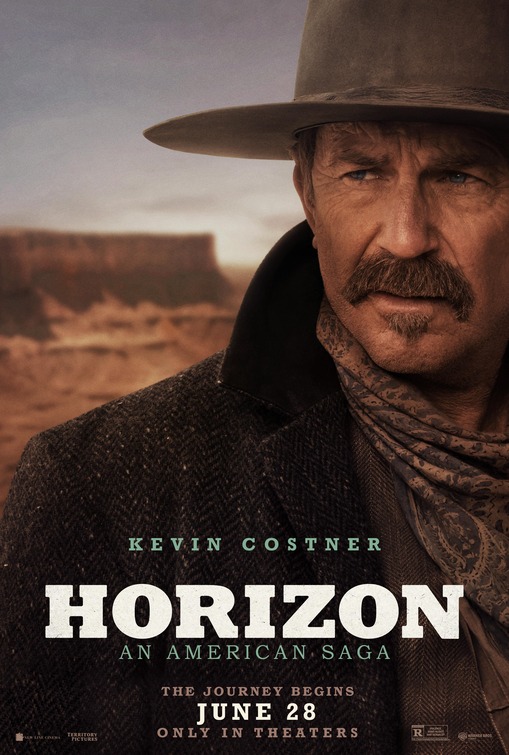
Dub’s Take: Horizon Chapter 1 (2024)

A spoiler-free mini movie review.


3.5 out of 5

In a 2022 interview, actress Emily Blunt said she’s tired of being offered roles for “strong female leads”: “I’m already out. I’m bored. … you spend the whole time acting tough and saying tough things.”

Blunt is not a candidate for a place in Kevin Costner’s Wild West, where the women hold themselves together in the face of relentless adversity. Of the major players in this, the first part of a planned four-part series, Sienna Miller, Jena Malone, and Abbey Lee leave the greatest acting impressions, even if the film’s three-hour runtime still manages to omit information about their backstories.

The greatest strength, then, of “Horizon Chapter/Part 1” was that I was OK with my questions going unanswered until the next film, or not at all. There’s a “flying by the seat of your pants” quality to the narrative, whereby Costner plunks us in the middle of a juicy patch of land in contentious Aboriginal territory, and lets the plot play itself out. In a way, it’s the perfect continuation of “Dances With Wolves”: there, Kevin rode off mid-mission only for a titlecard to inform viewers that the Indigenous genocide continued unabated. Here, the antagonistic Apaches are represented as a dwindling, dissented tribe, holed-up in the mountains, waiting for fate’s intervention.

In my review for Costner’s 2003 feature “Open Range”, I said it lacked the “Costner Factor”, likely due to a critically-induced restraint. By the Costner Factor, I’m referring to the audacity he shows by having his self-acted characters save women and dogs from drowning, fish dead bucks out of water, and drink their own piss. Say what you want about Kevin’s acting, but he’s fearless as a producer.

Here, Costner’s discipline could be laid at his 69 years, but he still frames shots in the curvature of a prostitute’s bust, gets laid even when his character doesn’t want it, and orchestrates at least two of the tensest scenes of encroaching violence outside of a horror film.

“Yellowstone” was good for about three seasons, coincidentally the number Costner was originally contracted for, but I stopped watching the latest when it was clear the show was spinning its wheels in the writers room. Horizon may be taking its sweet time in this first chapter, but I trust Costner more than Taylor Sheridan to carry me over the finish line.


Poster sourced from impawards.com. What do you think? Did you, too, think the “wagon trail” story – despite the promising ensemble of Luke Wilson, Will Patton, and Isabelle Fuhrman – is perfunctory in the face of the ultimate wagon trail simulator that is Taylor Sheridan’s “1883” (even if it was basically garbage)? How many takes of the “boob shot” did Kevin have to do before he got it “just right”? Was it necessary for Costner to use his kid in a short role, only for all the news reports about it to highlight that Kevin “went hard” directing him? Leave your comments below!

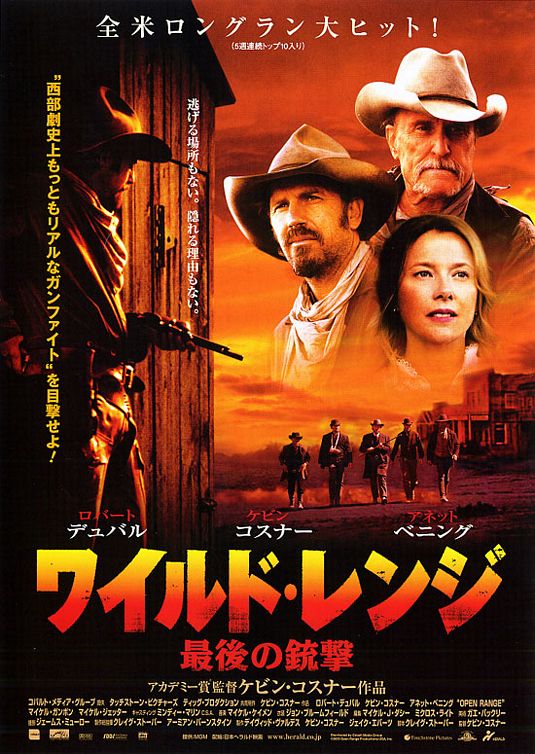
Dub’s Take: Open Range (2003)

A spoiler-free mini movie review.


1.5 out of 5

Everything about Kevin Costner’s “Open Range” is calculated antithesis to his much-maligned 1997 feature “The Postman”, and that is where its failure lies: Costner seems more concerned here with atonement than doing anything new & exciting with the Western genre.

Coming off Postman & “Waterworld” probably humbled Kevin enough to dial the front-and-centre “Costner Factor” back for this, his third official directorial effort. Along with top billing, Costner has given up the density of background extras, dolly shots, and side-stories that distinguishes both Postman and his first feature “Dances With Wolves”. It’s clear this is a deliberate sanitization on Costner’s part: Open Range’s first-act visual metaphor of him digging a stuck wagon out of mud is apt.

But taken as its own entertainment as opposed to a feature-length critical response, Open Range lacks the Costner Factor’s chutzpah. It’s a “two people in a room” movie, but on a field. Nothing in screenwriters Lauran Paine’s & Craig Storper’s monologues come to any revelatory philosophical conclusions: it’s all dialogue you’ve probably heard already on Costner’s current revivification “Yellowstone”. Robert Duvall’s & Costner’s acting is fine, but Annette Bening seems to have taken her direction of “speaking with the eyes” (like DWW’s Mary McDonnell and Postman’s Olivia Williams) too literally, looking like a deer-in-the-headlights the whole time.

There was some nice texture. I liked the design of the town and its quick-and-dirty construction. I liked how the two men were pretty much able to take over the whole thing with just their combined gunslinger experience. Having animals in distress (especially the Good Bois here) is a dirty filmmaking trick, but Costner the director goes-for-broke, which I appreciate, because if you’re going to go there, go all the way. And the climactic showdown – for all its over-editing – is gleefully violent, with touches of Leone, Peckinpah, and even John Woo. But these details stand out independently of the overlong film, rather than elements of its whole. DWW justified its length with solemnity, and Postman with narrative scope. Open Range has neither.

Kevin should be commended for his attempts at diffidence here but, for those of us who care, time will tell whether his upcoming four-part theatrical serial “Horizon” is a return-to-form of the Costner Factor.


Poster sourced from impawards.com. What do you think? Are you a fan of The Postman like I am? Were you equally-horrified when you showed it to your friends and they all laughed and said it was crap? Share your Postman Viewing Party stories in the comments below!

Now Available on Laserdisc: A Perfect World

IMG_20190902_093331
“Everything under the sun is in tune, but the sun is eclipsed by the moon.”

Clint Eastwood. The man with the ever-brusque facial expression. Western hero turned cop hero turned cineaste with an output that rivals Woody Allen: in quantity and quality. I mean terrible. Wait, I don’t mean terrible. I mean “not for me”. His directorial efforts are not for me. You see, Eastwood seems to make movies that fit his own demographic: seniors that need everything spelled out for them.

Clint isn’t one for subtlety or ambiguity: his characters are often expressing exactly how they are feeling; and if they don’t express it, then someone else will put the words in their mouth. He wants the viewer to feel unburdened by things like subtext and metaphors. He wants you to “be on the same page”. A few examples: Sully, the discouraged aircraft pilot simulator; Mystic River, the child sex trauma victim simulator; and Invictus, the Nelson Mandela fanclub simulator. I use the word “simulator” because Clint’s movies are deliberately-paced for maximum pragmatism. You start to “feel” for Sully’s social isolation; for Dave Boyle’s self-inflicted alienation; for how stoked you’d be to get the chance to meet Nelson Mandela.

Continue reading