A Canadian Legacy TV Review and Personal Discussion
“(…) Why do they call news, ‘stories?’ After man takes care of his basic animal needs, he indulges in a behaviour not imposed by nature, but invented by him. Emerging, as it does, from his imagination, can we not, then, call all invented human life (…) a fiction?”
– Peter Keleghan in
Ken Finkleman’s The Newsroom
(Episode 1×12: Meltdown Pt.3)

Preface
What are ‘White guy problems’?
Patriarchally speaking, man-kind is always thinking about ‘man-things’. Whether you have the privilege to only have to worry about yourself determines its White guy status.
Ken Finkleman – Canada’s answer to a Winnipeg-born, politically-charged Woody Allen (without the marrying-your-adopted-daughter nonsense) – has lots of White guy problems.
That isn’t to say the one-time Hollywood screenwriter & director (Grease 2; Airplane 2; Head Office), comedian, and provocateur’s satirical agenda on fascism & privatization wasn’t valid in its time – isn’t still valid – to the right viewer. Art is, above all, subjective. But when Finkleman calls his audience “an abstract” in a 2013 interview with Canada’s Dick Cavett, George Stroumboulopoulos, Ken’s peak on national television between 1996 & 2005 could retrospectively appear to some as the practice of a middle aged White guy with White guy problems, and the federal financing to produce aesthetically-pleasing art about it.
His acme for most (myself included, as of today) would be The Newsroom – not to be confused with the Aaron Sorkin HBO series – which ran for three split seasons and a TV movie at the Canadian Broadcasting Corporation. As a Larry Sanders Show-style spoof (think an early-90s The Office) at a television network, Finkleman’s alter ego – news director George Findlay, as played by Ken himself – is his preferred vessel for his commentary on male myopia; cowardliness; and Fellini-esque disdain & admiration for the opposite sex, going so far at one point to physically liken himself to Marcello Mastroianni’s Guido from Fellini’s 8 1/2 (although without making that connection, Ken’s dark sunglasses will likely make a newer generation of viewers think he smoked a big fat doob off-camera, which I wouldn’t rule out, either).
While there are plenty of pro-tem left-minded observations about North American society, it’s Ken’s George and his ensemble’s flagrant pettiness & sharp-edged selfishness that defines season one of the show, with Jeremy Hotz & Karen Hines being personal supporting highlights. But the majority of viewers will flock to Peter Keleghan’s meme-worthy portrayal of an idiot anchor, not unlike Michael Scott.
This era of Newsroom is often very funny and occasionally poignant – particularly the three-parter – but no one else I’ve shown it to, over the last twenty years of being a fan, shares my sentiment.
Time and experience has taught me why: empathy. Ken Finkleman is a Daskeman.
[cont’d]
*
The Review
Part i
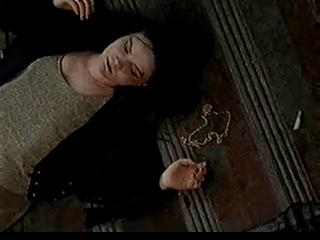
“There’s this guy in our Malaysian plant – he’s like 15, right? And God, he’s amazing – he’s a chess player, and we play chess all the time, and he kills me. He makes, like, $2.50 a day.”
“So, like, what’s the real difference between $2.50 a day, and $2 billion? He kicks his ass every time.”
– Kenny Vadas & Joe Roncetti
(“Business”)
Between The Newsroom’s first season run and its made-for-TV revival film in 2002, Finkleman produced a trilogy of unrelated miniseries’ for the CBC, two of which featured major appearances from his Findlay.
I’d seen 5/6ths of middle-child Foolish Heart, through a torrent – now no longer available. It’s an anthology that fulfilled my curiosity to whether Ken could handle a plain-spoken romance – the segments with Tony Nardi, as a court Justice in therapy, demonstrates he can. A shame, then, that Ken falls back into White guy problems for Foolish Heart’s home stretch: the final two episodes, centered on George, were so unintentionally narcissistic when contrasted against the first two-thirds that I gave up.
Even if Woody Allen is a creepy old White guy, at least he tries different genres – sometimes, too, different subjects. My hope, then, for More Tears – the direct follow-up to The Newsroom and, as far as I can tell, only presently available as a second-gen VHS dub from a senseful YouTube user (see footnotes) – was that Ken would be more experimental with his dramatic material.
But my suspicions were grounded: More Tears is, more-or-less, a direct sequel to The Newsroom, and I had to adjust my expectations accordingly. Really, viewing the series’ overarching story under this light makes sense: I’m not surprised that Ken’s George is now working independently, what with his presumably getting fired from the Corporation – for going over-budget on his nuclear-meltdown story – to mitigating the fallout of a political assassination in the post-season Campaign special.
None of these trials have fazed Findlay, as More Tears begins with him back at work – manipulating spectators to a hot news story about a lost little girl – while juggling a detached marriage with the wife he was always cheating on but who we never saw in Newsroom (Ararat’s Arsinée Khanjian), and a new, young fling, who loves George so much it makes her physically ill. Nothing has changed in George’s little world since we last saw him.
Episode one of More Tears, then, is a good summary of what made the human element of Newsroom’s first season successful, which is substantially owed to Finkleman’s direction, and knack for supportive casting. Ken’s dialogue often has a gift in its double-and-triple reverses, where something is explained one way only to be corrected back ludicrously: the bit with Teryl Rothery (Stargate SG-1 & Virgin River) as an American reporter simultaneously lamenting her husband’s death while clinically revealing the various ways she’s profited off it is a small work of monological genius, delivered with gusto.
Episode two raises the bar with a controversial fashion show segment that takes the tier-list of victim exploitation to its extreme (whether or not the sequence is based on a true event is lost to the ether of the internet), only to end the half-hour with a Lynchian long-shot that makes the viewer question what the definition of a victim really is. It’s clear that Ken’s artistic prerogative this time around isn’t a narrative expansion, but a deeper dive into themes he’d previously explored, and ones controversial enough to have distracted from the carefully-median vibes of Newsroom.
*
The Discussion
Part i
“Relationships that work have nothing to do with romance. Romance can only exist when there’s danger, tragedy, uncertainty, and inevitable betrayal. That’s love’s paradox… we fear, and desire, women. The only compromise, really, is an unemotional, erotic friendship.”
– Hrant Alianak in More Tears
(“Victims”)
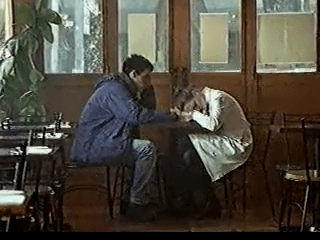
Finkleman’s acting here, or lack-thereof, is worth noting. Unlike Woody, who puts himself front-and-centre of his self-acted features & can’t seem to stop talking – with other characters prompting his next quip as opposed to joining in on the fun – Ken’s supporting characters do all the talking.
Consider the bookending monologues by Hrant Alianak (returning to the best-friend role from Meltdown) that are interspersed throughout the series, presented from Ken’s POV, with George’s brief queues acting as pauses throughout the dense anecdotes. How do I know they are told from Ken’s POV? Because there are no interjections: they are one-sided conversations where George, and by extension the audience, listens. Ken also has George sit and watch, but as opposed to shooting these moments solely from the camera’s perspective (to put the viewer in his protagonist’s shoes, which one would normally see as a key ‘goal’ of mainstream filmmaking), he insists on cutaways back to himself, watching. Ken is always omnisciently present.
And when he isn’t overseeing his chess pieces, co-star Leah Pinsent (Gordon Pinsent’s daughter & Made In Canada/The Industry alum alongside Keleghan & Rick Mercer) serves in his place: an unscrupulous interviewer who implicitly trusts George, never questions him, and does whatever he asks – traits that George would normally be looking for in a mistress. Without a character arc throughout the four episodes, Diane is truly in complete servitude to George’s, and writer Ken’s, whims. There’s not really anyone in More Tears for a casual audience to sympathize with, or put themselves in their place: not many would admit to such apathetic conduct.
*
Speaking of whims, there is a point where White guy problems can cross into creepy territory. Where other industry examples like Woody himself or Louis C.K. have tried to atone for their real-life improprieties through their art, or at least explain their genesis (C.K. returning to stand-up; Woody’s half of Crimes and Misdemeanors), Ken’s George – through the lens of Ken’s work – is irredeemable.
At the present moment, nothing of similar anti-social ilk has come out publicly about Finkleman, but it just as easily could with how quick Ken is to portray himself as a philanderer who throws women away. Sometimes George strikes out, and sometimes he doesn’t, and it isn’t really explained what it is exactly that keeps him permissed around straight female company.
Pondering for a moment Woody’s Manhattan: in that picture, all of Woody’s on-screen friends know that Muriel Hemingway’s character (who has since spoken out about her co-star’s off-camera behaviour) is 17 years old, and yet, how did Woody meet someone so young in the first place? What sort of gaslighting was necessary to make Hemingway’s Tracy so attracted to Woody’s Isaac? Why doesn’t Isaac’s friends question him more about the ethics of such a relationship, rather than simply reminding him ‘how young she is’ when those troublesome, youthful traits emerge?
Many hints are placed throughout More Tears to Ken’s answers to George’s discourse around these questions: his intelligence; his wit; his ability to shut his mouth & listen, sometimes; his money (following a gut-punch conclusion to the third episode – my favourite half-hour of the series); that he’s a follower and not a leader, where the changing of power can be a turn-on; the sum of the good times spent versus the bad; or possibly just his thinly-masked apathy that keeps him stoic. No one answer is settled on – not that one can, in the series’ meager (when compared to streaming contemporaries) two-and-a-half-hour cumulative runtime.
*
The Review
Part ii
To say that episode four’s double-length series finale concludes on a disappointing note is a bit of a misnomer, but Nasty, Poor, Brutish And Short does have the same overall flavour as Meltdown, with George abjectly overseeing every aspect of a new independent film project (as opposed to the big headlining news story of Meltdown); coming to some personal realizations; and balancing each of his now-trio of female relationships, all of whom show up on-set at the same time to support him, only for them all to have the same climactic epiphany that he’s a loser.
Where Meltdown homages 8 1/2, here we are name-dropped Truffaut’s Day For Night: both sharing the story similarity of a director having to micromanage the personal & professional lives of the people he’s hired for the film he can’t finish because of all the distractions. Same plot as Meltdown: been there, done that, though I did like the visual juxtaposition of Evan Solomon’s frosted tips & Ken’s greying mane. Finkleman also puts a definitive period on his season-long jabs against the Reform Party (remember them?) with the plot of his film-within-a-series, about a federal cabinet retreat “where something goes horribly wrong.” I wonder what Ken thinks of fellow Winnipeg-born Guy Maddin’s recent G7 satire Rumours – although Ken’s description of the material makes it sound more like Pasolini’s Salo than a comedy.
But More Tears isn’t over. It epilogues psychosocially: in a film studio, as Ken’s camera dollies around & around abstract, staged interviews between Diane and, first, the cast of Findlay’s film-within-a-series; then George’s three belles; and, finally, Findlay/Finkleman’s mother; all while George directs downward from the top of a scaffolding, considering not only the state of his life but, presumably, those of the working-class Canadians the alternate half of the series grieves over.
The appearance of George’s mother is not new – she features second-hand as the brunt of an ongoing Newsroom joke, and materializes in Meltdown – but the discourse around her use took on a new meaning having seen Paul Thomas Anderson’s Phantom Thread. That film was about a middle-aged artist reconciling with an endearment to his mother that informed all his female relationships. Here, taking mom’s frequent past appearances into account, as well as the spinning camera & Ken’s series-ending facepalm, I took More Tears’ coda to mean not only that Ken doesn’t see any of these issues – his or Canada’s – going away anytime soon, but, retrospectively, that Ken himself acknowledges the loop his own fascinations will have on his art moving forward, never truly being free of the problems he makes for himself, or whatever childhood trauma that elicited these bubbling emotions in the first place.
In critical summary, More Tears – in my opinion – is conjoined at the thematic hip of the first season of Newsroom and, taken as such, is a worthy sequel that is contented to tackle the same things in more detail & darker packaging. The writing & acting are superb, Ken the director gets the correct performance out of each of his players, and it’s genuinely funny in fits & starts while thought-provoking in others. If I was rating it traditionally using my system, the series would warrant a 4.5 out of 5, losing the half-star for parts of the meandering final episode.
Had I been one of the live viewers when More Tears originally aired (I was 10, so I didn’t care then), I may have gotten pissed that Ken the Commercialist kept using George into the foreseeable future when Ken the Artist proved he didn’t need his avatar to generate discussion-worthy work. Now, I just see it as his being stuck in the creative loop, where everything curls back to one individual’s opinion – or possibly a right-minded void, which we all peer inside eventually, only to see our own reflection within the machinations.
*
The Discussion
Part ii
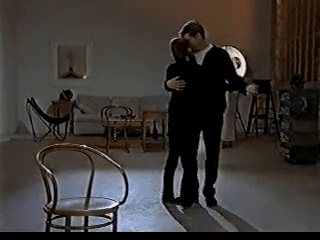
“(…) You’re trying to say too much with this movie (…) Are you incapable of dramatizing a relationship? Maybe that’s the problem with your life: you abstract relationships, and when the woman doesn’t live up to your abstraction, you can’t deal with it. You have a romantic vision of women that has absolutely nothing to do with the facts of day-to-day life.”
– Eugene Lipinski
(“Nasty, Poor, Brutish And Short”)
Six years after The Newsroom’s breakthrough season, there’s a scene in the movie Escape from the Newsroom where Ken – pulling a Kiarostami & speaking through the fourth-wall – bitches how all the CBC wants from him is the ‘muffin joke’ from the first episode of the first season again.
Ken the Artist never did climb out of the hole Ken the Commercialist had dug themselves into with his Newsroom, and season one will stand as his legacy. Seasons 2 & 3, while still benefitting from the aesthetic & acting framework the first season established, didn’t reach those same pitying heights, instead leaning too heavily on low-brow White guy problems for its humour (the fifty-dollar bill; the handicapped bathroom; a corruptible intern) as opposed to the pathos he so effectively swirled his audience up into on his first go around.
He should have made an episode where George doesn’t stand up for a date who gets harassed (à la Louie), or maybe doesn’t stand up for himself; or a two-parter about a son he never knew he had from a time he didn’t use protection, maybe who wants nothing to do with him (and still doesn’t at the end of the hour). I seem to remember the psychiatrist trope was used, but it was in service of a lame narrative about George’s sexuality being questioned. His visions alone are certainly worth exploring his mental health over.
These story suggestions are done to death in today’s woke marketplace, but back then, it would have been intriguing to know how George would have handled those challenging plot devices – probably poorly. But I don’t think Ken’s prerogative has ever been putting his private life on a pedestal for examination: he seems like a satirist first. I could be wrong.
*
My encounters with Ken’s work haven’t been chronological, nor consistent. I checked out his HBO Canada show Good Dog in 2011 when it was new: I had only ever seen Newsroom, and coming off that, I only lasted two episodes into Good Dog.
It wasn’t funny. Ken was George again, but – pandering to trends – he likened himself to a Canadian Larry David, spending the first episode referencing Curb Your Enthusiasm & adopting that show’s bright colour scheme (which may have had to do with budget limitations and a possible switch to digital photography), none of which I feel served Ken, or his art. I can’t tell you if a creative upswing occurred for his 2006 serial At The Hotel because it isn’t currently available either (despite journalistic claims to Finkleman’s place in the pantheon of Canadian programming making one assume that it would be), but it doesn’t really matter because all roads, yet again, led back to George.
I could say the same for my own interest in Ken’s work: despite not jiving with his other non-Newsroom shows, I kept trying to watch his stuff, following Good Dog with Foolish Heart, and now, More Tears: always circling back, curious as to what I had missed and whether that second breakthrough I know Ken has in him ever actually happened.
The last time I watched Newsroom, or tried, was in 2013: a year after I met my current wife. While we were courting, I made her sit through a few episodes while she visited me in my one room co-op’d bunker with no windows, while we sat on the convertible futon I still owned from my prior, failed relationship. My future wife watched quietly & politely, since she was trying to be open to the things her new beau enjoyed. A year later, after we moved in together, I tried to put it on again.
She was not having it. She told me that she didn’t enjoy it, she didn’t think it was funny, and chastised me for watching it so often. I vividly remember her being so mad: I don’t think I had rewatched it that many times before, had I? I never get that angry when she’s watching another Tyler Henry. Even for this review, when I told her I was watching something “by the guy who did that Newsroom show you don’t like,” she was like, “Oh yeah. That’s all you, buddy.” This is twelve years after the fight.
Odd to still so clearly recall such a tiny, petty argument a decade-on, but memory is its own kind of revisionism. My wife wasn’t angry because I was rewatching Newsroom (although she was): it was because I’m so much like George (and he is so much like my father, down to visually resembling him, too), and George’s unattractive traits, universal they may be, though often attributed to men – foolishness; selfishness; meekness; bullishness; submissiveness; indecisiveness; and creepiness – are ones my wife already has to deal with in reality, with whatever compassion she can muster out of her love for the larger picture. She doesn’t want to be forced to watch a show using the same behaviour as comedy & escapism. I suppose she could have left the room – clearly, she really wanted me to know her position.
It’s hard to relate to the minutiae of male delinquency if you haven’t admitted to those failings within yourself first: the material just comes across as petty tyranny to outsiders (also coincidentally, the name of a Newsroom episode), and run-of-the-mill middle-aged White guy problems.
“Your neighbours (…) have said what a terrific couple you are, and that, what happened 50 years ago (is) water under the bridge. But, I have to dip my toe into that water for a moment, and ask you (…) as a father; a neighbour; a human being – just one question about the 11,000 people you ‘allegedly’ murdered: how did you feel?”
– Leah Pinsent (“Victims”)

*
Postscript
Ken Finkleman says in the Strombo interview that his practice is “the search for the truth.” He also says in More Tears that he “can’t write romance.” Though the bottom has fallen out of the contemporary market for event series’ about White guy problems, that shouldn’t dissuade him from trying.
Maybe an autobiographical coming-of-age story about a young Jew in the Prairies growing up with first-world problems, or around the Canadian elite – you could find a way to put a sweet little love story in there while poking fun at the class structure here up North. Would that come across too much like Mordecai Richler’s The Apprenticeship Of Duddy Kravitz? Maddin’s My Winnipeg? What about Spielberg’s The Fabelmans? Ken has a distinct, literate voice that could offer a fresh perspective on echoic fiction, even if that fiction is a true one.
If he has any juice left in him, Ken should take all he’s learned & the moments he’s excelled in (in my opinion, that’s directing & casting; Meltdown; the first half of Foolish Heart; the second half of Escape; and Newsroom’s season three finale), jettison George and all of Finkleman’s artistic desire for idealogical lambastery, and settle his human drama once and for all, for all of us who’ve followed it to its presently inconclusive end.
That, or just, we could make all his work available for streaming so, you know, buffs new & old of Canadian media (particularly pieces that have won the Emmy/Oscar crêpe we used to call the Geminis, now known as the Canadian Screen Awards) can decide for themselves. Ken may not care what audiences think, but I care, Ken. And if I care, there have to be other Daskemen out there who care, too.
MORE TEARS
RIP 1998
//wd 4.4.2025
Screenshots author-obtained. A special thanks to ‘sstackh2’ for hosting More Tears on YouTube. Despite owning their own streaming service (Gem), the CBC’s preservation efforts are lacking. Newsroom is not currently available there, either, but as of publication, all three seasons & the movie can be found for free at archive.org (that’s season 1, the movie, then 2 & 3).
For those interested in the political & satirical side of More Tears, here’s an archived Maclean’s interview with Finkleman from around the same time as the show’s televised debut.

