or, “Misanthropic Thanatophiles in Love”: A spoiler-free mini movie review.
3.5 out of 5
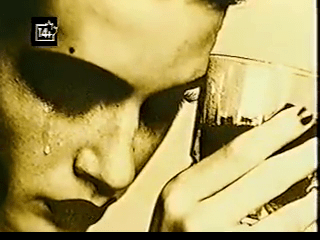
“Kissed” is a bizarre but on-brand Canadian film, with Molly Parker (from Global TV’s “Doc”) in her first major appearance. It’s a drama that skews closer to video art, with a striking premise that eventually plays second-fiddle to a middling obsession plot.
But damned if it exists at all: a straight-faced movie about necrophilia.Jörg Buttgereit’s “Nekromantik” this is not – though both films share the same fleeting duration of just over an hour: an unheard-of runtime in today’s feature market. Plenty for director Lynne Stopkewich to poke her head in, make her points, and leave, in – fingers-crossed – the most memorable way possible.
In that regard, its prologue is laudable: a snapshot of heroine Sandra’s youth & learned Wiccanness: evolving from a respect for the dead, into intimacy. Getting these character beats so early made me emotionally invested in the unorthodox subject matter – as did Parker’s fearless, Genie award winning performance as the adult Sandra (Genies are the Canadian Oscars, now called the “Canadian Screen Awards”).
or, “Reconciled to Live from the Sidelines”: A spoiler-free mini movie review.
1.5 out of 5
“…it’s been so long since I did that stuff, I literally cannot remember how we did most of it. […] I really have to insist that we don’t talk about ‘Scanners’, or special effects, or exploding heads…”
– Canadian filmmaker David Cronenberg on Ken Finkleman’s “The Newsroom”, 1996
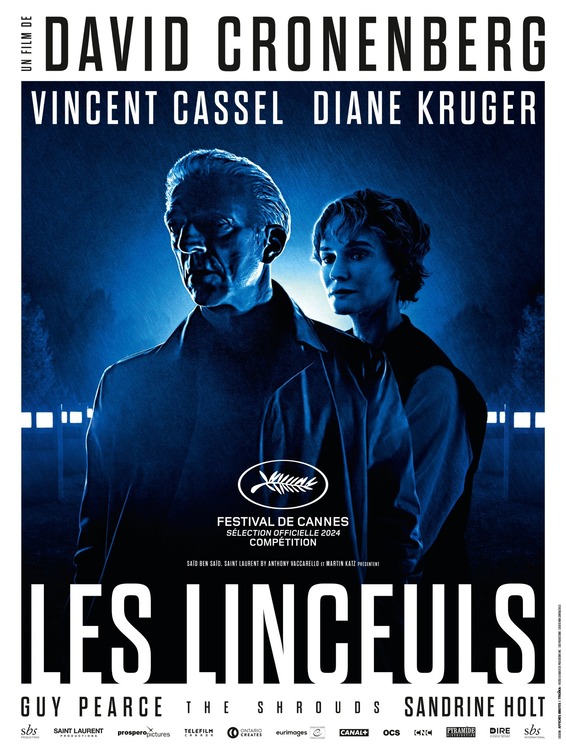
“The Shrouds” is an 82-year-old artist’s auto-elegiac statement. It’s aesthetically pleasing, and way too talky; its themes cerebral, though defeatist; its characters horny but dispassionate; and it’s told from a sanctimonious perspective that engenders viewer apathy.
My high school friends & I once drove an hour to see “A History of Violence”. We walked in late to the screening after getting a parking ticket, and immediately after the big 69’ing scene (but before the diner shootout). We didn’t find out until much later what else we had missed.
A Canadian Legacy TV Review and Personal Discussion
“(…) Why do they call news, ‘stories?’ After man takes care of his basic animal needs, he indulges in a behaviour not imposed by nature, but invented by him. Emerging, as it does, from his imagination, can we not, then, call all invented human life (…) a fiction?”
– Peter Keleghan in Ken Finkleman’s The Newsroom (Episode 1×12: Meltdown Pt.3)
Preface
What are ‘White guy problems’?
Patriarchally speaking, man-kind is always thinking about ‘man-things’. Whether you have the privilege to only have to worry about yourself determines its White guy status.
Ken Finkleman – Canada’s answer to a Winnipeg-born, politically-charged Woody Allen (without the marrying-your-adopted-daughter nonsense) – has lots of White guy problems.
That isn’t to say the one-time Hollywood screenwriter & director (Grease 2; Airplane 2; Head Office), comedian, and provocateur’s satirical agenda on fascism & privatization wasn’t valid in its time – isn’t still valid – to the right viewer. Art is, above all, subjective. But when Finkleman calls his audience “an abstract” in a 2013 interview with Canada’s Dick Cavett, George Stroumboulopoulos, Ken’s peak on national television between 1996 & 2005 could retrospectively appear to some as the practice of a middle aged White guy with White guy problems, and the federal financing to produce aesthetically-pleasing art about it.
His acme for most (myself included, as of today) would be The Newsroom – not to be confused with the Aaron Sorkin HBO series – which ran for three split seasons and a TV movie at the Canadian Broadcasting Corporation. As a Larry Sanders Show-style spoof (think an early-90s The Office) at a television network, Finkleman’s alter ego – news director George Findlay, as played by Ken himself – is his preferred vessel for his commentary on male myopia; cowardliness; and Fellini-esque disdain & admiration for the opposite sex, going so far at one point to physically liken himself to Marcello Mastroianni’s Guido from Fellini’s 8 1/2 (although without making that connection, Ken’s dark sunglasses will likely make a newer generation of viewers think he smoked a big fat doob off-camera, which I wouldn’t rule out, either).
While there are plenty of pro-tem left-minded observations about North American society, it’s Ken’s George and his ensemble’s flagrant pettiness & sharp-edged selfishness that defines season one of the show, with Jeremy Hotz & Karen Hines being personal supporting highlights. But the majority of viewers will flock to Peter Keleghan’s meme-worthy portrayal of an idiot anchor, not unlike Michael Scott.
This era of Newsroom is often very funny and occasionally poignant – particularly the three-parter – but no one else I’ve shown it to, over the last twenty years of being a fan, shares my sentiment.
Time and experience has taught me why: empathy. Ken Finkleman is a Daskeman.
Let’s consider the contentiousness between celebrity parents & their offspring: the Voigt/Jolie/Pitt’s; the O’Neal’s; the Barrymore’s…
The public only receives as much information that’s dished; often, that doesn’t include the forgiveness intrinsic to maintaining a healthy, life-long relationship with one’s family. That’s usually something us plebs experience ourselves, in time.
Great, then, for actor Kiefer Sutherland actually wanting to work with his late father & icon Donald. Kiefer hasn’t been featured on-screen so much since the height of COVID, what with his side-gig as a country musician. I saw him live in 2019 and, while I can’t remember his music, I think all of us in attendance were awed to see Jack Bauer/David the Daywalker in the flesh.
Where their filmography choices differ, father & son’s similar acting disciplines, and uncanny biology, can be felt in their shared scenes for the 2015 western Forsaken.
Forsaken has noble intentions – no doubt about that. It has a linear, easy-to-follow man-versus-himself redemption story, devoid of texture that doesn’t serve the plot. It has wonderfully verbose dialogue, recited melodramatically by its cavalcade of character actors (Demi Moore; Michael Wincott). It has a subversive epilogue, swapping a lovesick reunion for a tearful family goodbye. There really isn’t anything thematically wrong with it.
But it’s slow. Damn slow! Characterizations & script points are blander than superior genre examples, like Clint Eastwood’s Unforgiven (Richard Harris’ English Bob vs. Wincott’s Gentleman Dave) and Ed Harris’ Appaloosa (the love triangle). Brian Cox as the villain is Brian Cox as the villain, doing his billowy, profane Brian Cox thing – though credit goes to director Jon Cassar for convincing the Shakespearean-trained thespian to die next to a big pile of horse shit. And it’s always a bit rocking to see close-ups of gory, chunky gibs in the last ten minutes when the previous eighty lacked such morbid details.
Although only an hour-and-a-half, Forsaken feels twice as long when its quiet moments insist on themselves, like endless wood-cutting, and rumours from the church social club. If there were fewer of those hyperrealistic pauses – so common in modern prestige television – perhaps Kiefer & Donald’s understated work here would have serviced the picture as a whole, as opposed to being ‘one effective element’ of a decidedly average film.
If you want to see peak cinematic familial synchronicity, Forsaken is a low-calorie – if forgettable – clone.
Poster sourced from themoviedb.org. As of publication, Forsaken is available to watch for free in Western Canada on CBC Gem (unsponsored).What do you think? Leave us a comment below!


 theory of a daskeman