A lifetime ago, I made an uncouth script pitch for a cop movie to a university girlfriend, with its villain a serial rapist. She asked why it was so important to use rape as a plot device. “Because it sells!”
What I meant to say (retrospectively) was that, along with child peril & domestic abuse, rape elicits a powerful viewer response, which they want ‘avenged’ by the time the credits roll. That’s just one of the stupid things I said & did to send that relationship into free-fall, much like Marvel Studio’s stupid choices since “Avengers: Endgame” in 2019 – theirs’ being a lack of creative honour, and too much contextual juggling.
Irrespectively, Marvel productions still carry a professional-grade aesthetic, even if you don’t connect with them on a human level. But while there’s no literal rape in Thunderbolts*, it violated my other sensibilities.
or, “Reconciled to Live from the Sidelines”: A spoiler-free mini movie review.
1.5 out of 5
“…it’s been so long since I did that stuff, I literally cannot remember how we did most of it. […] I really have to insist that we don’t talk about ‘Scanners’, or special effects, or exploding heads…”
– Canadian filmmaker David Cronenberg on Ken Finkleman’s “The Newsroom”, 1996
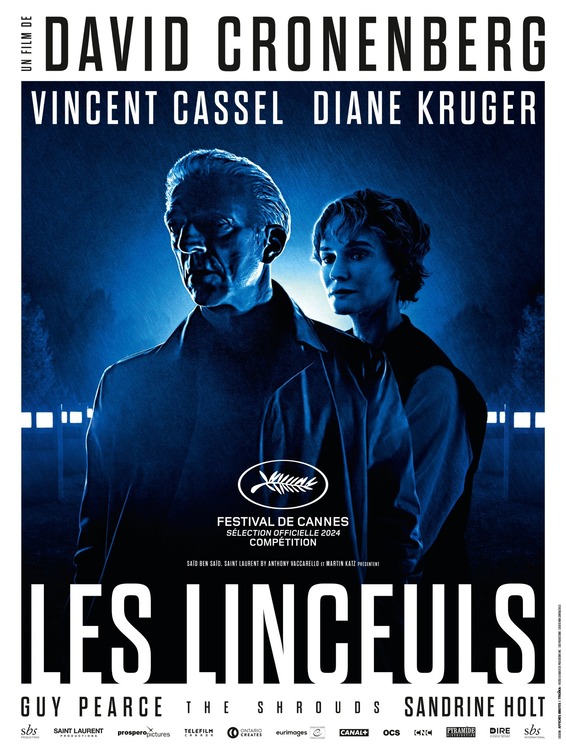
“The Shrouds” is an 82-year-old artist’s auto-elegiac statement. It’s aesthetically pleasing, and way too talky; its themes cerebral, though defeatist; its characters horny but dispassionate; and it’s told from a sanctimonious perspective that engenders viewer apathy.
My high school friends & I once drove an hour to see “A History of Violence”. We walked in late to the screening after getting a parking ticket, and immediately after the big 69’ing scene (but before the diner shootout). We didn’t find out until much later what else we had missed.
or, “Buying-In to the Confusion”: A spoiler-free mini movie review.
3 out of 5
While my wife would call me a “gamer”, I don’t clock nearly as many hours as when I was a kid: life gets in the way. So when I do play, it’s almost exclusively ‘arcade-style’ games that I can disconnect from quickly – physically & mentally – and there must be a Pause button.
Though I can’t attest, “Until Dawn” seems regarded as one of the premier, Western-made, story-driven video games of the previous console generation: a group of disposable teens trying to survive a throng of wendigos, with a branching narrative based on player interaction. “Until Dawn: The Movie” swaps out the choose-your-own-adventure input for a “Groundhog Day” esque time-loop, with some other surprises meant to mimic the discovery a player would get from the game.
My surprise was palpable. Though lacking the original’s star-power (which featured Rami Malek & Hayden Panettiere), the movie’s twenty-something players do a convincing job and, tonically, all five are spotlighted equally throughout the script. The savagery is effective, including a show-stopping water tower sequence & a close-up of a crushed face that gave me “Irréversible” flashbacks. The dialogue isn’t bad either, often breaking the fourth-wall to cheekily address the core plot’s uninspiredness, or the suicidal inclinations of its protagonists to reset the loop & try again.
A Canadian Legacy TV Review and Personal Discussion
“(…) Why do they call news, ‘stories?’ After man takes care of his basic animal needs, he indulges in a behaviour not imposed by nature, but invented by him. Emerging, as it does, from his imagination, can we not, then, call all invented human life (…) a fiction?”
– Peter Keleghan in Ken Finkleman’s The Newsroom (Episode 1×12: Meltdown Pt.3)
Preface
What are ‘White guy problems’?
Patriarchally speaking, man-kind is always thinking about ‘man-things’. Whether you have the privilege to only have to worry about yourself determines its White guy status.
Ken Finkleman – Canada’s answer to a Winnipeg-born, politically-charged Woody Allen (without the marrying-your-adopted-daughter nonsense) – has lots of White guy problems.
That isn’t to say the one-time Hollywood screenwriter & director (Grease 2; Airplane 2; Head Office), comedian, and provocateur’s satirical agenda on fascism & privatization wasn’t valid in its time – isn’t still valid – to the right viewer. Art is, above all, subjective. But when Finkleman calls his audience “an abstract” in a 2013 interview with Canada’s Dick Cavett, George Stroumboulopoulos, Ken’s peak on national television between 1996 & 2005 could retrospectively appear to some as the practice of a middle aged White guy with White guy problems, and the federal financing to produce aesthetically-pleasing art about it.
His acme for most (myself included, as of today) would be The Newsroom – not to be confused with the Aaron Sorkin HBO series – which ran for three split seasons and a TV movie at the Canadian Broadcasting Corporation. As a Larry Sanders Show-style spoof (think an early-90s The Office) at a television network, Finkleman’s alter ego – news director George Findlay, as played by Ken himself – is his preferred vessel for his commentary on male myopia; cowardliness; and Fellini-esque disdain & admiration for the opposite sex, going so far at one point to physically liken himself to Marcello Mastroianni’s Guido from Fellini’s 8 1/2 (although without making that connection, Ken’s dark sunglasses will likely make a newer generation of viewers think he smoked a big fat doob off-camera, which I wouldn’t rule out, either).
While there are plenty of pro-tem left-minded observations about North American society, it’s Ken’s George and his ensemble’s flagrant pettiness & sharp-edged selfishness that defines season one of the show, with Jeremy Hotz & Karen Hines being personal supporting highlights. But the majority of viewers will flock to Peter Keleghan’s meme-worthy portrayal of an idiot anchor, not unlike Michael Scott.
This era of Newsroom is often very funny and occasionally poignant – particularly the three-parter – but no one else I’ve shown it to, over the last twenty years of being a fan, shares my sentiment.
Time and experience has taught me why: empathy. Ken Finkleman is a Daskeman.



 theory of a daskeman