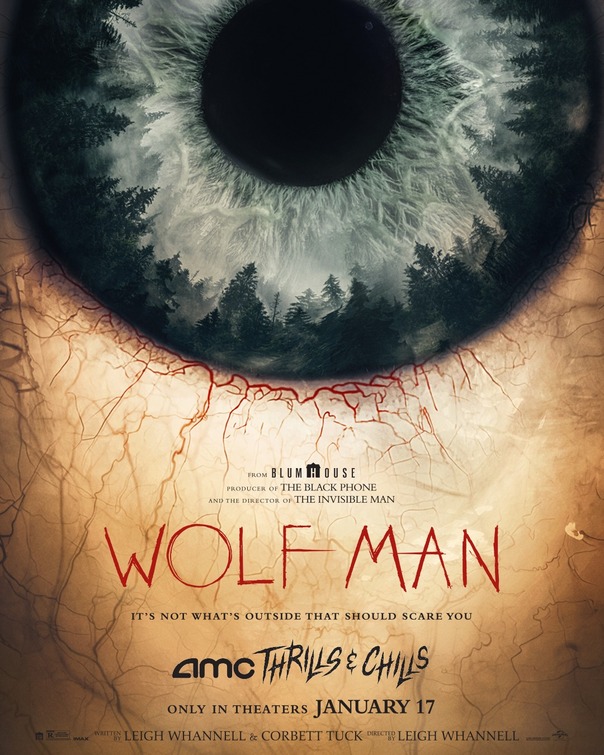
Dub’s Take: Wolf Man (2025)

A spoiler-free mini movie review.

1 out of 5

You can blame Film School for my objectively watching movies wondering what I’d do different: “Well, if they had moved the opening flashback to the midpoint, flash-forward to the middle for a bit, then go back, cut the next twenty minutes…” and etcetera.

However, I’m sure the only way to fix “Wolf Man” would be to start over with new hires. To quote “Family Guy,” it “insists upon itself”: it’s innately serious with its body-horror aspirations à la Cronenberg’s “The Fly”, but lacks Jeff Goldblum’s humanizing arc or, plainly, anything else of interest.

What happened? I mentioned TV’s “The Handmaid’s Tale” in my negative review for Blake Lively’s “It Ends With Us”, but actress Elisabeth Moss’ time there – particularly the long close-ups of her character’s mental atrophy – made her the perfect actress to quietly communicate the fear of an abusive partner in director Leigh Whannell’s 2020 reimagining of “The Invisible Man”. A palatable discomfort made that project borderline-unwatchable, but its potency made me excited for what Whannell did next.

Well, next is here, and Wolf Man’s casting sucks: indie-darling Christopher Abbott and “Ozark’s” Julia Garner, as a bickering couple, have zero chemistry. Despite his character’s learned sheepishness, Abbott lacks primality as a father trying to break a cycle of toxic parenting. Garner equally trifles as the shocked city-mom out of her element, emptily channelling Moss’ internal acting successes. Putting Abbott & Garner together at their most unpleasant is like banging two coconut halves together and calling it a horse.

Bad acting can be charming if the story is still engaging, but Wolf Man’s specialty is its disengagement. Abbott’s character history isn’t fleshed out, leaving his father’s notes on hunting the lycan for no one to find and a neighbourly relationship undeveloped & whitewashed, a mother MIA, and a second-act twist without emotional resonance. We spend an inordinate amount of the first act with Abbott & Garner’s marital issues, and the transformation itself doesn’t start until the halfway point, prorating the rest with Abbott barricading only one of the two entrances into the farmhouse where the family is hiding, not including the windows.

Like a puzzle, Wolf Man’s pieces are all there, but there’s no ends tying the loose, disparate bits together, and what’s left doesn’t match the picture on the box: it’s poorly acted, poorly plotted, and goes nowhere fast. Next time, just remake “Van Helsing” instead.


Poster sourced from impawards.com. What do you think? Assuming there are always bits on the cutting room floor, should the filmmakers have swapped out scene-after-scene of Garner & her movie daughter running back & forth between the farmhouse and the barn with some actual backstory about Abbott’s father’s hunt for the lycan? Is it worth hypothesizing about movie scenes not included in the final cut, even if they didn’t exist to begin with? Do you re-edit movies while you’re watching them, too? Leave a comment for us down below!

Dub’s Take: Better Man (2024)

A spoiler-free mini movie review.


2 out of 5

What creative doesn’t love a contract, which includes being a good rep by spending your daylight hours fielding endless interview questions from a bevy of international reporters?

Much like film criticism, there’s a finite number of queries before you end up answering the same ones over-and-over again. But you still have to act like you’re chuffed no one’s asked you that one before, just like singer/songwriter/“Better Man” subject Robbie Williams and director Michael Gracey. Any conversation about Better Man is eventually going to devolve into an opinion on whether the monkey thing actually works or not. And much like questions at a press gala, if you have to ask so many of them to get the answer you want, then maybe it wasn’t so interesting to begin with.

Gracey says in the pre-show, “Whatever kind of movie you think (Better Man) is going to be, it’s not that movie.” But it is, following the same Sisyphean tropes that other biopics of its vein already have. While I can respect Williams’ tenacity of spirit, he hasn’t lived through anything the public hasn’t already seen from the celebrity sphere before. If Williams is this in-your-face in Britain then it’s no wonder his movie is struggling at the box office: the public already knows more than it wants to from the covers of tabloid magazines.

Better Man’s resilience, then, relies on its music & aesthetics which, for the most part, are successful. Despite some lackadaisical CGI (Williams’ avatar isn’t as detailed as those in “Kingdom of the Planet of the Apes”), the movie still looks good, including a solid visual metaphor for panic attacks. While I can’t see myself picking up the soundtrack album, the music was pretty good, too. If you go solely off the film’s cuts, you’d think Williams is a balladier like solo George Michael: these needle-drops work for the movie’s somber beats, but I longed for more up-tempo numbers like in the show-stopping Take That & Knebworth sequences.

At the film’s midway point, Robbie goes through a frosted-tip phase, but instead of solely colouring the monkey’s head hair blond, the filmmakers dye his face & neck hair, too. Does that mean his chest hair is blond as well? Where’s the walking on all-fours & clattering? Better Man gets points for trying something different, even if it’s a shallow template for another, more-bonkers film with superior follow-through.


Poster sourced from impawards.com. What do you think? Even if the film didn’t totally work, Williams & Gracey concocted some wild, “Across the Universe”-esque fantasy sequences, such as Williams & Raechelle Banno’s courting montage, when Williams is caught with heroin, or the left-field “Beowulf” climax. Would any of these scenes have played better with a human actor as opposed to a monkey? Should there have been more monkey-isms? Did the movie strike the right balance between monkey & man? Do you even care? Let us know in the comments below!

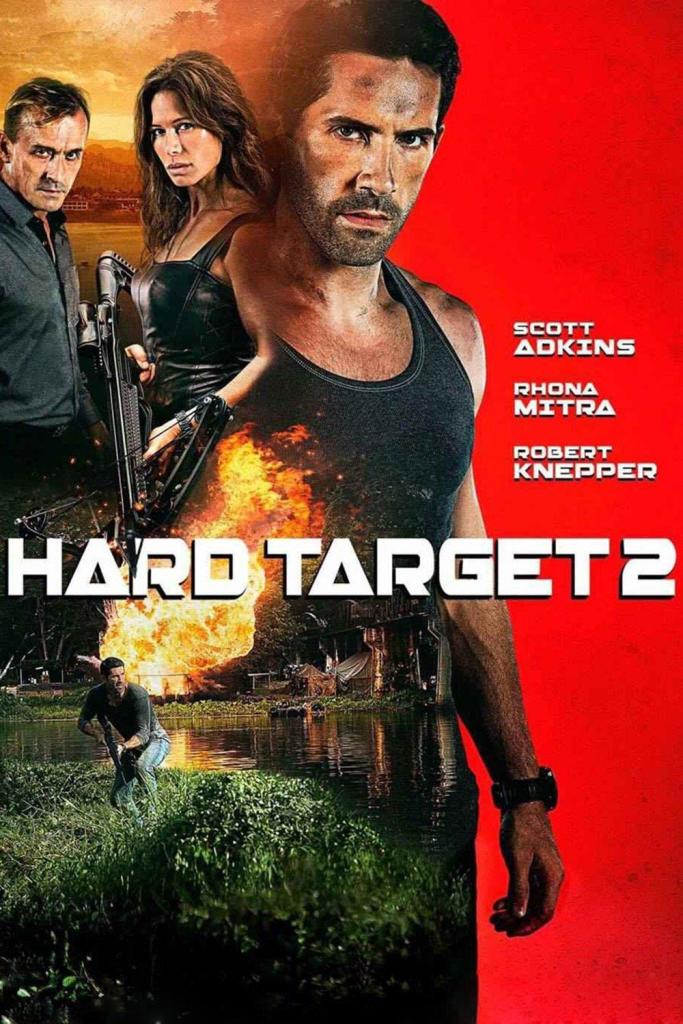
Dub’s Take: Hard Target 2 (2016)

A spoiler-free mini movie review.


3 out of 5

In 2009, when working at Blockbuster, I had to recommend movies to strangers. But my tastes are eclectic & subtitled and, sometimes, it was easier to suggest something I knew customers liked already instead of a personal favourite. One of those well-rented titles was “Vicky Cristina Barcelona”. One shift, I suggested it to a middle-aged woman, and she opposed because “Woody Allen is a child molester.” Oh, okay then. I wouldn’t have picked it because it’s crap.

Which leads us to today’s sidebar: even if someone has been exonerated of a crime, it doesn’t mean the court of public opinion ever really adjourns. Regardless of one’s feelings toward Robert Wagner; Depp and/or Heard; Kevin Spacey; or Allen, these people continue to work, and it’s up to each viewer’s own moral barometer whether they support these endeavours as their careers progress.

And so it goes that Robert Knepper (T-Bag on “Prison Break”) finds himself on that shortlist. Seeing Knepper’s name on the cast for Netflix’s recently-added direct-to-video sequel didn’t dispel me from watching it the same way I avoid a Woody Allen movie now: Knepper was great on Prison Break for its entire run playing an unrepentant asshat, so I assumed his presence in “Hard Target 2” would amount to him being a grade-A asshat here as well. And he is, even if his performance falls victim to some obvious ADR.

HT2 has great casting. Along with Knepper, we have Van Damme’s substitution in Scott Adkins; Bizarro World’s Kate Beckinsale: Rhona Mitra; and Boba Fett himself, Temuera Morrison as Knepper’s lackey. Adkins is awesome – maybe not a thespian (he’s better with tongue-in-cheek material, like his appearances in “Metal Hurlant Chronicles” & “John Wick 4”) but he’s been doing this a long time and at least looks like he’s enjoying himself.

Sadly, though, it’s with a heavy heart I report Miss Mitra’s femme-fatale in a leather tank-top isn’t given much to work with in the way of juicy lines or mindful direction. However, she’s vindicated in the film’s best scene, starting with her slow-motion dual-wielding mini-crossbows in front of an explosion, and ending with her pontificating on her character’s own awesomeness with a “Scarface”-sized pile of cocaine in the background. It’s great.

Most of Hard Target 2 is great. It’s nice when that happens. But there is a creepy guy in the cast. Up to you.


Poster sourced from imfdb.org. Yessir, that was Adkins in a fat suit playing the German in John Wick 4. Do you feel it’s time for mainstream Hollywood to give him more substantial roles? How do you feel about Kevin Spacey dipping his toe back into acting? Do you have anything good to say about more than 85% of Woody Allen’s output in the last thirty years, or are you done with him, too? So many questions – let me know what you think in the comments below!

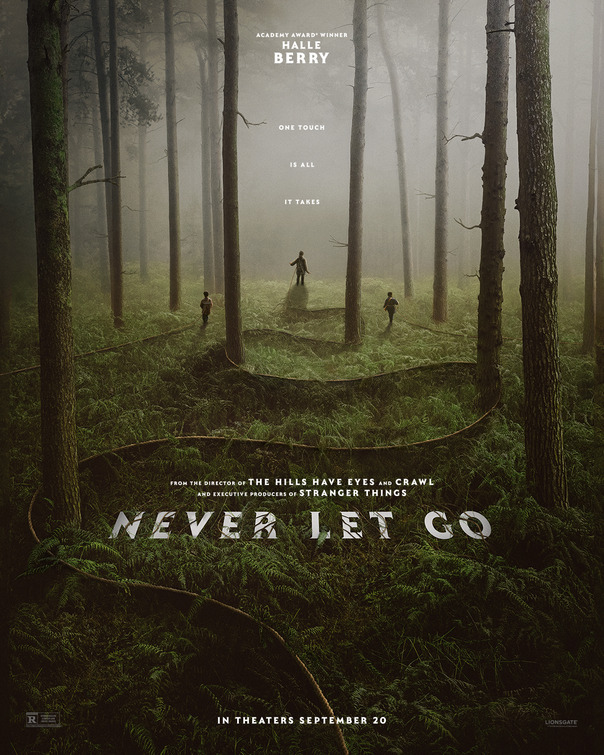
Dub’s Take: Never Let Go (2024)

A spoiler-free mini movie review.


4 out of 5

For all the five-dollar words I throw around here, I don’t think I’ve used discourse yet. Interpreting ‘discourse’ – or, “the meaning that we apply to things” – was a huge component of my first-year art school syllabus, along with learning what a paintbrush & canvas are for. Duh.

Director Alexandre Aja’s cinematic discourse morphs between two categories: horror, for fans of his breakouts “Haute Tension” and 2006’s “The Hills Have Eyes”; contrasted by the modern fables “The 9th Life of Louis Drax” and “Horns”. “Never Let Go”, with its chapter cards and brothers Grimm references, falls squarely into the second camp. While its moral isn’t spelled out, I took it as not losing sight of one’s humanity, even in the face of insurmountable odds – whether those are real or imagined.

Never Let Go is brutal, starting its characters off in deep crisis instigated by decades of off-screen trauma. Halle Berry is a dependable actress playing an unreliable protagonist: the script is aware it can end only one of two ways (or the dreaded third), and plays with the possibilities from its outset. It’s a challenging narrative tightrope, made more disturbing by audacious scenes of child endangerment.

But the ‘ropes’ – despite not being physically long enough to be coherent – are a fascinating thematic snare, and the cinematic framing of the central woodland location and its inhabitants is stellar: the constituents of the forest, which may or may not be hallucinations, unveil their biological horror through the production’s expert use of darkness & shadow. While the story doesn’t conclude with a traditional twist, there’s an excellent wrench thrown in to the plot earlier than anticipated. Shame it opts for the third ending, though.

With regard to the two child stars, I can say from first-hand experience that managing child actors can be incredibly stressful, with the possibility of little reward. Sadly, as in life, children exist, and it’s relieving to say, then, that the two young men here who anchor the film do work that is unworthy of captiousness: they didn’t once take me out of the experience.

Never Let Go had me unsettled, angry, depressed, nervously laughing out-loud, bewildered, and ultimately mesmerized. Shouldn’t that be the discourse of good cinema?


Poster sourced from impawards.com. What do you think? Are you a fan of Aja’s horror movies, his trilogy (at present) of contemporarily-set fairy tales, both, or neither? Do you think Halle Berry puts on a good show regardless of what she’s acting in, or do you think the choice of role reflects the actor and Berry’s inconsistent filmography speaks for itself? What’s your interpretation of “the dreaded third ending”? Leave your comments below!