Dub’s Take: Mother’s Day (2010)

or, “Bullshit-Free: 400 Words on
Patrick John Flueger”:
A spoiler-free mini movie conversation.


In my previous post, I wrote that certain scenes of movie violence only register viscerally with audiences, opposed to emotionally, were it not for the “mettle” of the participating actors.

As Devyn LaBella’s “Horizon 2” lawsuit illustrates, professionally-minded directors – not including the “Costner Factor”won’t force challenging material on the unprepared: potentials read a script; sign an agreement; and, afterward, may require healthy decompression.

But what about actors in the television industry? How do serial players on today’s gritty cop shows compartmentalize 15-hour workdays filled with repeat coverage of the world’s worst? Other than with a good cry?

Deadline recently disclosed that TV alumnus Patrick John Flueger (Shawn on the original “4400”; Ruzek on “Chicago PD”) would be taking a leave of absence from PD, possibly due to “an instance of alcohol… on set.” With PD’s frequently off-putting subject matter, I joked with my spouse that the guy must have finally broke.

[cont’d]

Continue reading

400 Words on: Him (2025)

or, “I Would Say That Was His Job”:
A spoiler-free mini movie review.


3.5 out of 5

“Innovation is not always embraced and art is to be interpreted… I’ve had a career of making classic movies that weren’t critically received…”

“Him” actor Marlon Wayans, comparing its critical disparity to the ‘cult’ status of 2004’s frequently-cited ‘worst movie ever’ “White Chicks”

[cont’d]

Continue reading

400 Words on: Until Dawn (2025)

or, “Buying-In to the Confusion”:
A spoiler-free mini movie review.


3 out of 5

While my wife would call me a “gamer”, I don’t clock nearly as many hours as when I was a kid: life gets in the way. So when I do play, it’s almost exclusively ‘arcade-style’ games that I can disconnect from quickly – physically & mentally – and there must be a Pause button.

Though I can’t attest, “Until Dawn” seems regarded as one of the premier, Western-made, story-driven video games of the previous console generation: a group of disposable teens trying to survive a throng of wendigos, with a branching narrative based on player interaction. “Until Dawn: The Movie” swaps out the choose-your-own-adventure input for a “Groundhog Day” esque time-loop, with some other surprises meant to mimic the discovery a player would get from the game.

My surprise was palpable. Though lacking the original’s star-power (which featured Rami Malek & Hayden Panettiere), the movie’s twenty-something players do a convincing job and, tonically, all five are spotlighted equally throughout the script. The savagery is effective, including a show-stopping water tower sequence & a close-up of a crushed face that gave me “Irréversible” flashbacks. The dialogue isn’t bad either, often breaking the fourth-wall to cheekily address the core plot’s uninspiredness, or the suicidal inclinations of its protagonists to reset the loop & try again.

[cont’d]

Continue reading

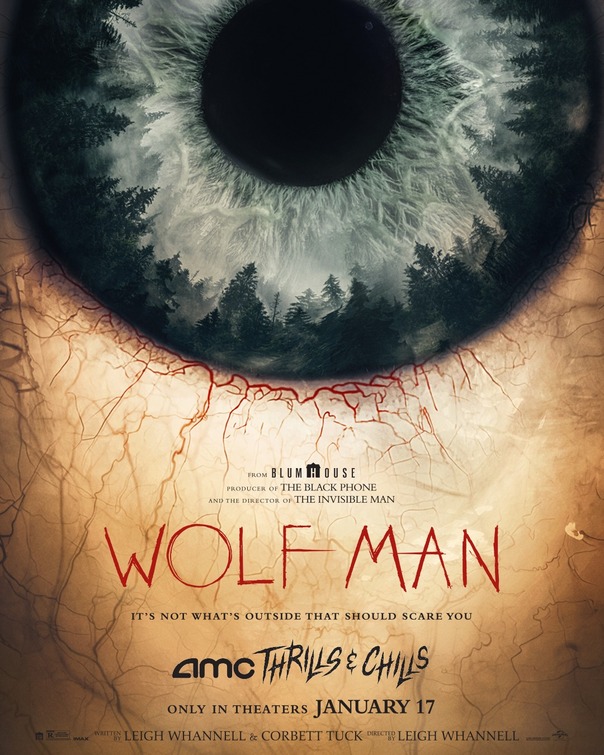
Dub’s Take: Wolf Man (2025)

A spoiler-free mini movie review.


1 out of 5

You can blame Film School for my objectively watching movies wondering what I’d do different: “Well, if they had moved the opening flashback to the midpoint, flash-forward to the middle for a bit, then go back, cut the next twenty minutes…” and etcetera.

However, I’m sure the only way to fix “Wolf Man” would be to start over with new hires. To quote “Family Guy,” it “insists upon itself”: it’s innately serious with its body-horror aspirations à la Cronenberg’s “The Fly”, but lacks Jeff Goldblum’s humanizing arc or, plainly, anything else of interest.

What happened? I mentioned TV’s “The Handmaid’s Tale” in my negative review for Blake Lively’s “It Ends With Us”, but actress Elisabeth Moss’ time there – particularly the long close-ups of her character’s mental atrophy – made her the perfect actress to quietly communicate the fear of an abusive partner in director Leigh Whannell’s 2020 reimagining of “The Invisible Man”. A palatable discomfort made that project borderline-unwatchable, but its potency made me excited for what Whannell did next.

Well, next is here, and Wolf Man’s casting sucks: indie-darling Christopher Abbott and “Ozark’s” Julia Garner, as a bickering couple, have zero chemistry. Despite his character’s learned sheepishness, Abbott lacks primality as a father trying to break a cycle of toxic parenting. Garner equally trifles as the shocked city-mom out of her element, emptily channelling Moss’ internal acting successes. Putting Abbott & Garner together at their most unpleasant is like banging two coconut halves together and calling it a horse.

Bad acting can be charming if the story is still engaging, but Wolf Man’s specialty is its disengagement. Abbott’s character history isn’t fleshed out, leaving his father’s notes on hunting the lycan for no one to find and a neighbourly relationship undeveloped & whitewashed, a mother MIA, and a second-act twist without emotional resonance. We spend an inordinate amount of the first act with Abbott & Garner’s marital issues, and the transformation itself doesn’t start until the halfway point, prorating the rest with Abbott barricading only one of the two entrances into the farmhouse where the family is hiding, not including the windows.

Like a puzzle, Wolf Man’s pieces are all there, but there’s no ends tying the loose, disparate bits together, and what’s left doesn’t match the picture on the box: it’s poorly acted, poorly plotted, and goes nowhere fast. Next time, just remake “Van Helsing” instead.

Poster sourced from impawards.com. What do you think? Assuming there are always bits on the cutting room floor, should the filmmakers have swapped out scene-after-scene of Garner & her movie daughter running back & forth between the farmhouse and the barn with some actual backstory about Abbott’s father’s hunt for the lycan? Is it worth hypothesizing about movie scenes not included in the final cut, even if they didn’t exist to begin with? Do you re-edit movies while you’re watching them, too? Leave a comment for us down below!

Dub’s Take: Candyman (2021)

A spoiler-free mini movie review.


1.5 out of 5

In its scant ninety-minute running time, “Candyman 4” tries to be:

BOOM: a direct sequel to the original 1992 movie;
BAM: a reimagining of the central villain & his lore (fans of late Tony Todd should look elsewhere: he cameos for 30 seconds as a visual bookend);
C: a commentary on gentrification & a nouveau generation of Black yuppies;
4: a satire of the Chicago arts scene;
– full-on body horror à la 1986’s “The Fly”;
a rallying cry for ‘Black Lives Matter’;

and more I may have missed. It even employs a shadow-puppet aesthetic for its flashbacks in a quirky touch that wouldn’t be out of place in a Wes Anderson joint.

Phew! It’s a lot, but Candyman 4 isn’t done yet. Its themes draw parallels to “Pontypool”: a 2008 Canadian horror where miscommunication itself breeds zombies. C4 recontextualizes Todd’s Daniel Robitaille so that all instances of White-on-Black violence in Cabrini-Green fall under the discourse of ‘The Candyman’.

It’s a fascinating narrative pivot: probably the contribution of consistently-creative producer/co-writer Jordan Peele. The film is also wickedly shot, and certain set pieces independent of one-another do play well (the opening titles; the murder of two gallery owners; Yahya Abdul-Mateen II’s Anthony interacting with a reflection).

However, in corking Todd’s time with the series, C4 spoils the wine. Partial blame falls on director Nia DaCosta’s pacing, which recalls the extended takes & quiet character pensiveness of the most leisurely, self-aware 10-episode streaming series when she should be hitting us with the goods fast & hard to justify the short duration.

Other demerits go to poor Abdul-Mateen II who – between this, “Matrix 4”, and the DCEU reset – may have a hard time finding franchise work moving forward: his is an uninspired performance of a derivative hero’s journey.

For all the posturing of the neurotic, unlikeable one-percenter protagonists at the heart of the protracted first act, it, too, contributes nothing new to the discussion around the periodicity of racialized violence. Since C4 seems comfortable dropping references to the first film without context, viewers unfamiliar with the original will tell immediately where this story’s motives lie in its most meandering sections, and the heavy-handed finale.

Candyman 4 is guilty of overextending, but it gets a half-point for the chutzpah it takes to swing this hard and miss.


Poster sourced from impawards.com.
The film’s script left me with plenty of leftover questions: why did Sherman choose to stay in the complex when he knew he was being targeted as a pedophile? Why did it take Anthony so long to go to the hospital with the bug bite, let alone have it noticed by his live-in girlfriend? What did underlining his father’s suicide have to do with anything? In the high school bathroom, why wasn’t the Black girl blamed for the deaths of the White girls, keeping in theme with the rest of the story? Have your say in the comments below!